
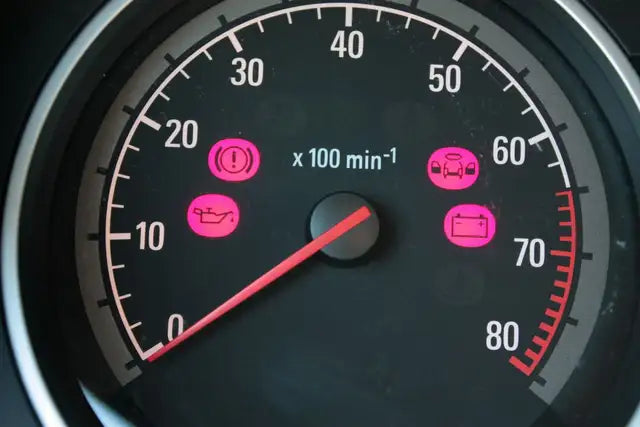
If the engine spins faster than it should when idling, it usually means something is going on with the air supply or with the control electronics. A properly warmed-up petrol engine should hold roughly 650–900 rpm at idle, and a diesel around 700–900 rpm. Anything above that range (especially when the revs jump around on their own) is worth checking. Sometimes it is something minor, like a dirty throttle body or a leaking vacuum hose. Sometimes it is something more serious. Below we explain how to recognise it, what you can check yourself and when it is better to take the car to a mechanic.
What exactly is idle speed?
Idle, or the familiar "neutral", is the engine running at its lowest speed – the speed at which the unit does not stall, but does not drive the car either. The engine then produces only as much power as it needs to keep itself running and to drive the ancillaries: the alternator, the power steering and the air conditioning compressor.
In modern cars the idle speed is controlled by the computer (ECU), which continuously reads data from the sensors and holds the revs at the set level. That is why, when those revs start to "live a life of their own", it is a sign that the ECU is receiving incorrect information or cannot cope with keeping the mixture right.
What idle speed is correct? (petrol)
There is no single figure for every car – it depends on the model, the year of manufacture and whether the engine is already warm. There are, however, some practical ranges.
|
Situation |
Typical rpm range |
Notes |
|
Engine warm, no load |
650–900 rpm |
The range most often found in passenger cars |
|
Engine warm, with air conditioning or electrical loads on |
up to approx. 850–900 rpm |
A slight rise is normal – the computer raises the idle under load |
|
Cold start (the first seconds/minutes) |
1,000–1,500 rpm |
Normal, the revs should drop once the engine warms up |
|
Consistently above approx. 1,000 rpm on a warm engine |
– |
Worth checking – usually air or a sensor |
In short: once warmed up, a petrol engine should tick over quietly at around 700–800 rpm. The figure often treated as the warning threshold is about 850 rpm – although that is a simplification, because some cars hold slightly more from the factory.
What idle speed is correct? (diesel)
It is similar in a diesel, although the way the engine runs is different and the sound alone can be misleading. The accepted figures are:
|
Situation |
Typical rpm range |
Notes |
|
Diesel warm, no load |
700–900 rpm |
Most modern passenger cars |
|
Cold start |
up to approx. 1,000–1,100 rpm |
The revs should drop once the engine warms up |
|
Consistently above approx. 1,000 rpm on a warm engine |
– |
It should not exceed 1,000 rpm once warm – worth diagnosing |
|
Running with electrical loads on |
a slight rise |
The computer may raise the idle a little |
With a diesel it is worth remembering one thing: a raised idle is often the result of a leak in the intake system (so-called "unmetered air") or a sensor problem. If you want to follow that trail, check the symptoms of a leaking air intake system. The injectors and the Common Rail pump play a smaller part here, although with more serious fuel system faults the engine can also start running out of tune.
Why does the engine rev up on its own when idling? The most common causes
There are plenty of reasons and they vary widely – from a cheap trifle to a costly repair. Here are the ones we see most often.
A dirty or faulty throttle body
This is one of the main culprits. The throttle body meters the air going into the engine. When it gets dirty, sticks or when its flap does not return to the rest position (for example because of a seized throttle cable in older cars), too much air reaches the engine and the revs rise. We cover this in more detail in the post on how a dirty throttle body causes the revs to hunt.
A leak in the intake system
A classic, especially in diesels. A cracked hose, a worn gasket or a leaking vacuum line make the engine "suck in" unmetered air. The mixture goes out of tune and the revs can rise or hunt.
Limp mode
The engine ECU can go into limp mode – for example after detecting a fault with the accelerator pedal or another sensor. The electronics then deliberately hold higher revs so that the car can still be driven at all.
Faulty sensors
The computer sets the idle speed based on data from the sensors. The most common "quiet saboteur" is the engine temperature sensor – when it reports too low a temperature, the ECU decides the engine is cold and raises the revs as if it were warming up. The lambda sensor, the air flow meter and the throttle position sensor can cause similar trouble.
The idle stepper motor
In some cars the idle speed is controlled by a stepper motor. Its failure is a typical cause of hunting or raised revs – we develop this subject in the post on hunting revs on a cold engine.
Other causes
The list can also include, among others:
- a blown fuse,
- a problem with the earth or the supply wire to one of the sensors,
- carbon build-up and deposits in the manifold and on the intake components,
- a failure of the computer itself (more rarely).
As you can see, the problem can come from something minor – like a blown fuse – but just as easily from something more serious, such as an intake leak. It also happens that the raised revs are accompanied by rough running or a loss of power. That is why it is not worth ignoring.
Can I check it myself? Home diagnostics step by step
Some of it you can handle at home, without a lift and without expensive equipment. Before you book a workshop visit, you can:
- check whether the revs rise only when the engine is cold, or also once it is warm – if everything returns to normal after the engine warms up, it is most likely fine,
- take a look at the intake and vacuum hoses, checking for cracked, loose or slipped-off rubber pipes,
- listen for a characteristic hissing from under the bonnet (a typical symptom of an intake leak),
- check the fuses according to the car’s manual,
- connect an OBD2 reader (they cost from around €15) and read the fault codes – this is often the quickest route to identifying the culprit.
If your car has a throttle cable, you can also check whether it is not seized and whether the throttle returns freely to the rest position.
What you should rather not touch yourself: stripping the throttle body without knowing how to carry out its adaptation afterwards, and attempts to "set the revs by feel" in electronically controlled cars – here the computer runs the idle and manual adjustment usually achieves nothing.
Can you drive with a high idle speed?
You can, but it is not worth putting off. A slightly raised idle will not immobilise the car overnight, but it does come with real downsides. Namely:
- it increases fuel consumption, because you pay more for fuel while standing in traffic or at the lights,
- it can wear out drivetrain components faster, especially with frequent running under load,
- it can be a symptom of a fault that gets worse over time, for example a growing intake leak.
The most worrying scenario is the ECU going into limp mode, or revs that jump around on their own and refuse to settle. In such situations it is better not to delay a visit to a mechanic.
How much does it cost to fix a high idle speed?
There is no single answer here, because everything depends on the cause. As a rough guide – approximate market ranges.
|
Cause |
Approximate cost |
Notes |
|
Diagnostic scan |
approx. €12–35 |
Often deducted from the cost of the repair |
|
Replacing the coolant temperature sensor |
approx. €7–60 (part + labour) |
A cheap part, easy in easily accessible cars |
|
Throttle position sensor / idle stepper motor |
the part often approx. €7–19 |
On easier cars the repair is inexpensive |
|
Replacing the throttle body (labour) |
approx. €47–120 |
Plus the price of the part; as a complete assembly it can cost as much as approx. €235–350 |
|
Repairing an intake leak (hose/gasket) |
from around €10 to a couple of hundred euros |
Very much depends on the model and on access |
These are guide figures – the real price depends on the make, the model, access to the component and the workshop’s rates. That is why it is always worth starting with diagnostics, so that you do not replace parts blindly.
How can you reduce the risk of idle speed problems?
Many faults come from a neglected intake and from deposits that gradually disturb the work of the throttle body, the valves and the sensors. Prevention really does help, so it is worth:
- keeping the intake system clean and replacing the air filter regularly,
- filling up at trusted stations, because dirt and water in the fuel encourage deposits,
- reacting to the first symptoms (hunting revs, hissing from under the bonnet, the check engine light) instead of waiting for the problem to develop,
- using preventive intake cleaning, especially in higher-mileage cars and after mostly urban driving.
On that last point, TEC 2000 Induction Cleaner works well – a preparation for cleaning the intake system that helps remove carbon build-up and deposits from the turbocharger, the manifold, the throttle body housing and the control valves. It is a preventive solution: it will not replace the repair of a mechanically damaged component, but it helps keep the intake clean and reduce the risk of some rough-running problems.
Important during application: Induction Cleaner is fed into a running engine, and during cleaning the revs have to be held at around 2,000–2,500 rpm – which is why the job is usually done by two people (one feeds in the product, the other watches the revs). The preparation is flammable and corrosive, so watch out for the bodywork and the lights. There is more in the guide on why cleaning the intake system is so important.
If you are dealing with the opposite symptom – the revs hunt or drop instead of rising – start with the post on hunting revs on a cold engine. And if the subject concerns diesels with exhaust gas recirculation, check why the EGR valve is used and what its failures can lead to.
FAQ
What idle speed should a petrol engine have?
A warmed-up petrol engine usually holds 650–900 rpm, most often around 700–800 rpm. When cold the revs can be higher (1,000–1,500 rpm) and should drop once the engine warms up.
What idle speed should a diesel have?
Most often 700–900 rpm once warm. After a cold start they can reach about 1,000–1,100 rpm, but they should quickly return to normal.
Why does the engine rev up on its own when idling?
Most often because of excess air reaching the engine – a dirty or sticking throttle body, an intake leak – or because of incorrect data from a sensor (for example the temperature sensor). It can also be the result of the ECU going into limp mode.
Is a heavy load on the engine at idle something normal?
A slight rise in revs after switching on the air conditioning, the lights or the heated windscreen is normal – the computer raises the idle so that the engine does not bog down under load. Consistently and clearly raised revs with no obvious reason are already worth checking.
Can I diagnose raised revs myself?
Partly yes: check the intake and vacuum hoses, listen for any hissing, take a look at the fuses, and ideally read the fault codes with an OBD2 reader. Diagnosing the fault itself and any throttle body adaptation are better left to a mechanic.
Can you drive with a raised idle speed?
You can, but it is not worth delaying. Rising fuel consumption, faster wear of components and the risk that the fault will get worse are reason enough to have the car checked fairly quickly – especially when the revs jump around on their own.
How much does the repair cost?
From around €10–20 (for example a cheap sensor or a fuse) up to a couple of hundred euros, and in more difficult cases more (for example replacing the throttle body as a complete assembly). It is worth carrying out a diagnostic scan first (approx. €12–35), so that you do not replace parts blindly.
Will an intake cleaning product solve the problem of high revs?
It will not replace the repair of a damaged component, but it works preventively – it helps remove carbon build-up and deposits from the intake, the throttle body and the valves. Thanks to that it can reduce the risk of some rough-running problems. If the cause is, for example, mechanical damage to the throttle body or a broken hose, a repair will be needed.


Leave a comment
This site is protected by hCaptcha and the hCaptcha Privacy Policy and Terms of Service apply.