
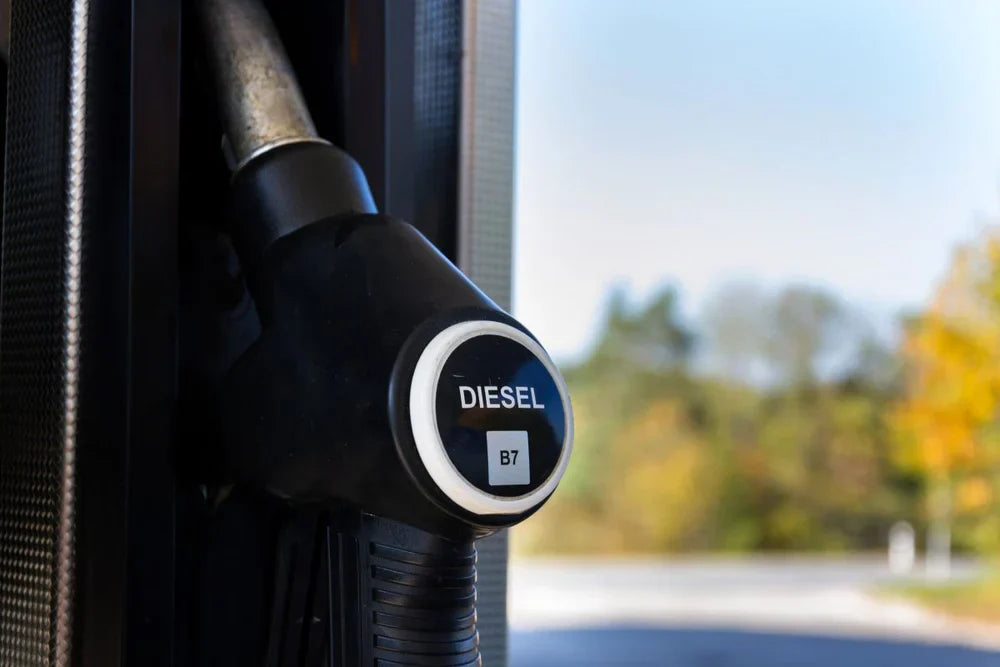
B7 is standard diesel with up to 7% of the FAME biocomponent added – the fuel you will put in the tank today at practically every station in Poland. It is safe for the vast majority of diesel engines, from older designs to modern common rail units. It does, however, have one catch: the biocomponent ages faster and attracts water more strongly than a pure petroleum base. In practice this means that the fuel does not like standing in the tank for a long time, and that it is worth keeping the injection system clean.
Below we have gathered what will really be of use to you as a driver: what exactly B7 means on the pump, how this fuel affects the engine, which cars it suits, how long it can sit in a tank, how much it costs and how it differs from B0. At the end you will find a short FAQ.
What does B7 on the pump mean?
You will find the B7 designation in a black frame (a square) on the pump nozzle and on the fuel filler flap – it is the same harmonised labelling system that has applied across Europe since 2018. The letter "B" is biodiesel (fatty acid methyl esters, in other words FAME) produced from, among other things, rapeseed oil. The number "7" says that there is at most 7% of this biocomponent by volume, and the rest is classic diesel from crude oil.
The same labelling system also covers the other diesel variants: B10 (up to 10% FAME) and XTL – a synthetic diesel that is not obtained from crude oil. If you want a full overview, we have described them in a separate article on the types of diesel fuel B7, B10 and XTL.
How does B7 affect the engine and the fuel system?
In normal use – you fill up and you drive regularly – B7 behaves like ordinary diesel and causes no problems in a modern engine. The differences only emerge when the fuel stands for longer or when the car is driven mainly on short, urban journeys. They stem from the nature of the biocomponent itself.
What the FAME biocomponent actually does:
- it attracts water – FAME is hygroscopic, that is, it absorbs moisture from the air, which condenses on the walls of the tank as the temperature fluctuates,
- it oxidises faster – plant esters are chemically less stable than a petroleum base, so the fuel "goes sour" sooner and forms gums and deposits,
- it encourages microorganisms – bacteria and fungi develop at the water-fuel boundary (the so-called "diesel bug"), forming a slimy deposit that blocks the filter,
- it acts as a mild solvent – in older cars it can, over time, affect some rubbers and seals that are not designed for biodiesel.
The effects of these phenomena can be deposits on the injector tips, poorer fuel atomisation, black smoke and a loss of power, and in extreme cases – a blocked fuel filter and trouble starting. We write more about why modern diesels "break down by themselves" despite good treatment in the article on IDID deposits in a modern diesel.
Why is it worth filling up with B7? The advantages
- Availability. It is the base fuel – it is at every station, with no searching and no premium.
- Compatibility with most cars. It suits the vast majority of diesel engines, from older ones to the newest common rail units.
- The required lubricity. The biocomponent itself improves the lubricity of the fuel, which matters for new-generation injection pumps.
- A lower carbon footprint. The share of biocomponent lowers CO₂ emissions across the fuel’s whole life cycle.
- A sensible price. B7 is cheaper than premium fuels, and for everyday driving it is perfectly sufficient.
Does B7 have drawbacks or contraindications?
Yes – but in practice they concern specific situations, not everyday driving. Three things worth knowing:
- It copes poorly with long storage. The more FAME, the shorter the fuel’s "shelf life" in the tank – more on that in the next section.,
- It attracts water. The hygroscopic nature of the biocomponent increases the risk of corrosion and microorganism growth, especially in seasonally used cars and machinery.,
- It can be troublesome for very old designs. In vehicles not designed for biodiesel, caution and checking the manufacturer’s recommendations are advised.
In that last situation the solution is B0 fuel with no biocomponents – if you are torn between the two, the comparison of B0 and B7 – which fuel to put in the car will help.
The key point – a short summary
B7 is a safe, standard fuel for most diesels – for everyday driving you do not need to look for anything else. The problems only start with long storage and with cars driven mainly on short journeys, because the biocomponent binds water more readily and ages faster.
Stick to a simple rule: fill up with as much as you will realistically use within a reasonable time, and in seasonally used cars and stored fuel help yourself with a water-binding additive. An additive and a filter change are prevention, not a repair – they help keep the system clean and limit the effects of poorer fuel, but they will not undo wear of the pump or the injectors. If the symptoms (smoke, jerking, a loss of power) do not go away, that is a signal for diagnostics at a workshop.
How long can B7 diesel sit?
This is one of the most important questions – and here B7 has a real limitation. Pure mineral diesel usually keeps its properties for 6–12 months, whereas biodiesel (FAME) on its own ages much faster – roughly within a few to a dozen or so weeks. B7, as a blend, sits in between: in good conditions (a sealed, cool, shaded tank) it will easily survive several months, but with longer storage it is worth keeping an eye on the quality or supporting the fuel with an additive.
The storage life of a fuel is determined in the laboratory as oxidation stability – it is measured by the Rancimat method (the PN-EN 15751 standard). The PN-EN 590 quality standard requires at least 20 hours for diesel in this test. It is an accelerated test at 110 °C, so hours in the laboratory translate into months in a real tank (at around 20 °C).
What does that give in practice? At the request of the manufacturer TEC 2000, the independent ORLEN Laboratorium S.A. used the Rancimat method to test two samples of the same diesel – without the additive and with TEC 2000 Diesel System Cleaner added:
|
Diesel sample |
Oxidation stability (Rancimat, 110 °C) |
PN-EN 590 requirement |
|
without the additive |
65.09 h |
min. 20 h |
|
with TEC 2000 added |
111.94 h |
min. 20 h |
That is an increase of about 72% – almost a doubling of the fuel’s "freshness reserve". Both samples meet the standard, but the one with the additive exceeds the minimum more than fivefold. For someone who stores diesel between seasons (a farmer, say, or the owner of a storage tank), that means many additional months of safe storage.
Source: ORLEN Laboratorium S.A., Rancimat method to PN-EN 15751, reports no. SM-13-MAJ-2026-1223062 and -1223063, approved on 17.06.2026. A non-accredited result, referenced to PN-EN 590.
B0 or B7 fuel – which to choose?
In short: for most everyday cars you choose B7, while B0 makes sense with very old engines and with fuel intended for longer storage. A quick summary below – you will find the full comparison in a separate article on B0 versus B7.
|
Feature |
B7 (up to 7% FAME) |
B0 (no biocomponents) |
|
Availability |
at every station |
harder to get, often to order |
|
Best for |
most modern diesels |
very old engines, long storage |
|
Tendency to bind water |
higher (FAME is hygroscopic) |
lower |
|
Life in the tank |
shorter |
longer |
|
Price |
lower, the base fuel |
usually higher |
What are the prices of B7 and where can you buy it?
B7 is the base fuel sold at every station in Poland as ordinary diesel (ON) – do not look for a separate "B7" label on the price pylon, because it is simply standard diesel. In June 2026 a litre of diesel cost roughly €1.44–1.55 (retail prices, after the period of the government price caps, which expire at the end of June). Fuel prices change almost daily, though, along with oil quotations and the dollar exchange rate, so treat this figure as a reference point, not a fixed value.
A more expensive alternative is premium / high-cetane fuels. It is worth knowing that a higher price does not always mean better storage life – more on that in the article premium fuels – are they worth filling up with, and on how additives compare against them, in the piece on fuel stabilisers.
What is the future of B0 and B7 fuel?
The direction is clear: the share of biocomponents in fuels is growing, not falling. EU climate policy is pushing the market towards higher blends (B10 and beyond), synthetic XTL and renewable fuels of the HVO type. B7 will remain the standard available at every station for years to come, but it will gradually be accompanied by more and more variants.
B0 is going in the opposite direction – as a fuel with no biocomponents it is becoming more and more niche and harder to get, bought mainly where long storage or compatibility with an old design matters. Whichever way the market goes, one thing will not change: the more biocomponent there is in the fuel, the more important its cleanliness and stability become – and here fuel treatments help.
How do you look after the fuel system when filling up with B7?
Since the biocomponent attracts water and encourages deposits, prevention comes down to two things: keeping the injection system clean and controlling the moisture in the fuel. That is what TEC 2000 Diesel System Cleaner is for – a diesel additive that binds and removes water from the tank, cleans the injectors and the whole fuel system, and reduces smoking. It is safe for common rail systems and for AdBlue. All you have to do is pour it into the tank when filling up.
When is it worth using:
- preventively twice a year, ideally before and after the winter season,
- when the car is driven mainly on short journeys or stands seasonally,
- when you suspect water in the fuel, or black smoke and a loss of power appear,
- with fuel stored for longer (storage tanks, agricultural machinery).
With more serious contamination of the injectors themselves, the stronger, more interventional solution is TEC 2000 Diesel Injector Cleaner. You will also find the full set of diesel preparations in the diesel kit and in the diesel engine additives category.
Important: an additive is support, not a miracle cure. It helps clean and protect the system and limit the effects of poor fuel, but it will not replace the repair of a damaged pump or injectors. After using a cleaning preparation, the manufacturer recommends changing the fuel filter.
FAQ
Is B7 diesel?
Yes. B7 is simply standard diesel with up to 7% of the FAME biocomponent added. It is the fuel that most drivers of diesel-engined cars in Poland put in their tanks.
Can I fill my diesel with B7?
In the vast majority of modern diesel engines – yes, without any concerns. The exception can be very old designs not adapted to biodiesel; in that case check the manufacturer’s recommendations in the owner’s manual and consider B0 fuel.
What is the difference between B7 and B0?
B7 contains up to 7% of the FAME biocomponent, while B0 has none at all. B0 copes better with long storage and attracts less water, but it is more expensive and harder to get. For everyday driving B7 is enough.
How long can B7 fuel be stored?
In good conditions (a sealed, cool tank) usually several months. The biocomponent does, however, shorten its life compared with pure diesel. With longer storage it is worth using an additive that improves stability – in the ORLEN Laboratorium study, the TEC 2000 additive extended the fuel’s oxidation stability by about 72%.
Can the biocomponent in B7 harm the injectors?
In normal use, no. The risk rises with old, oxidised fuel and with moisture in the tank – deposits can then form that worsen the injectors’ work. Preventive cleaning of the fuel system and keeping water in check limit this problem.
Is more expensive premium fuel longer-lasting than B7?
Not necessarily. Some additives that raise the cetane number can actually speed up the ageing of the fuel. We write about when premium makes sense in a separate article on premium fuels.



Leave a comment
This site is protected by hCaptcha and the hCaptcha Privacy Policy and Terms of Service apply.