
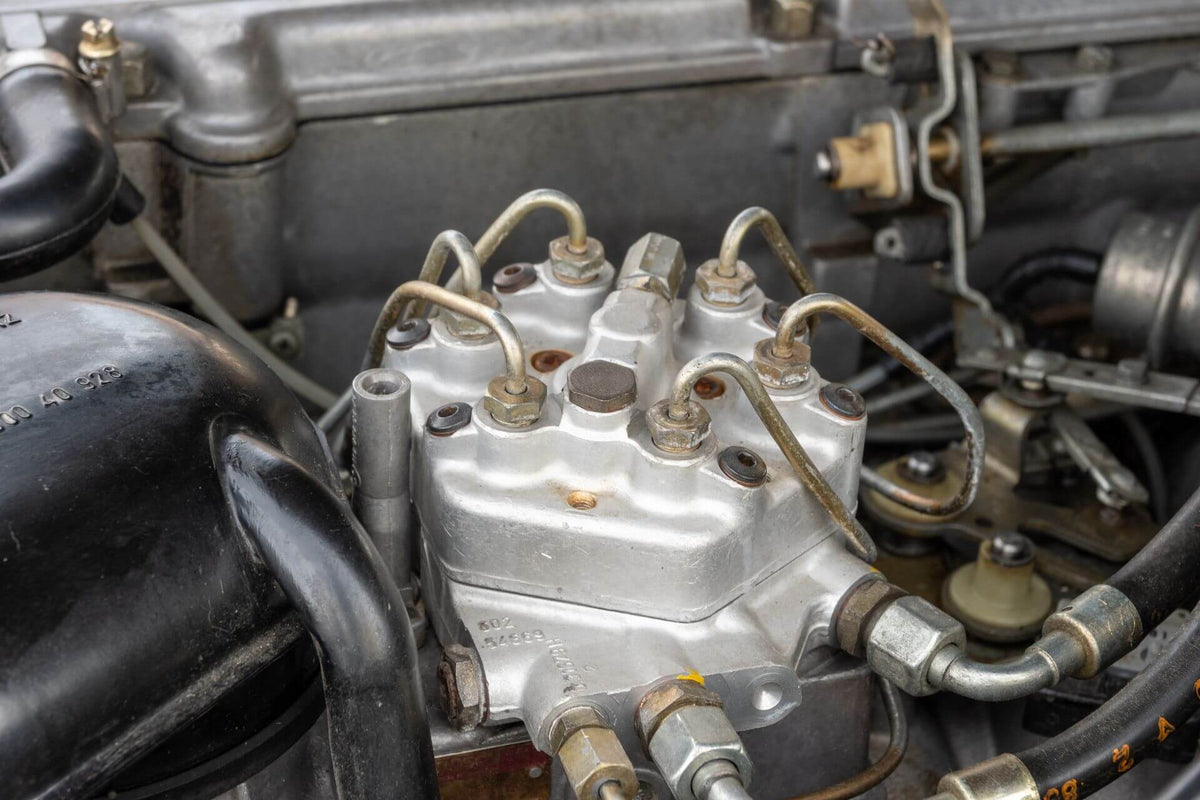
Before anyone starts talking about methods for cleaning the EGR valve, it is worth understanding why it clogs up in the first place – because that determines whether an intervention will help or whether you will be back at square one in six months. Deposits in the EGR cooler form a porous, insulating layer of soot and condensed hydrocarbons that reduces heat-exchange efficiency by as much as 20–30%.
Why do deposits build up specifically around the EGR outlet?
It is no coincidence that deposits accumulate in one specific place. EGR gas carries soot particles from the combustion chamber, while oil mist from the crankcase ventilation system, or breather, enters the same intake manifold. This mist acts like a sticky net – it catches soot particles carried by the EGR gas, and the combined oil-and-soot deposit builds up in one specific place: around the EGR pipe outlet, until it can eventually block it completely.
This explains why the problem can be worse in turbocharged engines – if oil from the turbo bearings leaks into the intake manifold, a third source of oil mist is added, driving exactly the same mechanism. Keep this in mind if you suspect a turbocharger problem alongside symptoms of a clogged EGR.
Once the deposits really build up, the system loses control precision. Too much recirculated exhaust gas or, conversely, none at all means the engine receives a mixture that the ECU can no longer compensate for properly. Workshops once used ‘methods’ such as drilling holes in the manifold and mechanically scraping out deposits – a good example of why invasive DIY methods can be risky. It is easy to damage the manifold or the valve itself this way instead of solving the problem.
Why does city driving harm the EGR more than longer-distance driving?
There is another mechanism that is rarely discussed. Deposits on the valve stem build up mainly on the part that does not regularly travel through the full opening range – because during normal driving the valve spends most of its time working within a narrow range. Deposits adhere strongly there and are difficult to remove even when the valve finally opens fully. That is why cars driven mainly in the city, where the valve keeps operating within the same narrow range, clog up faster than cars that regularly cover longer distances as well.
The physics behind this is simple: the thermal resistance of the deposit layer in the EGR cooler decreases as exhaust-gas flow speed rises. Driving under higher load limits the rate of clogging compared with constant low-rev driving and short journeys. Two more relationships matter as well: lower coolant temperature increases hydrocarbon condensation and the total mass of deposits, while higher exhaust-gas temperature intensifies soot deposition through thermophoresis. Together, these three factors explain why short winter journeys around town are the worst possible scenario for the EGR system.
The engine partially cleans the EGR itself
This may be the most interesting point in the whole subject. Not all of the deposits that could theoretically settle in the EGR cooler actually stay there – the engine has its own natural self-cleaning mechanisms that continuously remove as much as around 70% of the soot before it can settle permanently.
The key is condensing water vapour – when coolant and engine operating temperatures change cyclically, for example during a full warm-up after a cold start, condensed water breaks up and washes away the deposit layer. This scientifically confirms something that sounds like common-sense advice: regularly bringing the engine fully up to temperature acts as a natural cleaning mechanism that cannot be replaced by constantly driving with a half-warm engine.
EGR clogging is not an endless process either – it reaches a kind of equilibrium. Cooler efficiency usually stabilises after several dozen hours of engine operation instead of deteriorating indefinitely. This does not make EGR deposits a one-off problem; it simply shows that regular, healthy use genuinely limits how much deposit remains permanently. It is also worth knowing that newer low-temperature combustion strategies, introduced specifically to reduce emissions, generate more unburned hydrocarbons – which intensifies clogging and extends it to other components, including the turbocharger. This is not a fault limited to one particular car, but a characteristic of an entire category of engines designed to meet today’s emissions standards.
Why do clean injectors mean less work for the EGR?
Two separate issues come together here and in practice work as one. Dirty or partially blocked injector nozzles worsen fuel atomisation in the combustion chamber, which leads to incomplete combustion – and that measurably increases emissions of soot, unburned hydrocarbons and carbon monoxide.
An engine running with neglected injection regularly shows noticeably heavier smoke across its operating range because blocked nozzles disrupt fuel atomisation. Fuel quality also matters: trace amounts of metals, especially zinc, significantly accelerate carbon deposit formation on injectors, which directly translates into lower torque and increased smoke. The mechanism is simple: more soot in the exhaust means more soot returning to the engine with the EGR gas.
If you notice black smoke from the exhaust and a loss of power, check the condition of the injectors before focusing exclusively on the EGR itself.
What does this mean in practice?
All of this leads to one conclusion: the EGR is rarely the problem in isolation – it is usually the place where the effects of what is happening elsewhere in the engine accumulate. The condition of the breather, combustion quality in the cylinders, injector condition and driving style together determine how quickly the system clogs up.
- Driving mainly in the city and over short distances combines all the unfavourable factors at once – low exhaust-gas flow speed, low coolant temperature and no cyclical full warm-up.
- Regular, longer journeys reverse this mechanism and allow the natural self-cleaning processes to do their job.
- A properly functioning breather and a sealed crankcase ventilation system reduce the amount of oil mist entering the intake manifold, limiting one of the two streams that drive deposit formation.
- Clean injectors and complete combustion mean less soot at the source – which means less work for the EGR and slower deposit build-up.
- A suspected turbo problem is worth checking alongside EGR symptoms if oil from the bearings is leaking into the intake manifold.
If you notice uneven engine operation or an engine warning light combined with a loss of power, do not begin diagnosis with the EGR valve alone. Check whether the problem starts elsewhere – in the breather, the injectors or the way you use the engine day to day. These are the factors that determine how long the EGR remains functional before it starts causing trouble.
FAQ
Why does the EGR valve clog up?
Because two streams meet in the intake manifold: soot carried by the EGR gas and oil mist from the crankcase ventilation system. The oil mist acts like a net, catching the soot, and the combined deposit builds up around the EGR pipe outlet until it can block it.
Why does city driving harm the EGR more than longer-distance driving?
Because it combines several unfavourable factors at once: low exhaust-gas flow speed, lower coolant temperature and no cyclical full warm-up of the engine, which naturally washes away some of the deposits. In addition, the valve then keeps working within the same narrow opening range, which encourages deposits to adhere in one place.
Does the engine clean the EGR system itself?
Partly, yes. Natural mechanisms continuously remove around 70% of the soot that would otherwise settle permanently – mainly thanks to water condensation during engine heating and cooling cycles.
Does EGR clogging ever stop?
Yes, it reaches a kind of equilibrium. EGR cooler efficiency usually stabilises after several dozen hours of engine operation rather than deteriorating indefinitely.
What is the relationship between injectors and the EGR?
Dirty injectors worsen fuel atomisation, leading to incomplete combustion and higher soot emissions. That soot returns to the engine with the EGR gas, adding more work to a system that is already clogging up – a vicious circle that intensifies itself.
Is an EGR valve also used in petrol engines?
Yes, although the mechanism and rate of clogging can differ from those in a diesel. You can read more about this in our article on whether petrol engines also use an EGR valve.


Leave a comment
This site is protected by hCaptcha and the hCaptcha Privacy Policy and Terms of Service apply.