
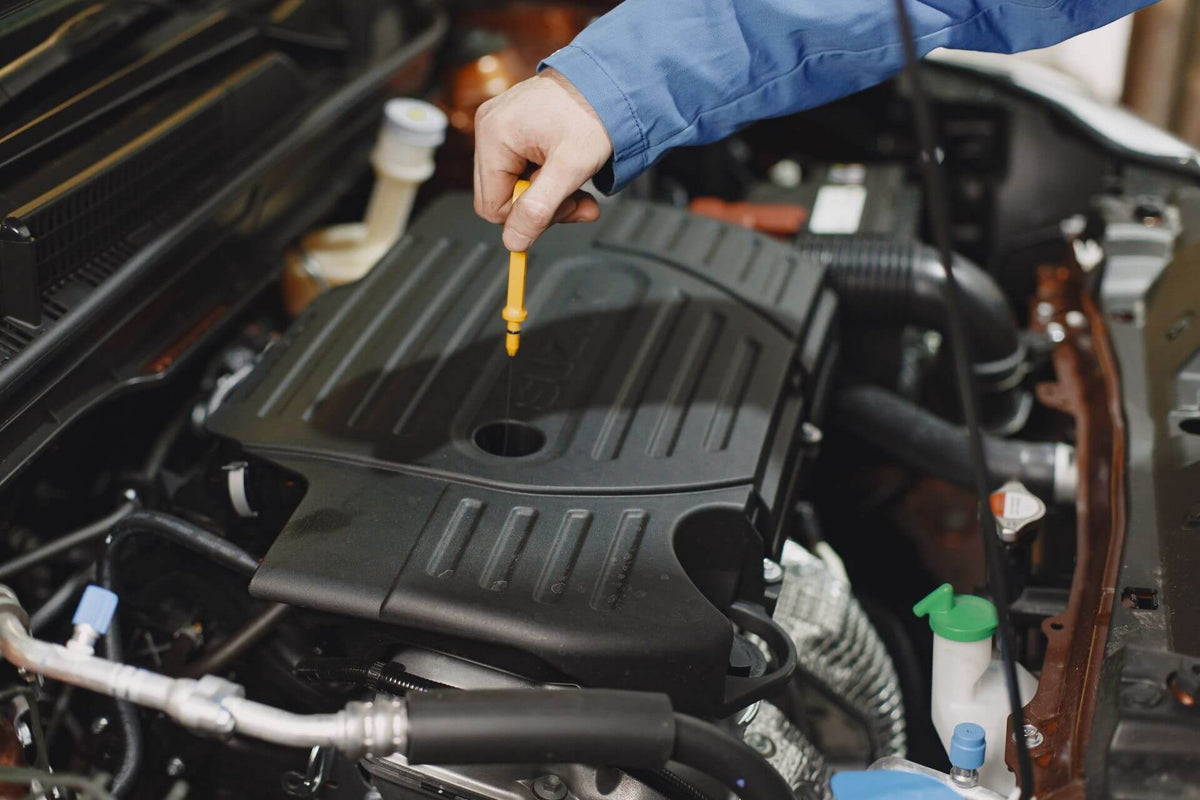
You add the flush to the old oil just before draining it – it is one moment, not a separate workshop visit. The question “before or during the oil change” is therefore a little misleading, because in practice it is the same event. Frequency depends on fuel type and driving style, but the simplest rule is: flush at every oil change. That is what we do – regular flushing keeps the engine clean instead of waiting for deposits to cause symptoms.
Engine flush before an oil change or during an oil change? It is the same thing
It is worth clearing this up at the start because it creates unnecessary questions. “Before the oil change” does not mean a separate stage several days earlier or an additional workshop visit. It means the order within a single service operation: the product goes into the oil you are about to drain anyway.
You warm the engine on the old oil, add the product, leave the engine idling for 15 minutes, then drain the used oil together with the flush and fit a new filter. The whole procedure fits into a single visit and adds no more than a quarter of an hour to a standard oil change. We described the exact procedure in our guide on how to use an engine flush.
If you come across the term “long-distance engine flush”, it refers to a different category of products with a lower concentration, added several hundred kilometres before the planned oil change and working gradually while you drive. It is a separate, less common variant and not what we are describing in this article.
Do you need to use an engine flush before every oil change?
There are plenty of conflicting answers to this question, so it is useful to show where they come from before you decide which approach to follow.
More cautious opinions advise against flushing at every oil change, citing the risk of removing deposits that supposedly “sealed” worn oil seals. This concern mainly comes from older kerosene-based methods and home remedies with uncontrolled formulations – and they rarely define what “too often” actually means.
Our position, consistent with what we do ourselves: we flush every time to keep the engine clean. This is not an unsupported opinion. With a product that has a neutral pH and contains no acids or esters, the argument about a risk of causing leaks simply has no basis – acids and esters are responsible for seal problems, not cleaning itself. The manufacturer of our TEC 2000 Engine Flush states that no cases of engine damage after using the product have been recorded. We discuss the leak myth in more detail in our article on whether an engine flush is safe for rubber seals.
Caution makes sense elsewhere: with products of unknown composition or home methods based on kerosene. In those cases, there really is a risk to consider. With a proven product used according to the instructions, regular flushing is simply part of normal engine care – just like replacing the air filter.
Engine flush – how often if not at every oil change?
If you prefer a gradual approach rather than “every time”, adjust the frequency to the fuel type and your driving style.
In a petrol engine used mainly on longer journeys and serviced on time, every second oil change is usually enough. With mainly urban driving and short journeys, flushing more often makes sense because the oil rarely reaches full operating temperature and deposits build up faster.
In a diesel, especially one with a particulate filter and EGR valve, using a flush at every oil change makes sense. A diesel produces more soot that finds its way into the oil, so deposits build up faster than in a petrol engine – not because the design is worse, but because combustion is different.
Two situations call for a flush regardless of the schedule above. One is a car bought with an unknown service history – you do not know what oil was used or how often it was changed, so the first oil change after purchase is a natural point for a clean start. The other is an engine after a long period without servicing, where it is better to spread the cleaning over two consecutive oil changes rather than trying to remove everything at once.
Signs that mean you should not wait for the scheduled interval
Whatever schedule you follow, some symptoms mean flushing straight away rather than waiting for the next planned oil change.
- The car is burning oil. Rising consumption between oil changes and more frequent top-ups than before are signs that carbon deposits are building up inside. We explain the phenomenon itself in our article on why an engine burns oil.
- Dark or blue smoke from the exhaust, especially visible after the car has been standing for a while.
- Loss of power or difficult starting – this can point to stuck piston rings, which an engine flush can sometimes free.
- Tappet noise after a cold start. Deposits in the oil passages restrict oil flow to hydraulic components, and cleaning the lubrication system can be a cheaper solution than replacing the tappets.
- You bought a car with an unknown service history. You do not need to wait for the first oil-change interval planned by the previous owner.
- You are switching to a different oil, especially changing manufacturer or specification. A flush removes residues of the previous product.
Even without any of these symptoms, an engine flush can still make sense – simply as routine preventive maintenance added to a normal oil change rather than as a reaction to a problem.
Why does regular engine flushing make sense rather than only using it reactively?
The difference between “I flush when something starts happening” and “I flush every time” comes down to one thing: how much deposit has time to build up before you act.
Carbon build-up in piston-ring grooves does not appear overnight. It builds gradually, thousand kilometres by thousand kilometres, and for a long time causes no symptoms – until it starts reducing compression or blocking the tappet oil passages. Regular flushing prevents it from reaching that thickness. It is the difference between removing a thin layer every few months and tackling a thick crust once every few years.
There is also an economic argument. A neglected engine in which deposits have had time to harden sometimes needs two flushes at two consecutive oil changes instead of one – twice the product cost compared with regular preventive maintenance that never lets the engine reach that state. We discuss the economics in more detail in our article on whether engine flushing is worth the cost.
Why is regular use not a risk with TEC 2000 Engine Flush?
The recommendation to “flush at every oil change” only makes sense when the product is suitable for it. TEC 2000 Engine Flush is formulated specifically for regular use rather than as a one-off, high-risk intervention.
- No acids, neutral pH. Fresh oil retains the correct alkalinity after every flush, while rubber and silicone seals are not exposed to degradation.
- Lubricating additives in every dose. The engine does not lose protection during repeated treatments because the product compensates for the reduction in oil viscosity in the same way each time.
- No sulphur, molybdenum or Teflon. Regular use does not cause anything to accumulate in precision engine components.
- It does not produce soot. Frequent flushing does not place any additional load on a diesel particulate filter.
In short: a product designed for one-off, cautious use and a product designed for regular maintenance differ in their formulation, not just their label. Ours belongs to the second category, which is why we recommend it as a regular part of servicing rather than a last-resort treatment.
FAQ
When should you use an engine flush?
The simplest answer: at every oil change as routine preventive maintenance. Also use it whenever symptoms such as oil consumption, loss of power, dark exhaust smoke or tappet noise after a cold start appear – regardless of when the next oil change is scheduled.
Do you use an engine flush before an oil change or during the oil change?
It is the same moment. The product is added to the old oil just before you drain it – there is no separate visit and no need to wait several days. “Before the oil change” and “during the oil change” describe the same operation in different words.
Do you need to use an engine flush before every oil change?
You do not have to, but regular flushing is a sensible and safe practice with a product that contains no acids or esters. Concerns about risk mainly relate to products of unknown composition or home kerosene-based methods, not proven products used according to the instructions.
How often should you use an engine flush if not at every oil change?
For a regularly serviced petrol car used mainly on longer journeys, every second oil change is usually enough. With urban driving and in a diesel with DPF and EGR, it is better to flush at every oil change because deposits build up faster.
Can flushing the engine too often cause damage?
With a good-quality product – no. The risk comes from acids and esters in the formulation, not from the frequency of cleaning itself. A neutral-pH product with lubricating additives can be used regularly without concerns about seals or compression.
Which symptoms mean you should flush immediately rather than wait for the scheduled interval?
Oil consumption, dark or blue exhaust smoke, loss of power, difficult starting, tappet noise after a cold start and buying a car with an unknown service history. In these situations, do not wait until the next scheduled oil change.


Leave a comment
This site is protected by hCaptcha and the hCaptcha Privacy Policy and Terms of Service apply.