
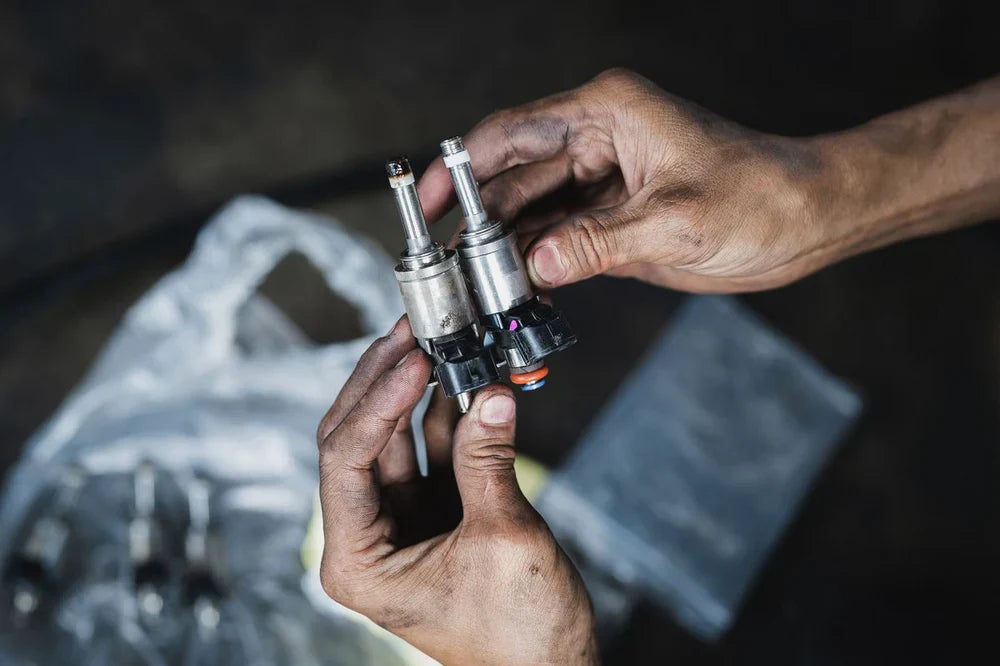
If your car starts using more fuel, loses its edge, and at idle you get a gentle surging or jerks when you press the throttle, the answer is usually simple: the fuel system is no longer running as evenly as it should. And very often the culprit turns out to be contamination around the injectors – fuel deposits, carbon build-up and moisture do their work, especially if you drive mainly around town or fill up “wherever you happen to be”. The good news is that in many cases you can sort it out without dismantling half the engine. The bad news? If the subject has been put off for too long, cleaning may already be nothing more than a diagnostic stage before a more serious repair.
Jerking, using more fuel and losing power? Check whether it isn't your petrol injectors calling out to be cleaned
Most often you can see the answer in everyday driving: the car becomes “heavier” on the throttle, accelerates less willingly, and fuel consumption starts to rise for no sensible reason. On top of that come the things many drivers shrug off – rough running at idle, slight engine vibrations, sometimes even brief hesitations when accelerating. These are signals that fuel isn't being delivered perfectly evenly, and that the engine is compensating for the problem in its own way.
Before you start guessing, it's worth looking at the subject sensibly. “Injector” symptoms can imitate problems with the spark plugs, coils or the intake, but there are a few clues that usually recur. Pay attention to whether the problems get worse on a cold start or in town, where there are lots of short stretches. Also check whether the smell of the exhaust has changed, or whether the engine runs more loudly under load.
If you can hook up a simple OBD reader, look at the things that genuinely tell you something: misfires, fuel trims, uneven injection times. You don't have to do full diagnostics on a test bench straight away, but it's good to have a starting point. At this stage the goal is one thing: to confirm that the problem concerns fuel metering, and not some random sensor.
Why do petrol injectors seize up and “leak”? Discover the 6 most common causes that shorten their life
Injectors rarely “break down overnight” for no reason – more often they take a series of small blows that eventually do the job.
- The first classic is fuel quality and its stability.
- The second – driving style: frequent short trips, traffic jams, low operating temperatures, i.e. conditions in which the fuel system has more opportunities to pick up moisture and lay down deposits.
- The third factor, which has come back like a boomerang, is fuel containing ethanol. E10 contains 10% ethanol, and ethanol is hygroscopic by nature – it draws in moisture. In practice this means that while the car is standing and in use, the fuel can absorb water, and with long-term storage the risk of problems in the fuel system rises.
- The next issue is deposits resulting from temperatures and the way the injector works. In modern petrol engines, especially with direct injection, injectors are exposed to conditions that favour deposits forming on the tips, which affects flow and the quality of atomisation. These aren't “theoretical considerations” – research papers describe the influence of deposits on injection and combustion parameters, i.e. exactly where you later feel the difference behind the wheel.
If you want to look at the subject practically, these are the causes that come back most often:
- driving mainly in town and on short trips (accumulation of deposits, moisture),
- E10 fuel and longer periods of standing (greater susceptibility to moisture and to fuel “ageing”),
- contamination in the system – lines, filter, tank (sometimes it's simply a “dirty base”),
- a neglected fuel filter (poorer quality of supply, greater load on the injectors),
- natural wear of seals and mating components (here cleaning won't always solve the problem),
- intervals between preventive treatments that are too long – no cleaning when the first signals appear.
Clogged or “leaking” injectors – how do you recognise the problem before the Check Engine light comes on?
A dirty injector usually gives symptoms along the lines of rough running and a worse response to the throttle, because fuel atomisation becomes less precise. A “leaking” injector, on the other hand, can make a bigger mess: clear fluctuations appear, sometimes smoking, and in extreme situations a smell of fuel and trouble starting after the car has been standing.
To tell them apart you don't need magic tools, only a level-headed approach. If the symptoms are subtle and build up gradually, the usual suspects are deposits and carbon build-up. If, on the other hand, the problem appeared suddenly, the car started jerking badly, and a message about combustion errors shows up on the dashboard – the risk grows that one cylinder is getting a dose “from outer space”, or that the injector has stopped holding its parameters.
It's good practice to make a quick list of observations before you start cleaning anything. Write down:
- when the symptoms are strongest – a cold start, city driving, high load,
- what is happening to fuel consumption – sudden jumps or a slow creeping up of the figures,
- whether the problem is constant or “comes and goes” – better one time, worse the next,
- whether other signals appear – smoking, a smell of fuel, uneven revs.
Such a “symptom diary” sounds ordinary, but in practice it does the job, because it stops you wandering around in the dark. And if you end up at a workshop, the mechanic will get down to specifics faster instead of starting with a lottery.
Why do dirty injectors wear an engine out faster than you think – and how do you prevent it?
When an injector doesn't atomise fuel the way it should, the engine starts working under worse conditions. This isn't just a matter of comfort and fuel consumption. A wrong dose and poorer atomisation mean less predictable combustion, a higher thermal load in certain places and a greater chance that the exhaust system will take a hit. In practice the consequences can spread wider: from a drop in refinement, through accelerated wear of ancillary components, all the way to problems that become expensive, because they affect things that are difficult and costly to repair.
The most treacherous part is that many people get used to the car running worse. Since “it drives somehow”, the subject gets pushed into the background. Except that driving for longer with uneven fuel metering is asking for further side effects: fluctuating revs, jerking, rising fuel consumption, and on top of that higher exhaust emissions. If starting problems join in, it becomes not only irritating but also risky – especially in winter.
Prevention doesn't have to be complicated, but it should be consistent. What matters most is what you do “in the background”, before the symptoms appear:
- better fuel quality and avoiding random stations “on the reserve tank”,
- regular replacement of the fuel filter, because a clogged filter can imitate an injector fault,
- making sure the car gets a longer drive from time to time, and not only short stretches,
- sensible fuel system chemistry used preventively, not only once the car starts playing up.
This approach is boring, but effective. And that's exactly the point: fewer nerves, fewer “unknowns” and a greater chance that cleaning will be a choice rather than a rescue operation.
Cleaning petrol injectors without dismantling them – when does a service product really work?
The answer right away: a service product makes sense when the problem stems mainly from contamination, carbon build-up and moisture, and not from mechanical damage. If the injectors are seized up, excessive trims appear, the car loses its smoothness and you have the feeling that the fuel system “isn't keeping the rhythm”, chemical cleaning without dismantling is often the most sensible first step. In this method the intensity of the action is what counts – the product works directly in the system, and the effects can be noticeable straight after the treatment.
In practice such a treatment looks specific: the product is fed directly into the fuel rail, after disconnecting the supply and return lines. The engine runs on the product alone for about 20 minutes, because a standard can is enough for exactly that running time. If the injectors are heavily contaminated, the procedure is sometimes extended to around 40 minutes using two cans. Afterwards, replacing the fuel filter is recommended, because the dissolved deposits have to end up somewhere and there's no point pretending the filter “will somehow cope with it”.
What you can't skip also matters. Such a treatment is effective, but it requires the right approach: good ventilation, working with the bonnet open, avoiding doing it in an enclosed space with no through-draught. And one more thing that isn't worth dismissing: if you don't have experience, having a mechanic do it often saves your nerves. Because with this method the point is to do it cleanly, safely and without random mistakes that will later show up somewhere completely different.
Flushing petrol injectors on the rail – the last step before an expensive reconditioning?
Yes, in many cases it's the last sensible attempt before you start counting the cost of removal, test-bench testing and possible reconditioning or replacement. Flushing on the rail means that the injectors run directly on a powerful cleaning product, bypassing the tank and the standard fuel circuit. This is no longer gentle prevention – it's a high-intensity service treatment, whose job is to dissolve accumulated carbon deposits and restore the correct fuel spray.
In practice such an operation makes sense when you observe clear symptoms of disturbed combustion, but there is still no hard evidence of mechanical damage to the injector. If the engine jerks under load, uneven revs appear and the fuel trims “run away” beyond the norm, flushing is often a logical stage before deciding to take anything apart.
Before you make the decision, it's worth knowing what to expect. Flushing on the rail:
- works more intensively than a fuel additive,
- lets you clean the injector tips and nozzles without dismantling them,
- can bring a noticeable improvement in engine running after just one treatment,
- is sometimes treated as a “last chance” procedure before reconditioning.
If after such cleaning the engine regains its even running and fuel consumption stabilises, it often means the problem was purely a matter of use. If, however, the symptoms come back quickly or don't go away at all – that's a signal the matter goes deeper and the injectors need to be diagnosed off the car. Chemistry can do a great deal, but it won't repair a cracked tip or a leaking body.
A fuel additive or professional petrol injector cleaning? Choose the method that makes sense in your case
The answer depends on exactly what you're dealing with.
- If the car drives properly and you want to look after the fuel system “in advance”, a fuel additive will be a sensible and convenient solution.
- If, on the other hand, the symptoms are already clear – a drop in power, rough running, starting problems – then simply pouring something into the tank may turn out to be too gentle.
A fuel additive works during normal use. You pour the product into the tank and let it circulate through the system with the fuel, dissolving deposits and binding moisture. It's a method that is:
- easy to use,
- safe for catalytic converters,
- suitable for prevention twice a year,
- good for mild symptoms.
Professional cleaning – whether on the rail or after removal – is a completely different level of intervention. This is about situations in which:
- clear combustion errors appear,
- fuel consumption rises with no explanation,
- the engine runs unevenly even when warm,
- you suspect an injector is “leaking”.
There is no single universal answer. If the problem is only just beginning, start with the less invasive solution. If, however, you feel the engine has genuinely lost its refinement, there's no point counting on one can in the tank to sort it out. The method has to match the scale of the problem, otherwise you're only postponing the decision.
TEC 2000 Fuel Injector Cleaner in practice – what do the 20 minutes that can save your injectors look like?
Specifics are what count here. The procedure consists of feeding the product directly into the fuel rail, after disconnecting the supply and return fuel lines. The engine runs solely on the cleaning product for about 20 minutes, because a single 375 ml can is enough for exactly that running time. If the injectors are heavily contaminated, the treatment can be extended to around 40 minutes using two cans.
While it works, the product:
- frees up seized injectors,
- restores correct fuel atomisation,
- helps reduce rough running at idle,
- can limit excessive fuel consumption,
- supports better starting of both a cold and a warm engine.
The treatment requires the right conditions. The engine shouldn't be hot, the operation is carried out with the bonnet open, in a well-ventilated place. Once the work is finished it's worth:
- replacing the fuel filter,
- checking the operating parameters with a diagnostic tester,
- taking a drive and paying attention to the throttle response and the stability of the revs.
If after such cleaning the engine clearly “calms down” and the response to the accelerator pedal becomes more predictable, that's a sign that the injectors were dirty, not damaged.
Prevention or emergency rescue? When should you reach for Fuel System Cleaner, and when for a bigger calibre?
Fuel System Cleaner is a product intended for use directly in the tank. It works well when you want to keep the fuel system in good condition and prevent deposits from forming. The manufacturer recommends using it twice a year, especially during periods of temperature swings, when moisture can gather in the tank.
The product:
- cleans and preserves the entire fuel system,
- removes water and limits its impact on the installation,
- improves fuel atomisation,
- supports even engine running at idle,
- is safe for catalytic converters.
This is the solution for you if:
- the car isn't showing serious symptoms,
- you want to look after the engine before the winter or summer season,
- you drive mainly around town and want to limit deposits.
The bigger calibre – i.e. cleaning on the rail – comes into play when prevention has been skipped and the symptoms are already clear. In short: Fuel System Cleaner prevents, while the product applied directly to the rail (Fuel Injector Cleaner) intervenes in a crisis situation. Both solutions make sense, but at different moments in the car's life.
How much does ignoring an injector problem cost? Check before you pay for a catalytic converter or an engine rebuild
If the car starts using 1–2 litres more per 100 km, at a mileage of 15,000 km a year that means an extra 150–300 litres of fuel. At an average price of €1.53 per litre we're talking about €230–460 a year spent purely because the fuel dose isn't correct. And that's the mildest scenario.
If the problem goes further, the costs rise dramatically:
- cleaning and testing a petrol injector (port injection) – around €10–19 per unit,
- cleaning a direct petrol injector – on average €24–35 per unit,
- reconditioning a petrol injector – usually from €28–70 per unit,
- a new, latest-generation injector – most often €235–350 for a single component,
- labour for replacing a full set – around €95–190 depending on the engine.
If you ignore a “leaking” injector and the catalytic converter gets damaged, be prepared for an outlay in the region of €350–940 for popular models. In engines with a more elaborate exhaust system the amount can exceed €1,200. And that still isn't the worst-case scenario.
In extreme cases uneven combustion leads to burnt valve seats, damage to a piston, or excessive dilution of the oil with fuel. A top-end rebuild is already at the level of €950–1,900, and a fuller rebuild of the unit can reach €2,350–3,500, depending on the design.
That's why, when you notice:
- repeated jerking when accelerating,
- difficulty starting from cold,
- a clear rise in fuel consumption with no change in driving style,
- a Check Engine light with combustion errors,
don't put the matter off. In many cases a cleaning treatment costing a few dozen or a few hundred euros is enough to stop the problem at the operational stage. The difference between prevention and repair is counted not in tens, but in thousands of euros. And that is precisely why reacting quickly simply pays off.
How often should you clean petrol injectors using an additive poured into the tank, in order to avoid a reconditioning costing several thousand euros?
Put simply: preventively twice a year or roughly every 10,000–15,000 km – and here we're talking about using cleaning fuel additives poured into the tank, not about direct, workshop cleaning of the injectors. With intensive city driving it's worth doing it even more often. If the car already has higher mileage and covers mainly short distances, it's sensible not to wait for the first symptoms, but to act in advance.
The cleaning interval depends on a few real factors, and not on a “magic mileage” written into the manual. Pay attention above all to:
- driving style – short trips and an engine that is constantly under-warmed favour deposits,
- fuel quality – frequently filling up at random stations increases the risk of contamination,
- the type of injection – direct petrol injection is more sensitive to carbon build-up,
- operating conditions – town, traffic jams, frequent starts in winter make for a harder working environment.
If you use the car mainly on longer routes and the engine regularly reaches operating temperature, cleaning twice a year is usually enough. In city traffic, with constant “driving round the block”, it can make sense to shorten the interval to every 8,000–10,000 km. That isn't overkill – it's a response to real working conditions.
It's worth distinguishing two things: prevention and intervention. Preventively you use a product in the tank, which:
- limits the formation of carbon deposits,
- binds moisture in the tank,
- supports correct fuel atomisation,
- helps keep the engine running evenly.
As an intervention – when symptoms appear – you move on to cleaning on the rail or a professional service treatment. And here there's no point waiting for “a better moment”. If the engine starts to jerk, fuel consumption rises by a litre or two, and starting becomes less reliable, act straight away. Putting it off often ends with a decision to recondition or replace, where the cost of a full set of injectors can exceed €950–1,400, and considerably more in newer designs.
FAQ
Does cleaning the injectors really do anything if there are no clear symptoms?
Yes. In preventive mode you limit the formation of deposits and stabilise the combustion parameters. The effect is often smoother running and fuel consumption held at a constant level.
Can you clean the injectors too often?
No – with products poured into the tank there are no rigid limits on how often you use them, because they are safe for the fuel system with regular use. In practice, however, with standard use it is entirely sufficient to use an additive around twice a year. More frequent use mainly makes sense in harder conditions – e.g. with city driving, short trips or in older cars.
Which is better – a fuel additive or cleaning on the rail?
An additive works well as prevention. Cleaning on the rail is the solution when the symptoms are clear and heavier contamination is suspected.
Do you have to replace the fuel filter after cleaning?
With intensive service cleaning, replacing the filter is recommended. Dissolved deposits shouldn't go on circulating in the system.
How long does it take to see the effects of cleaning?
With a treatment on the rail the improvement can be noticeable immediately after the engine has finished running on the product. With a fuel additive, the effects appear gradually as the whole tankful is burned.


Leave a comment
This site is protected by hCaptcha and the hCaptcha Privacy Policy and Terms of Service apply.