
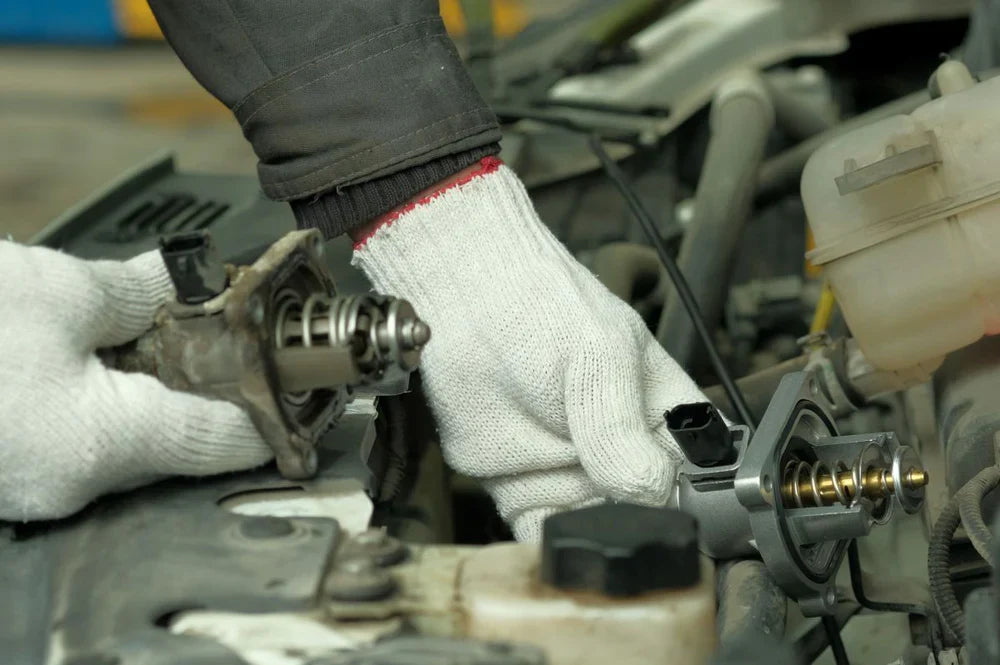
If a thermostat starts playing up, there's no point “rescuing” it – in practice you simply replace it. It's one of those parts where trying to be clever usually ends in a waste of time and money. It seems like a trifle costing a couple of hundred euros, but its influence on the engine is big enough that the game isn't worth the risk.
The temptation often appears: maybe it can be cleaned, maybe it will “unstick”, maybe it will run a bit longer. And sure – sometimes things will be better for a while. Except that a thermostat is a precision component which has to work exactly within a specific temperature range, and that can't be restored with home-made methods.
That's why the approach at workshops is simple and fairly indisputable. If a thermostat isn't working properly – replacement. No half measures.
Is it worth repairing a thermostat in a car, or is it better to replace it straight away?
Repairing a thermostat makes no sense in practice – replacement is faster, cheaper and above all more reliable.
The reasons are fairly specific:
- a thermostat isn't a component that gets reconditioned,
- after a “repair” you have no certainty how it will work,
- the mechanic's working time often costs more than a new part,
- the risk of another failure is very high.
This isn't only about the workshop's convenience. Simply put, nobody is able to guarantee that a “repaired” thermostat will open at exactly the same temperature as a new one. And a few degrees' difference really does matter.
From the driver's point of view it looks even simpler. Either you replace the part and have peace of mind, or you're left with a component that has already let you down once and may do so again – often at the least appropriate moment.
Why does repairing a thermostat simply not pay off?
Because the saving is only apparent – the costs quickly even out, and the risk remains.
The most important arguments are very down-to-earth:
- a new thermostat usually costs €19–60 in popular cars,
- labour is most often €35–95,
- the time needed for a “repair” eats up man-hours,
- the end result may force a replacement anyway.
So you have a situation in which you try to save a handful of euros, and along the way you pay for the time, the tests and the risk of the problem coming back.
On top of that comes the question of precision. A thermostat doesn't work “more or less well”. It has to react at exactly the right moment. If it starts sticking, that means wear of the material or of the mechanism. That can't be undone with simple cleaning or “freeing off the valve”.
And that is precisely why in service practice the subject is closed with a single sentence: we don't repair – we replace.
When is replacing a thermostat necessary, and when is it worth doing preventively?
Replacement is obligatory when symptoms appear, but in many cases it makes sense even before a problem shows up.
The most obvious situations:
- the engine overheats or doesn't warm up,
- the temperature “floats” for no clear reason,
- the heating works poorly despite driving,
- the car starts burning more.
This is the moment when there's nothing to think about. The thermostat stops fulfilling its role and its continued operation makes no sense.
But there is also a second group of cases – less obvious. If the car already has a considerable mileage, say 80,000–120,000 km or a few years of intensive use, the thermostat is simply “at that stage of its life”.
It's also worth thinking about it during bigger repairs. Are you replacing the water pump or the radiator, or taking the cooling system apart? Adding the thermostat is often a few dozen per cent of the cost of the parts, and it saves taking things apart again some time later.
It's one of those decisions that aren't obligatory, but later turn out to be very sensible.
How far can you drive with a faulty thermostat and when does it get dangerous?
As far as you really have to – ideally only to the workshop.
A lot depends on what exactly has happened:
- a thermostat stuck open – the car will drive, but:
- it will burn more,
- the engine will wear out faster,
- driving comfort will drop,
- a thermostat stuck closed – the situation is serious:
- the engine starts overheating,
- the risk of a serious failure rises with every minute,
- driving on may end with a rebuild.
In the second case there's nothing to calculate. Overheating an engine can, in a short time, lead to damage to the head gasket or something even more serious.
Under-warming, in turn, is a kind of “quiet cost”. The car drives, but you pay more at the station, and the engine works in conditions that accelerate its wear.
Neither one nor the other is a situation worth putting off until later.
How much does replacing a thermostat cost and why is it better not to put the decision off?
In most cases it's an outlay counted in the hundreds of euros – definitely less than the consequences of ignoring the problem.
Prepare yourself for roughly:
- the part in popular cars – around €19–60,
- more advanced solutions – €70–190,
- electronic thermostats – as much as €95–350,
- labour – usually €35–95, sometimes more with difficult access.
So in many cases you close the subject for €70–165, and in more complicated designs slightly higher.
Now set that against the potential consequences. A head gasket is a couple of thousand euros, and more serious engine damage can reach several thousand.
And suddenly it turns out that putting off this one repair is no saving at all. It's rather deferring an expense that may be many times larger.
FAQ
Can a thermostat be repaired?
Technically you can try, but in practice it isn't done – replacement is the standard.
Does repairing a thermostat make economic sense?
No, because the cost of the working time and the risk of failure are greater than the cost of a new part.
Why is a thermostat always replaced with a new one?
Because it has to work very precisely, and a worn component can't be restored to its factory condition.
When does a thermostat have to be replaced?
When symptoms appear – overheating, under-warming, temperature fluctuations or a rise in fuel consumption.
How far can you drive with a faulty thermostat?
Ideally only to the workshop – driving on increases the risk of costly repairs.
How much does replacing a thermostat cost?
Most often from around €70 to €165 in popular cars.
Can you replace a thermostat yourself?
In simple cars yes, but in many cases it's better to take the car to a workshop.
Is it worth replacing a thermostat preventively?
Yes, especially at a higher mileage or on the occasion of cooling system repairs.


Leave a comment
This site is protected by hCaptcha and the hCaptcha Privacy Policy and Terms of Service apply.