
The engine doesn't warm up one time, and picks up temperature faster than it should the next? Often a small component is behind it that hardly anyone thinks about day to day – the thermostat. It seems like a trifle, and yet it can throw the whole engine's operation out of adjustment. And what's worse, it doesn't always give a clear signal that something is wrong.
What is a thermostat in a car for, and why does it have such a big influence on the engine?
A thermostat in a car is responsible for maintaining the right engine operating temperature – neither too low, nor too high.
The most important things worth understanding straight away:
- it doesn't cool the engine by itself, it merely controls the flow of coolant,
- with a cold engine it closes the circuit, so that operating temperature is reached faster,
- once warmed up it opens access to the radiator, in order to carry away the excess heat,
- it maintains a stable temperature, which is crucial for combustion and for the engine's operation.
Here something appears that many drivers interpret the other way round. The natural thought is: “the sooner the coolant reaches the radiator, the better”. Except that an engine likes neither cold nor overheating.
If it runs too cool, the ECU treats it as under-warmed and delivers more fuel, in order to heat it up. If it gets too hot, problems with durability begin.
That's why a thermostat works a bit like a guard – it watches over the moment when the engine passes from the warm-up phase to normal operation. Without it the whole cooling system loses its point, because the temperature stops being controlled.
How does a thermostat work in a car – what happens after starting up and after the engine has warmed up?
A thermostat's operation is based on a simple pattern: closed when cold, gradually opening as the temperature rises.
The whole process looks like this:
- after starting the engine the thermostat is closed – the coolant circulates only in the small circuit,
- the engine warms up quickly, because the heat doesn't escape to the radiator,
- at a particular temperature the thermostat starts to open slightly,
- once operating temperature is reached it regulates the flow, maintaining stable working conditions.
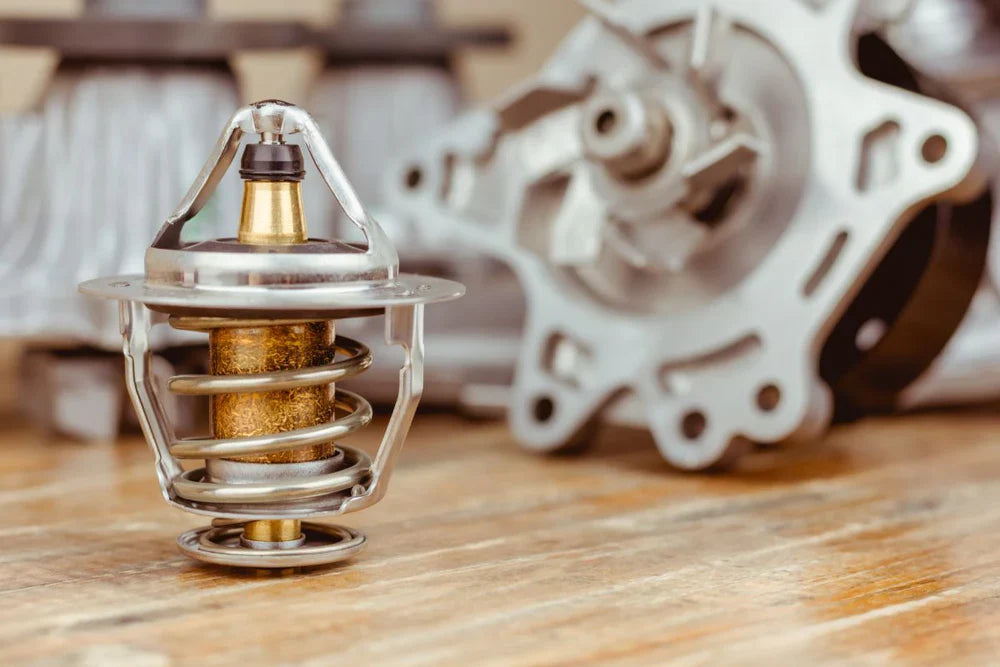
Something rather clever happens inside. In a classic thermostat there is an element filled with wax, which reacts to temperature. When it gets warmer, the wax increases in volume and moves a valve, opening the flow. When the temperature drops – everything goes back into place.
It sounds simple and on the whole it is. Except that this simplicity has to work very precisely. Even small deviations in the moment of opening can change the way the engine warms up and works afterwards.
In newer cars even more advanced solutions appear – electronically controlled thermostats, which match the temperature to the engine's load and to driving style. That is no longer just mechanics, but part of the working strategy of the whole power unit.
Where is a car thermostat located and why is it sometimes so hard to get to?
A car thermostat is most often located in the vicinity of the cylinder head, at the coolant outlet towards the radiator.
In practice its location can look different:
- by the hose leading to the radiator,
- in a housing by the engine,
- near the water pump,
- in some cars deep under the ancillaries or the manifold.
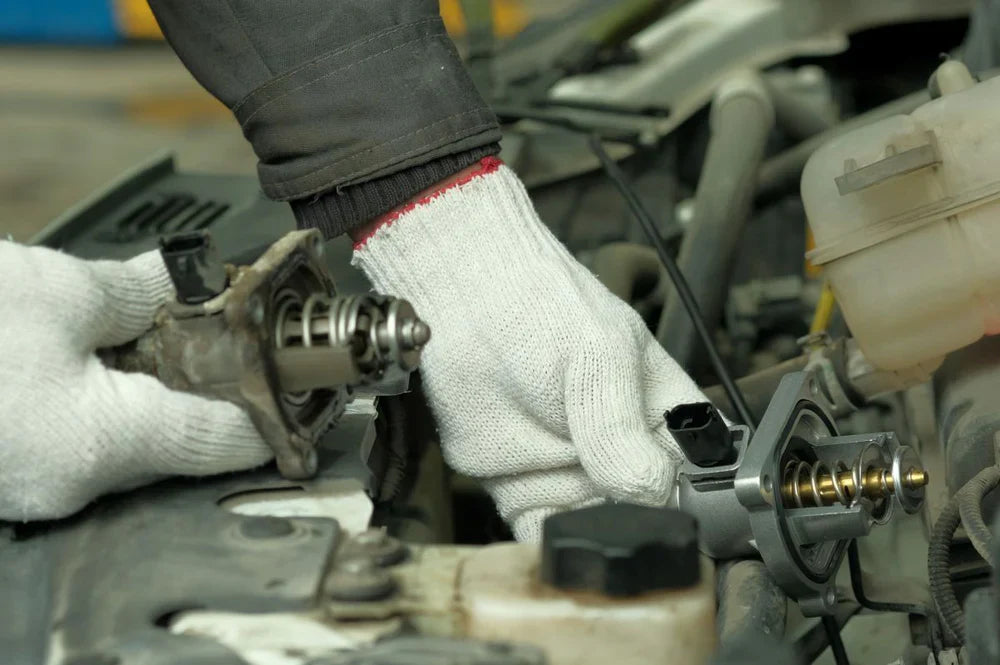
The part itself may be cheap, but access to it can be really difficult. In some cars you have it “on the surface”, a few bolts and you're done. In others – you have to take half the front apart or remove components that at first glance have nothing to do with it.
That is precisely why the cost of replacement can vary so much. It isn't only about the thermostat, but about how much work has to go in to reach it and to put everything back together correctly.
In modern designs one more thing is added – more and more often the thermostat doesn't exist as a simple insert, but as a whole module with a housing and sensors. That changes both the price of the part and the approach to the repair.
Why is a working thermostat about more than temperature – also fuel consumption, durability and driving comfort?
A working thermostat handles far more than just “holding the temperature” – it affects fuel consumption, engine wear and even whether the car is warm in winter.
From the driver's perspective the most important things happen a little “in the background”:
- the engine enters its optimal working mode faster,
- fuel consumption stays at a normal level,
- the oil reaches the right temperature and protects the engine better,
- the cabin heating starts working the way it should,
- the whole power unit runs more quietly and more smoothly.
And now something that is easy to overlook. If a car drives under-warmed most of the time, then it never really works in the conditions it was designed for. The ECU is constantly “working around it” – delivering more fuel, changing the operating parameters, trying to warm the engine up.
The result? From day to day nothing much happens. But after a few months you see that the car burns more, is more sluggish, and on top of that the components wear out faster.
Overheating, in turn, is a completely different story – here there is no time to get used to it. The temperature rises, everything works on the edge and suddenly a minor problem becomes very costly.
That's why the thermostat is a bit of a “quiet hero” of the cooling system. As long as it works, nobody thinks about it. When it stops – a chain reaction begins, which quickly goes beyond temperature alone.
What happens when a thermostat stops working properly, and will you always notice it straight away?
You won't always feel straight away that something is wrong – the first symptoms are often subtle enough to be blamed on the weather or on driving style.
It most often starts with small things:
- the engine warms up clearly more slowly than before,
- the heating works well one time, and less well the next,
- the temperature needle gently “floats”,
- the car starts burning a little more for no clear reason.
And this is exactly where many drivers give up. Because the car drives, after all, nothing knocks, no light comes on. Except that this is the moment when the cooling system stops working the way it should, even if it doesn't look dangerous yet.
Over time the symptoms become more obvious. Either you have constant under-warming and cold in the cabin, or the opposite – the temperature starts rising faster than it should.
The most treacherous part is that a thermostat can work irregularly. It opens one time, and doesn't the next. One time everything looks normal, and the next day something goes out of kilter. And then the guessing begins: is it the sensor, the coolant, or something more serious?
And often the answer is simple – a small component that stopped responding the way it should.
How much does a car thermostat and its replacement cost – what do the differences in price depend on?
The price of a thermostat and of its replacement can vary a great deal, because today it isn't always the same “simple part” it used to be.
The approximate ranges look like this:
- a simple mechanical thermostat – around €12–60,
- more elaborate designs – €70–190,
- integrated or electronic thermostats – as much as €95–350,
- labour – usually €35–95, but with difficult access considerably more.
At first glance the differences may seem exaggerated. It's still “only a thermostat”, after all. Except that in many modern cars you no longer replace the insert alone, but the whole module – with the housing, the sensors, sometimes the electronics.
On top of that comes access. In some cars a mechanic needs an hour, in others several. And it is precisely the labour that can push the bill up the most.
There is one more aspect that is rarely mentioned. Servicing costs are rising from year to year – according to current data by as much as a dozen or so per cent recently. So putting a repair off “until later” rarely ends in a saving.
And here the arithmetic is simple anyway. The thermostat itself may be relatively cheap, but the consequences of ignoring it – definitely not.
FAQ
What is a thermostat in a car?
It's a valve that controls the flow of coolant and maintains the right engine operating temperature.
What is a thermostat in a car for?
It makes sure the engine warms up quickly and later doesn't overheat while you drive.
How does a thermostat work in a car?
On a cold engine it is closed, and as the temperature rises it gradually opens and directs the coolant to the radiator.
Where is a car thermostat located?
Most often by the engine, in the vicinity of the hose leading to the radiator, although the exact place depends on the car's design.
Does a faulty thermostat increase fuel consumption?
Yes, especially when the engine doesn't warm up – fuel consumption then rises.
Can you drive with a faulty thermostat?
It depends on the fault, but it's better not to drag it out, because it affects the engine and running costs.
How much does a thermostat for a car cost?
Most often from around €12 to €60, but in newer cars it can cost even more than €235.
How much does replacing a thermostat cost?
In most cars it falls within the €70–190 range, although in more complicated cases it may be higher.
Can you replace a thermostat yourself?
In simpler cars yes, but access is often difficult and it's better to leave it to a workshop.
How do you look after the thermostat and the cooling system?
Change the coolant regularly and look after the cleanliness of the system with TEC 2000 Radiator Flush (it cleans the cooling system; it restores the efficiency of the radiator, the thermostat and the heater matrix), so that deposits don't gather.
Can a lack of heating in the cabin mean a problem with the thermostat?
Yes, it's one of the more common symptoms, especially when the engine doesn't warm up.


Leave a comment
This site is protected by hCaptcha and the hCaptcha Privacy Policy and Terms of Service apply.