
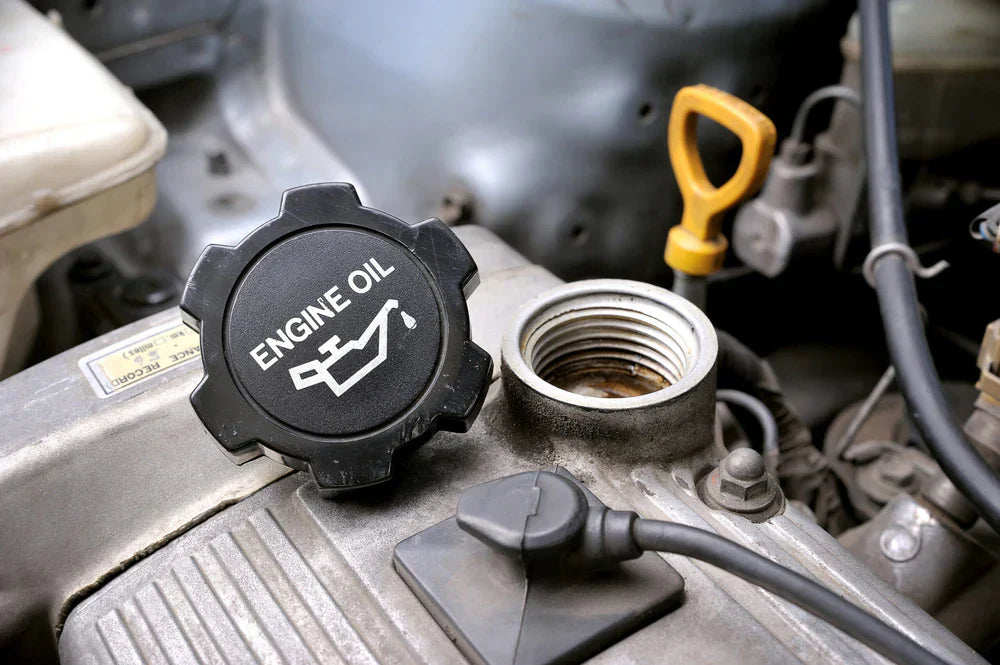
"I hardly drive, so why change the oil every year?" – that is one of the most common questions we hear. The problem is that oil wears out not only from the kilometres but also from the mere passage of time, so that logic can cost you an engine. A safe reference point is a change every 10,000–15,000 km or once a year, whichever comes first.
On top of that comes something few people remember at a service: fresh oil on its own will not remove what has already settled inside the engine. That is why it is worth flushing the unit at the oil change. Below we break this down – where the intervals come from, when they can realistically be extended and when they should be shortened, how to recognise worn-out oil and why a flush is not a whim but common sense.
How often should you change engine oil?
The starting point is always the car manufacturer’s recommendation – you will find it in the owner’s manual, given in kilometres or in time. Most often it is a range of 10,000–15,000 km or once a year. Some manufacturers, especially with new cars and long life oils, allow as much as 30,000 km. Those, however, are "catalogue" figures, set under favourable conditions.
In real-world use – short journeys, town, winter, Polish fuel – oil wears out faster than the table suggests. That is why it is often worth changing the oil more often than the manual says, not less often. It is one of the cheapest ways to avoid a really expensive failure. As a guide:
|
Interval |
Who / when for |
|
every 5,000 km |
only very intensive use, short journeys around town, a car used "for work", motorcycles, competitive driving |
|
every 10,000–15,000 km or once a year |
a sensible standard for most passenger cars |
|
every 30,000–40,000 km / every 2 years (long life) |
only where the manufacturer allows it and with a low, motorway mileage (TEC 2000 does not recommend it) |
An oil change every 2 years – is it safe?
It depends – and it really is "it depends", not an excuse. A change every two years only makes sense if you drive little and mainly on the open road. The reason is simple: oil loses its properties not only from the kilometres covered but also from the mere passage of time. It oxidises, has contact with the air, picks up moisture and combustion products. A car that covers a few thousand kilometres a year does not "save" its oil at all – it ages anyway, just more slowly.
That is why, even with a low mileage, it is safer to change the oil and the filter once a year. It is a small expense against the benefit to the engine. If you are wondering about the seasonal timing, we develop that in a separate piece on whether to change the oil before or after winter.
Long life oils – do they really last 30–40 thousand km?
Long life oils are synthetics with a larger dose of antioxidant and detergent additives, designed for extended intervals (up to ~30,000–40,000 km or two years). In theory it sounds great. In practice they work well only where the manufacturer expressly provides for them – in the VW group (Skoda, Audi, Volkswagen), for example, this is covered by the "QG1" service designation, that is, a variable interval depending on how intensively the car is driven.
It is worth treating long life oil and extended intervals with some reserve if:
- you drive mainly short distances, around town and in traffic,
- the car is sometimes heavily loaded – a trailer, a towbar, mountain driving,
- you care about maximum engine life, not about the number of visits to the service centre.
Long life is above all a convenient solution for fleets and high motorway mileages. A private driver will usually gain more from an ordinary, good oil changed more often.
When should you shorten the interval? Extreme operating conditions
There are situations in which oil wears out noticeably faster and it is worth shortening the interval – usually by 20–50% compared with the manufacturer’s recommendations.
- Short journeys – the engine does not have time to warm up, and water and fuel collect in the oil.
- Urban driving and traffic jams – constant pulling away and stopping puts a heavy load on the unit.
- Winter and frequent cold starts – the hardest moment for lubrication.
- Heat, heavy dust, towing – higher temperatures and loads speed up the degradation of the oil.
If your driving profile is mainly the above conditions, do not wait for the "round" mileage from the manual – it is better to change the oil sooner.
How do you recognise that the oil is worn out?
Sometimes the engine tells you itself that the oil has done its job. Look out for these symptoms:
- A dark, almost black colour – fresh oil is light brown/amber; heavily blackened and cloudy oil is a sign of wear.
- A thick, sticky consistency – the oil loses its fluidity and lubricates less well.
- A burnt smell – noticeable at the dipstick or the filler cap.
- Louder running or knocking – weaker protection means more friction; we develop this subject in the piece on a noisy engine.
- A falling oil level – if the car is "using" oil, check why; we describe the causes in the article on why an engine burns oil.
It is worth checking the oil level with the dipstick regularly, especially before a longer trip. And remember: topping up with fresh oil does not replace a change – it only makes up the loss, but it does not restore the properties of the whole charge.
What are the risks of driving on old oil?
Worn-out oil is not a cosmetic problem. A spent lubricant lubricates less well and carries heat away less well, and on top of that it carries metal particles and contamination with it, which increase friction. Over time, deposits and sludge form that block the oil passages and hinder lubrication. In an extreme case, restricted oil flow ends in the engine seizing or in damage to the turbocharger – that is, a repair running into thousands of euros. To put it plainly: the cost of a regular oil change is incomparably lower than the cost of an engine rebuild.
Why is it worth flushing the engine at every change?
An oil change on its own removes the oil – but not what has already settled inside. Carbon build-up, sludge and oil lacquers collect in the piston ring grooves, the oil gallery passages and around the valve lifters, and fresh oil will not dissolve that on its own. What is worse, when you drain the old oil without a flush, some of the dirt stays behind and contaminates the new charge straight away.
That is why it is worth using a flush at every oil service – and obligatorily with infrequent changes (every 2 years, long life), after buying a used car with an unknown history and when switching to a different oil. A proven choice is TEC 2000 Engine Flush – a flush free of acids and chlorinated hydrocarbons, safe for rubber and silicone seals. You add it to the old oil, let the engine run for a good ten minutes or more at idle, and then drain the oil together with the preparation and change the filter. We describe the exact procedure in the guide on how to use an engine flush, and we break down its composition in the piece on what an engine flush is made of.
One more practical detail: carry out both the oil change and the flush on a warm engine. Warm oil is thinner, drains better and takes more contamination with it – more on this subject in the article on whether to change the oil on a warm or a cold engine. And if you are wondering whether the treatment pays off, we have worked it out in the piece on the cost of flushing an engine.
⚠ IMPORTANT – two rules to always stick to
Flush at every change. Whether you service the car every year or less often – a flush is a cheap way to make sure the fresh oil goes into an engine that is actually clean, and not into the remains of the old dirt.
Do not drag out the oil change. It is better to change it slightly too early than too late. Oil ages from time and from driving conditions, so when in doubt shorten the interval rather than extending it.
Fresh oil in a clean engine – how do you protect it for longer?
Now that you have flushed the engine and poured in new oil, it is worth making sure it keeps its properties for as long as possible – especially in older units or under heavier loads. That is what TEC 2000 Oil Booster is for – an additive for fresh oil that strengthens the oil film, slows the oxidation and hardening of the oil and helps maintain lubrication pressure. It is the natural complement to the treatment: first you clean with Engine Flush, then you protect the new oil with Oil Booster.
Change the oil yourself or at a workshop?
Doing it yourself is cheaper and gives you satisfaction, but it requires tools, space and basic knowledge – and remembering one thing: used oil is hazardous waste. It must not be poured down the drain or onto the ground – hand it in, in a sealed container, at a waste collection point or a workshop. A visit to a mechanic is more expensive, but it includes disposal and often additional diagnostics along the way. Whichever you choose, one thing matters most: regularity.
FAQ
How often should you change engine oil?
Most often every 10,000–15,000 km or once a year, whichever comes first. With intensive, urban use it is worth shortening the interval, and the reference point is always the car manufacturer’s recommendations.
Is an oil change every 2 years safe?
Only with a low, mainly motorway mileage and a long life oil approved by the manufacturer. Oil also ages with the passage of time, so with normal use it is safer to change it once a year.
Do I have to stick to the interval from the manual?
What is in the manual is the maximum the manufacturer provides for. With short journeys, urban driving, winter or towing it is worth shortening the interval by 20–50%. A more frequent change will do no harm – too infrequent a one can cost you an engine.
How do you recognise worn-out oil?
By a very dark colour, a thick consistency, a burnt smell, louder running or knocking from the engine, and a falling level on the dipstick. These are signals that the oil is no longer protecting the unit as it should.
Does topping up the oil replace a change?
No. Topping up only makes up the loss, but it does not restore the properties of the whole charge. Old oil has to be changed, not diluted with fresh.
Do you have to flush the engine at every oil change?
It is not compulsory, but it pays off handsomely – a flush removes deposits that the oil alone will not take with it.
Change the oil on a warm or a cold engine?
On a warm one. Warm oil is thinner, drains better and takes more contamination with it, so less old oil and fewer deposits remain in the engine.
To sum up: stick to the manufacturer’s recommendations as a minimum, and in difficult conditions shorten the interval, do not extend it. Change the oil rather more often, on a warm engine, and flush the unit while you are at it – it is the cheapest insurance policy for a long engine life.




Leave a comment
This site is protected by hCaptcha and the hCaptcha Privacy Policy and Terms of Service apply.