

A diesel engine can throw up strange problems. The car starts normally one time, and cranks for ages the next. Sometimes it suddenly stalls while you're driving, or it loses power and doesn't respond to the throttle.
Many drivers assume the worst straight away – that the injection pump is on its way out. Meanwhile, a completely different component is very often to blame.
We're talking about the injection pump control unit – a small electronic module that decides how much fuel goes into the engine and at what moment. When it starts to fail, the symptoms can be very similar to a failure of the whole pump.
And that is precisely why this problem can be so hard to recognise.
What exactly is an injection pump control unit?
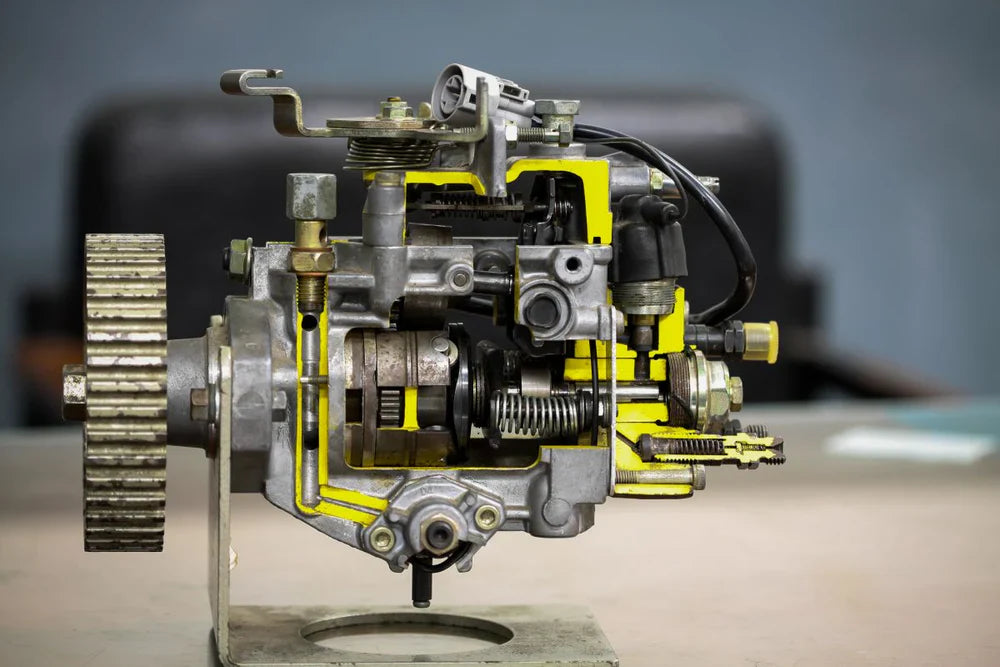
The injection pump control unit is an electronic module that controls the operation of the pump.
Its job is to control several key things:
- the fuel dose,
- the injection advance angle,
- the fuel pressure,
- communication with the engine computer and the immobiliser.
You could say the control unit acts as a computer managing the operation of the injection pump. If it works properly, the engine gets exactly as much fuel as it needs at any given moment.
When the electronics start to fail, problems with fuel metering and with the moment of injection appear. Then the engine:
- runs unevenly,
- loses power,
- starts to smoke,
- may go into limp mode.
Starting problems – one of the first signals
Most often the first symptom of a control unit failure is trouble starting the engine.
The engine turns over on the starter for a long time, or only fires after several attempts. Sometimes there is also a situation in which:
- the car starts from cold,
- after a short drive it stalls,
- and it won't start again until it has cooled down.
That's a very characteristic symptom for injection pump control units. In many cases the culprit is a damaged transistor controlling the fuel dose or broken connections in the module's electronics.
The engine then cranks, but the pump gets no signal to deliver fuel.
The engine stalling while driving
Another typical symptom is the engine suddenly stalling while driving.
It often looks like this:
- the car drives normally,
- once the engine has warmed up it suddenly stalls,
- after a few minutes it can be started again.
The reason is simple – the control unit's electronics stop controlling the fuel metering valve properly. The engine stops getting fuel and simply stalls.
To the driver it looks like a pump failure, but in reality the problem lies in the control electronics.
A drop in power and no response to the throttle pedal
If the control unit isn't working properly, the engine often loses power and stops responding to the throttle.
Drivers describe it in very similar terms:
- the car feels “sluggish”,
- the engine doesn't pick up revs,
- when accelerating there is a clear delay.
In many cars the control unit then detects a fault and activates limp mode. The engine works, but its power is limited so as not to lead to more serious damage.
Rough engine running and smoke from the exhaust
Another symptom is unstable engine running at idle.
You may notice:
- surging revs,
- jerking when accelerating,
- dark smoke from the exhaust,
- increased fuel consumption.
This happens because the control unit isn't delivering the correct fuel dose. Injection takes place at the wrong moment or in the wrong quantity.
The result is simple – combustion stops being optimal, and the engine starts running unstably.
The check engine light and diagnostic fault codes
Often the first signal of a problem is the check engine light coming on.
After hooking up a diagnostic computer, faults related to the pump control unit may appear, for example:
- P1630,
- P1631,
- P0606,
- P0340.
Such codes usually point to a problem with the electronics controlling the pump or with its communication with the engine computer.
The best step then is thorough diagnostics at a workshop that has experience with diesel injection systems.
Why does an injection pump control unit fail?
Most often the reason is high temperature and vibration in the engine bay.
The control unit is mounted directly on the injection pump. So it works in a place where there are constantly:
- strong engine vibrations,
- high temperature,
- changes in humidity.
Over time what may appear is:
- cracked solder joints,
- damage to the power transistors,
- broken connections in the electronics.
Failure may also be caused by:
- problems with the car's electrical system,
- voltage surges in the supply system,
- overloading of the pump resulting from problems in the fuel system.
How do you reduce the risk of problems with the pump and the control unit?
The control unit is an electronic component, but its service life depends largely on the condition of the whole fuel system.
If the pump works in difficult conditions – for example with contaminated fuel – its working resistance increases. The control unit then has to operate the valves under a greater load.
That's why keeping the fuel system clean is hugely important.
The simplest things that help:
- regular fuel filter replacement,
- filling up with good-quality fuel,
- avoiding driving on the reserve tank,
- periodic cleaning of the fuel system.
That is precisely why products such as these appeared in our range:
- TEC 2000 Diesel Injector Cleaner, which helps remove deposits from the injectors and from the components of the fuel system,
- TEC 2000 Fuel Injector Cleaner, which improves fuel atomisation and stabilises the way the engine runs.
Thanks to this the pump works with less effort, and the whole injection system – including the control unit – is under less load.
In practice it's one of the simplest things that help extend the service life of the fuel system in a diesel.
FAQ
Can a faulty injection pump control unit immobilise the car
Yes. If the control unit stops operating the fuel metering valve, the engine won't get fuel and the car simply won't start, or will suddenly stall while driving.
Are the symptoms of a control unit fault similar to a faulty injection pump
Yes, very often. A drop in power, the engine stalling, starting problems or rough running can look like a pump failure, even though the cause is the control electronics.
Can you drive with a faulty injection pump control unit
It isn't a good idea. The fault can get worse and eventually lead to a situation in which the car refuses to work altogether.
How much does repairing an injection pump control unit cost
It is most often considerably cheaper than replacing the whole pump. In many cases reconditioning the electronics or replacing the damaged transistors is enough.
Can you prevent problems with the pump control unit
Partly, yes. It's worth looking after the cleanliness of the fuel system, changing the fuel filter regularly and periodically using cleaning products, e.g. TEC 2000 Diesel Injector Cleaner, which help maintain correct operation of the injectors and the pump.


Leave a comment
This site is protected by hCaptcha and the hCaptcha Privacy Policy and Terms of Service apply.