
A working radiator keeps the engine at operating temperature and protects it from overheating. When it fails, you are no longer talking about hundreds but thousands of euros – because overheating brings a damaged head gasket with it, and in extreme cases a cracked cylinder head. The good news is that most of this trouble can be avoided with simple prevention: regular coolant changes, checking its level and periodically cleaning the system. Below we show what to look out for, how to recognise the first symptoms and when a small leak can still be brought under control with an additive, and when you have to go to a workshop.
What is a radiator actually for and why does its condition matter so much?
The radiator is a heat exchanger through which hot coolant from the engine flows. The rush of air and the fan take the heat out of it, and the cooled fluid returns to the block to pick up excess energy again. This whole circuit works under pressure and at temperatures well above 90°C, so the radiator is under constant load – thermal and mechanical.
The problem is that a radiator fails slowly and quietly. Over the years the coolant ages, loses its anti-corrosion properties, and scale and deposits build up in the system, narrowing the passages and worsening heat transfer. On top of that comes corrosion of aluminium and plastic-aluminium cores. The effect builds up over weeks, which is why it is easy to miss – until the day the temperature needle suddenly runs up.
How do you recognise that something is wrong with the radiator?
Typical symptoms of cooling system problems:
- a rising engine temperature – the needle goes beyond the normal range (usually around 90°C) or the temperature light comes on,
- falling coolant level – you have to top up more and more often, even though there is no large puddle,
- sweetish stains under the car – coloured (green, pink, blue), slightly sticky fluid where you park,
- poorly heating vents – cool air from the blower in winter can signal a low coolant level or air in the system,
- a fan running constantly – it comes on more often and for longer, because the system is trying to make up for weaker cooling,
- white smoke from the exhaust or a sweet smell under the bonnet – it can indicate that coolant is going where it should not.
If you notice white smoke on a cold engine or water / steam from the exhaust pipe, treat it more seriously than an ordinary leak – it can be a signal that coolant is getting into the combustion chamber, and that is already a matter for head gasket diagnostics.
The most common radiator failures – and what to do about them
1. A small leak and coolant loss
Symptoms: a slow drop in the coolant level, occasional stains, sometimes a slight glycol smell after driving. Cause: microcracks in the core, tired joints, corroded stubs or ageing seals. It is the effect of age and material fatigue, accelerated by neglected, "spent" coolant.
Can you drive? With very small losses – briefly and while keeping an eye on the level, but that is a temporary state, not the destination. If the leak is small (up to about 1.5 mm), a realistic way of getting the situation under control is TEC 2000 Radiator Stop Leak – a sealant that closes small leaks and lets you safely reach a workshop or hold out until a planned repair. Importantly, RSL can also be used preventively – it is neutral to the system right up until a leak appears and it does not block the passages of the heater matrix or the radiator. There is more in the guide: how to seal a radiator for just over €14.
2. Overheating despite topping up the coolant
Symptoms: the temperature rises under load (motorway, traffic jam, driving uphill), the vents blow cool air, the fan runs almost non-stop. Cause: a core blocked with deposits and scale, which no longer takes heat away as it should, air in the system, or a faulty thermostat or water pump.
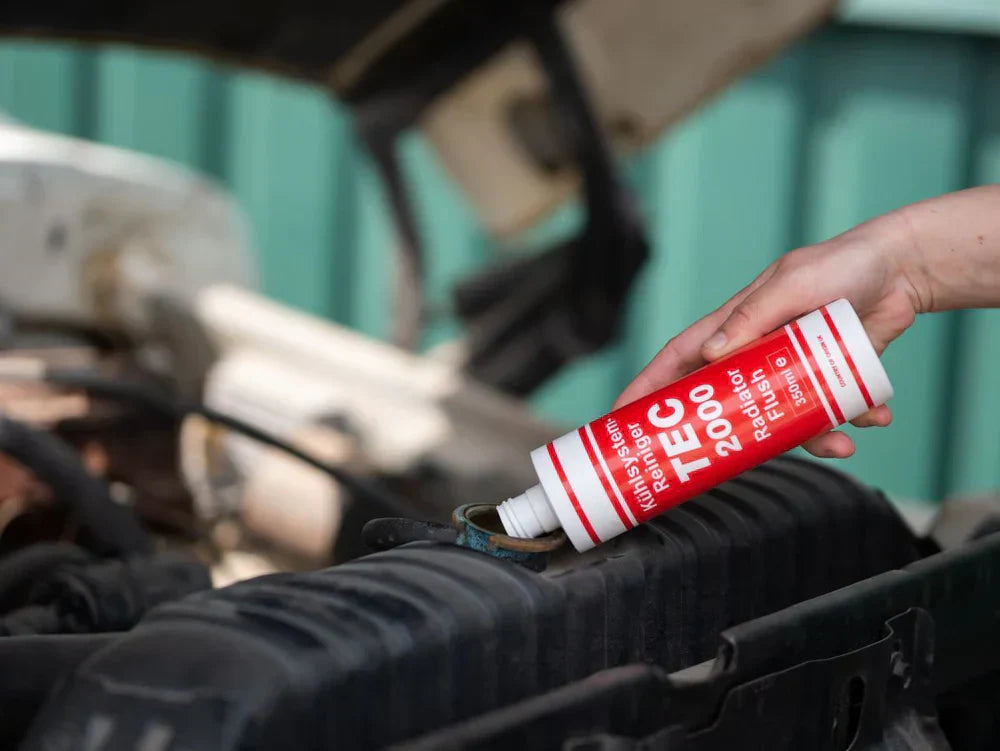
What should you do? If deposits are to blame, a thorough flush of the system with TEC 2000 Radiator Flush helps; it dissolves scale, rust and sludge, restoring the passages. It is a maintenance treatment – it will not repair a mechanically damaged core, but in many cars it genuinely improves heat transfer. Note: overheating must not be taken lightly. If, after flushing and changing the coolant, the temperature is still running away, that is a sign that the problem lies deeper (the thermostat, the pump, the core itself) and the car should be taken to a mechanic.
Other, less common faults
- A damaged pressure cap. It loses its seal, the system does not hold pressure and the coolant "evaporates" faster.
- A cracked expansion tank or stub. Often mistaken for a failure of the radiator itself – the symptoms can be identical.
- A faulty fan. The car overheats mainly when stationary and in traffic, although on the open road the temperature is normal.
- Air in the system after a coolant change. Air in the system blocks the circulation and gives symptoms similar to a radiator failure.
That is why, before you replace the radiator, it is worth confirming the diagnosis – not every case of overheating is the core’s fault. Regularly checking the level and the condition of the coolant also helps.
How do you know that the radiator is due for replacement?
- The leak is bigger than a small seep – you can see a trickle of coolant, a wet core or clear stains after every stop.
- The core is corroded or mechanically damaged – dented after a collision, with flattened fins, "eaten away" by corrosion.
- The sealant has stopped being enough – the leak has come back or is too big for the preparation.
- Overheating persists after the system has been flushed – despite clean, fresh coolant the core is not taking heat away.
In practice, gluing or soldering a radiator is a temporary and unreliable solution. If the part is genuinely worn out, it is cheaper and safer to replace it with a new one than to pay twice for removal and refitting.
How much does repairing and replacing a radiator cost?
Three things make up the bill: the price of the radiator, the labour and the additional materials (coolant, sometimes hoses and clips). The result depends most on the car model and on how much has to be taken apart to get at the radiator. Below are guide ranges for the Polish market in 2026 (a good aftermarket part + labour at an independent workshop).
|
Car class (examples) |
Radiator (aftermarket) |
Labour |
Total with coolant |
|
Segment A/B (Yaris, Fabia, Corsa) |
€47–105 |
€47–82 |
approx. €130–210 |
|
Compact (Golf, Astra, Focus) |
€70–190 |
€59–95 |
approx. €165–305 |
|
Premium / SUV (A6, BMW 5) |
from €190 upwards |
€95–190+ |
€400–950+ |
Guide ranges based on workshop price lists from 2026. At a main dealer and with original (OEM) parts the costs can be considerably higher. Add to the bill the coolant (about €7–14 per litre of concentrate) and any bleeding of the system.
For comparison, here is what neglect costs: overheating the engine most often means a damaged head gasket – replacing it is an expense of the order of €590–1,175, while a cracked head or block means costs running into many thousands of euros. Against that background, prevention is simply cheap.
The key point – remember this
You do not play games with the cooling system when there are symptoms of overheating. A rising temperature, coolant loss and a fan running constantly are not a case of "it will sort itself out", but a signal to act. If the needle runs into the red – pull over and switch the engine off, before a cheap repair turns into a head gasket replacement.
Keep to the order: prevention first, then repair. A coolant change every 2–3 years, periodic flushing of the system and a sealant for a small leak are prevention and a way of getting the situation under control – not a repair for a worn-out radiator. Additives will help keep the system clean and stop a small leak, but they will not undo corrosion of the core, nor will they replace the thermostat or the water pump. If the symptoms do not go away, that is a signal for diagnostics at a workshop.
Remember about safety, too: never unscrew the radiator cap or the expansion tank cap on a hot engine. The coolant is under pressure and very hot – it risks scalding. Wait until the system has cooled down, and unscrew the cap slowly.
How do you prevent radiator problems?
- Change the coolant every 2–3 years. Old coolant loses its anti-corrosion properties and starts to harm the system itself.
- Check the coolant level on a cold engine. A regular glance at the expansion tank catches losses before they become a problem.
- Flush the system when changing the coolant. Radiator Flush removes scale, rust and deposits, which block the passages over time.
- Do not mix random coolants. Stick to one specification (G11/G12/G13) in line with the car manufacturer’s recommendation.
- React to the first symptoms. A small leak or slight overheating is easier and cheaper to get under control at an early stage.
While you are checking the level, it is worth looking at the guide on the correct coolant level on a cold engine – it is the simplest habit, and it catches most problems at the outset.
Flushing or sealing – what to choose and when?
These are two different jobs, not competitors. The flush cleans, the sealant stops the leak. They are most often used at different moments in a car’s life:
|
Situation |
What to use |
What for |
|
A coolant change, prevention, weaker heat transfer |
Radiator Flush |
to remove scale, rust and deposits, to restore the system’s passages |
|
A small leak of up to 1.5 mm, coolant loss |
Radiator Stop Leak |
to close the leak, to reach a workshop, to hold out until a repair |
|
Prevention before the season / winter |
Radiator Stop Leak |
to protect the system, to reduce the risk of leaks and corrosion |
|
A corroded core, a big leak, overheating despite cleaning |
a visit to a mechanic |
replacing the radiator or repairing another part of the system |
In terms of cost the sum is simple: a can of flush or sealant is an expense of the order of €10–20, while replacing a radiator runs from a hundred or so to a couple of thousand euros. Prevention and getting a small leak under control on a temporary basis will not replace the replacement of a worn-out part, but they can push it back in time and, more importantly, protect the engine from overheating. You will find both preparations in the engine cooling and air conditioning category.
FAQ
Can I drive with a leaking radiator?
With a big leak – no, because you risk overheating and a costly engine failure. With a very small leak (up to about 1.5 mm) a sealant such as Radiator Stop Leak lets you safely reach a workshop, but it is a temporary solution, not the destination.
How often should you change the coolant?
Usually every 2–3 years or in line with the car manufacturer’s recommendation. Old coolant loses its anti-corrosion properties and starts to encourage deposits and corrosion in the system.
Does a radiator sealant block the heater matrix?
A good quality preparation, such as TEC 2000 Radiator Stop Leak, is formulated to close leaks without blocking the flow – it does not block the passages of the heater matrix or the radiator and it stays neutral to the system until a leak appears. Even so, do not use it "by force" with major damage.
What is the difference between Radiator Flush and Radiator Stop Leak?
Radiator Flush is a flush – it cleans scale, rust and deposits out of the system. Radiator Stop Leak is a sealant – it closes small leaks and can be used preventively. The first looks after the passages, the second after the seal.
Is flushing the cooling system safe?
Yes, when you use the preparation according to the instructions. Radiator Flush is formulated not to harm metal and rubber components. After flushing, the system should be rinsed through and fresh coolant added.
My vents heat poorly in winter – is the radiator to blame?
Not necessarily the radiator itself. Cool air from the vents can be the result of a low coolant level, air in the system, a blocked heater matrix or a faulty thermostat. Start by checking the coolant level and getting a diagnosis, before you decide to replace a part.




Leave a comment
This site is protected by hCaptcha and the hCaptcha Privacy Policy and Terms of Service apply.