
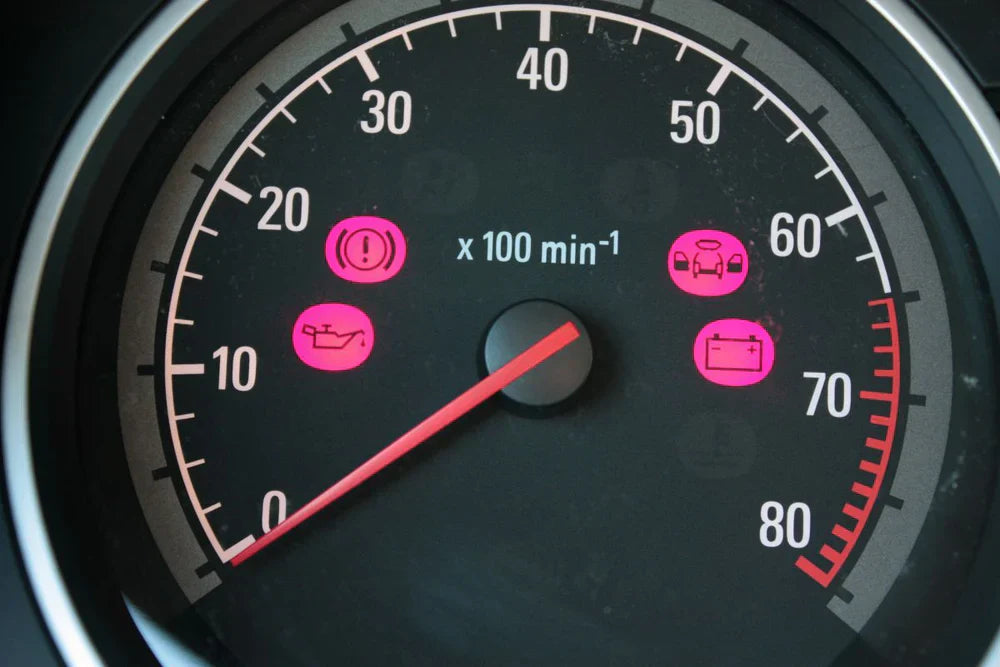
The car starts normally, you pull away, everything is fine… and suddenly, as you approach the traffic lights, the engine stalls. No warning, no message, just silence. This is one of those problems that can take you by surprise and, at the same time, is hard to explain in a single sentence.
Because the truth is this: an engine stalling at idle does not happen for one reason. It is a symptom that can originate in several different systems – from the intake, through the fuel, all the way to the electronics. And that is exactly why frustration comes up so often: "I replaced one thing and it is still the same".
The good news is that this problem almost always gives you warning signs beforehand. You just need to know what to look for – and where to look for the cause, instead of shooting in the dark.
The engine stalls at idle – what it looks like in practice and when it should worry you
Most often it starts with slight hunting of the revs or occasional dips, before the car begins to stall completely.
Pay attention to situations like these:
- the engine stalls after starting, when the revs drop to idle,
- the car stalls as you approach a junction or after slipping it into neutral,
- the revs drop too low and the engine does not "pick up",
- when stationary you can feel uneven engine running or slight jerking,
- the problem shows up more often on a cold engine, but not only then.
It is not as if the car suddenly starts stalling "overnight". In most cases a subtle drift in the idle running appears earlier. Once the revs will drop too low, another time the engine will shudder slightly, sometimes you have to add a touch of throttle so it does not cut out.
Many drivers ignore this, because the car still drives. It only becomes a problem the moment the engine actually stalls at the lights or in traffic – and that is when the hunt for the cause begins.
Why does the engine stall at idle – where does this problem come from?
Put simply: the engine is not getting exactly what it needs for stable running at low revs.
At idle everything has to be spot on:
- the right amount of air,
- precisely metered fuel,
- a working ignition system (in petrol engines),
- correct data from the sensors,
- stable control from the ECU.
At higher revs the engine has a bit of "headroom" – more air, more dynamic running. At idle there is practically no such margin. A small deviation is enough for the engine to lose stability.
That is why stalling at idle is often the first sign that one of the systems is starting to fail. And it does not always have to be something serious – sometimes a dirty throttle body or a filter that has not been changed in a long time is all it takes.
A dirty throttle body and intake – the most common cause in petrol engines (and not only)
One of the most common causes of an engine stalling at idle is a dirty throttle body, which disrupts the air supply.
What happens then:
- deposits restrict the airflow,
- the ECU is unable to set the revs precisely,
- the engine starts to hunt,
- when the revs drop it cannot sustain running and stalls.
This is a problem that develops slowly. Over time, contaminants build up on the throttle body and in the intake – carbon build-up, oil, dust. You cannot see it at first glance, but the engine starts to respond less and less steadily.
And it is at idle that this shows up most. The revs are low, the throttle body works within a very narrow range and every bit of resistance or dirt makes a difference.
In such situations, a thorough cleaning of the intake and throttle body often helps, for example with a product such as TEC 2000 Induction Cleaner, which removes deposits and restores the correct airflow. This is one of those things that can quickly improve how smoothly the engine runs.
Fuel system problems – when the engine is not getting the right dose
If fuel does not reach the engine in the right quantity or at the right pressure, maintaining idle becomes impossible.
The most common causes in this area:
- a blocked fuel filter,
- drops in fuel pressure,
- a worn fuel pump,
- dirty injectors,
- irregular fuel metering.
This is a problem that affects both petrol and diesel engines, although in diesels the symptoms are often more "pronounced". In Common Rail systems, even small deviations in the operation of the injectors can cause instability at idle.
In petrol engines, on the other hand, you often see it as a combination of several things – slightly uneven running, gentle jerking and occasional stalling.
In such cases it is worth thinking not only about repairs, but also about cleaning the system. Products such as TEC 2000 Fuel System Cleaner (for petrol) or TEC 2000 Diesel System Cleaner (for diesel) help to remove deposits from the injectors and improve the quality of fuel atomisation, which translates into more stable engine running – especially at idle.
A leaking intake, EGR and sensors – when the engine gets "the wrong data" to work with
Sometimes the problem lies neither in the fuel nor in the throttle body – but in the fact that the engine is getting the wrong information, or air is getting in where it should not.
The most common scenarios:
- an intake leak (so-called unmetered air),
- a sticking EGR valve,
- a MAF sensor giving incorrect readings,
- a temperature sensor or crankshaft position sensor working erratically.
These are the cases that can lead to situations such as the car stalling in neutral or the car stalling when you come to a stop, even though at first glance everything seems fine.
Why does this happen? Because the engine control unit relies on data. If it receives incorrect information about the amount of air or the temperature, it starts choosing the wrong fuel dose. And at idle there is no margin for error.
The EGR is a separate story. If the valve stays open at a moment when it should not, exhaust gases rather than fresh air reach the engine. And then the uneven running, the hunting and precisely that stalling at low revs begin.
The ignition system and injectors – differences between petrol and diesel that matter
In petrol engines the ignition is most often to blame, in diesels – the injection system and fuel pressure.
Typical for petrol engines:
- worn spark plugs,
- faulty ignition coils,
- problems with the ignition leads,
- misfires at idle.
In such cases a petrol car stalling at idle is a fairly classic symptom. The engine does not burn the mixture evenly and at low revs it simply "loses its rhythm".
In a diesel, the matter looks different. If a diesel car stalls at idle, it is often down to:
- injector back-leakage,
- pressure drops in the fuel rail,
- uneven operation of the Common Rail system.
In practice it looks like this: the car may run correctly under load, and the problem only begins when you lift off the throttle. Situations arise such as the car stalling while stationary or the car stalling at idle, particularly once it has warmed up.
And this is precisely where the difference between petrol and diesel is crucial – because the direction of the diagnosis goes down a completely different path.
What to do when the engine stalls at idle and how to approach the diagnosis?
The most sensible approach is to start with the simple things and only go a step further when they do not help.
Where to start:
- check the air filter and the fuel filter,
- note when the problem occurs (cold engine, warm engine, only in neutral),
- listen to the engine running – is it uneven or steady,
- check whether the check engine light comes on.
This matters, because the situation looks completely different when the engine stalls at idle while it is cold, and different again when the engine stalls at idle once it is warm.
If the problem appears sporadically, it is worth starting with cleaning and basic servicing. If it is regular – there is no point guessing.
In a workshop the diagnosis usually goes like this:
- reading the fault codes from the computer,
- checking the engine running parameters,
- checking the fuel pressure and the operation of the injectors,
- any more advanced tests, if needed.
It is also worth remembering that symptoms such as the car stalling at the lights or the car stalling in neutral very rarely disappear on their own. Usually it is the other way round – over time the problem deepens and takes in further components.
FAQ
Why does a car stall at idle?
Because one of the systems – air, fuel, ignition or engine management – is not keeping the engine running steadily at low revs.
What does it mean when a car stalls at idle?
Most often a problem with the air or fuel supply, or with dirt in the intake components.
Why does a car stall in neutral or when coming to a stop?
Because as the revs drop the engine loses stability – often due to a dirty throttle body, the EGR or fuel problems.
Can you drive when the engine stalls at idle?
You can, but it is risky – the problem usually deepens and may lead to a more serious failure.
Is the problem different in petrol and diesel engines?
Yes – in petrol engines the ignition and intake are more often to blame, in diesels the injectors and fuel pressure.
How much does the repair cost?
From a couple of dozen euros for a filter or a clean, up to a couple of thousand euros with injector or electronics problems.
Can you do anything yourself?
Yes – check the filters, clean the throttle body, use fuel system products. With more serious symptoms you need a workshop.


Leave a comment
This site is protected by hCaptcha and the hCaptcha Privacy Policy and Terms of Service apply.