
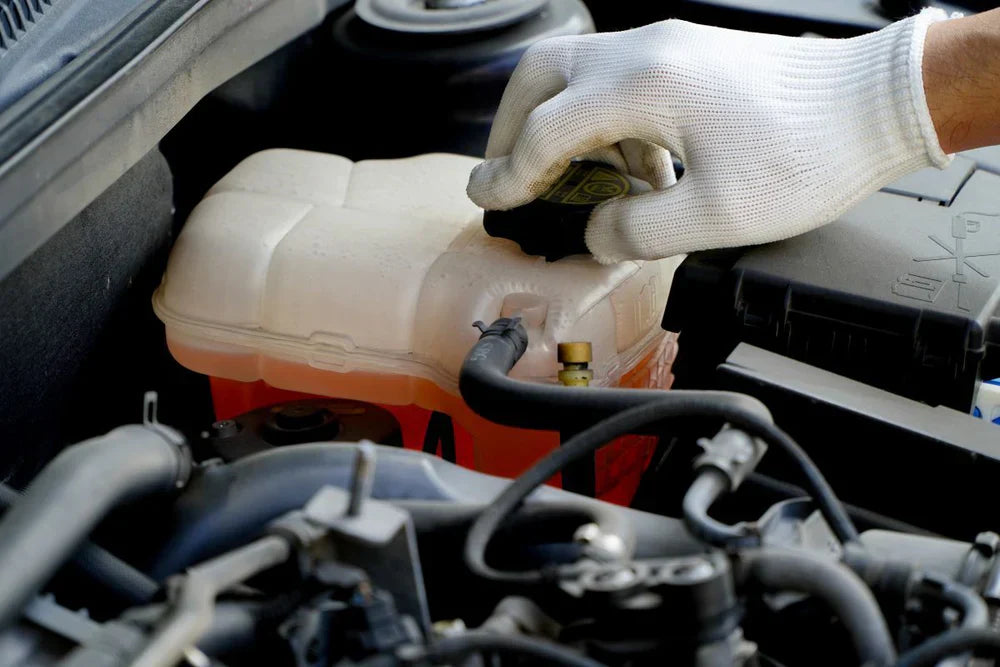
If you have the impression that the engine takes too long to warm up, or the opposite – the temperature starts climbing faster than usual, your first thought should be simple: check the thermostat. And the good news is that in many cases you can do it yourself, without taking half the car apart.
That is exactly why questions like how to check the thermostat in a car or how to check whether the thermostat is working come up so often. Drivers are not looking for theory – they want to know whether they can sort it out "in the car park" and whether the problem really lies in that part.
You can. And in several ways – from simple observation to a more accurate test after removal. It is best to start with the easiest things and only then go a step further.
How to check whether the thermostat is working without removing it, and does that even make sense?
Yes – an initial check of the thermostat without taking it out makes sense and often gives a clear enough answer.
Start with the basics:
- start the engine completely cold,
- watch how the temperature rises on the gauge,
- check whether the car reaches normal temperature within a reasonable time,
- note whether the temperature then stabilises.
It sounds simple, but this is exactly where most irregularities show up. If after a few or a dozen or so kilometres you still do not have a normal temperature, the first suspicion appears.
The opposite situation – the temperature rises very quickly and starts climbing higher than it should – is a sign that something may be blocking the flow of coolant.
It is worth remembering that what the coolant temperature should be depends on the car, but in most cases it is around 85–95°C, held steadily at that value. If the needle cannot "settle" there, something is wrong.
How to check the thermostat by the hoses – a simple test that tells you a great deal
The touch test on the radiator hoses is one of the most practical ways of checking whether the thermostat is working.
How to do it without overcomplicating things:
- the engine must be cold at the start,
- start the car and leave it idling,
- check the temperature of the radiator hoses from time to time,
- it is best to do this wearing gloves and with care.
At first everything should warm up unevenly. The hose leading to the radiator stays cooler for a while, because the thermostat is closed and the small circuit is working.
And now the key moment. At some point – when the engine reaches the opening temperature – that hose should become distinctly warm. This is a sign that the thermostat has opened and the coolant has started circulating through the radiator.
If both hoses become warm almost straight away, it looks like a thermostat stuck open. If the engine is warming up and the hose is still cold – the thermostat may be jammed.
How to check whether the thermostat opens and at what temperature it should work?
The thermostat should open at a specific temperature – most often around 85–95°C, depending on the car model.
What is worth knowing:
- the opening temperature is usually marked on the thermostat housing,
- opening is not sudden – it is a gradual process,
- after opening, the temperature should stabilise,
- no reaction means a problem with the flow.
This is where combining two observations comes in handy – the gauges and the hoses. If you see the temperature rising to its operating value and at the same time a sudden change in the temperature of the radiator hose appears, you have confirmation that the system is working as it should.
If that moment does not come – something is off. And this is precisely the answer to the question *how to check whether the thermostat is faulty* without reaching for diagnostic tools.
Testing the thermostat after removal – the most accurate method if you want to be sure
If you want to be one hundred per cent certain, the thermostat has to be taken out and tested in water at a controlled temperature.
What such a test looks like:
- remove the thermostat with the engine cold,
- place it in a container of water,
- heat the water and watch for the moment it opens,
- once it has cooled down, check whether it closes.
This is the simplest form of "workshop" diagnosis in home conditions. The thermostat should begin to open exactly at the temperature declared by the manufacturer, and after cooling down it should return to the closed position.
If it does not open, does not close or reacts with a delay – the subject is closed. A part like that is only fit for replacement.
Computer diagnostics – when the ordinary methods are no longer enough
In newer cars it is worth backing yourself up with OBD diagnostics, because the temperature gauge does not always show the full picture.
What you can check:
- the actual coolant temperature from the ECU,
- the rate at which the engine warms up,
- any faults related to the cooling system,
- the operation of an electronic thermostat.
This is particularly useful in modern cars, where the gauge on the dashboard is often "smoothed out" and does not show small deviations.
If you see differences between what the computer shows and what you feel while driving, it is worth digging deeper. Because sometimes the problem starts earlier than you are able to notice with the naked eye.
FAQ
How do I check the thermostat in a car without removing it?
The simplest way is to watch the engine temperature and check how the radiator hoses behave as it warms up.
How do I check whether the thermostat is working?
The engine should quickly reach operating temperature and hold it steadily, without large fluctuations.
How do I check whether the thermostat is faulty?
The symptoms are a lack of warming up, overheating or unstable temperature, along with abnormal behaviour of the radiator hoses.
How do I check the thermostat in a car without taking it out?
All you need is a cold start, observation of the temperature gauge and a check on when the hoses warm up.
What should the coolant temperature be?
Most often around 85–95°C, although it depends on the specific engine.
At what temperature should the thermostat open?
Usually between 80 and 95°C – the exact value is set by the manufacturer.



Leave a comment
This site is protected by hCaptcha and the hCaptcha Privacy Policy and Terms of Service apply.