
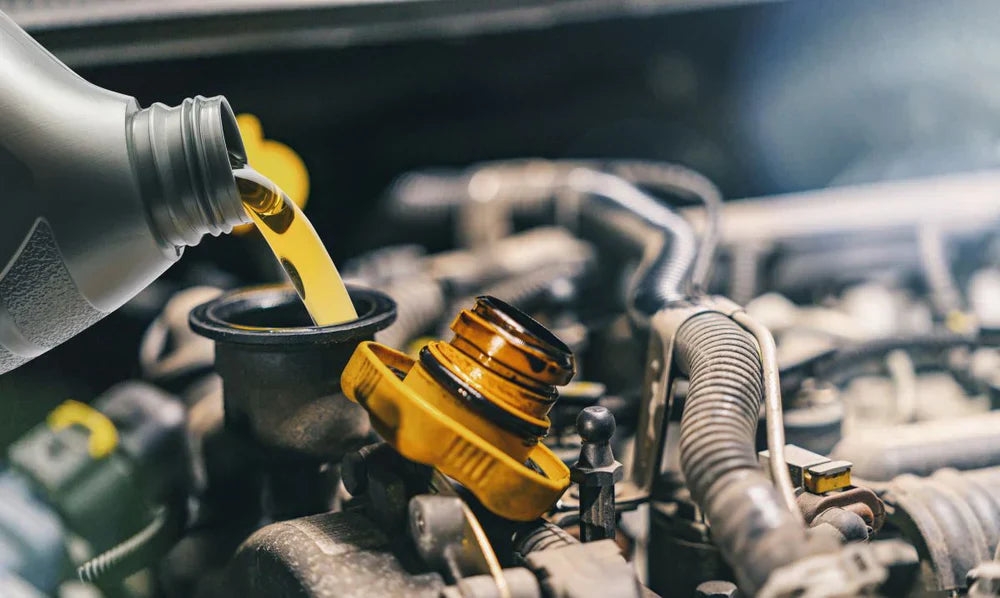
An engine may use small amounts of oil and this does not necessarily mean an immediate rebuild. The problem starts when the level on the dipstick drops faster than usual, blue smoke appears from the exhaust, the car loses power or topping up the oil becomes a regular ritual every few hundred kilometres. In practice, "using oil" is very often a symptom of another fault – from seized piston rings, through worn valve stem seals, all the way to problems with the turbocharger or the breather system.
In many engines the first symptoms are subtle. Sometimes it starts with a faint smell of burnt oil after a spirited drive. Another time the driver notices that after 3000–5000 km half a litre of oil has to be topped up, even though previously an oil change lasted "from service to service". It also happens that the car does not smoke at all, yet the oil regularly disappears anyway. And this is precisely why topping up alone does not solve the problem – first you have to establish where the oil is going and why the engine has started burning it.
How do you know the engine is burning oil and the problem is only just building up?
Usually the first signal is not thick smoke from the exhaust, but a steadily dropping oil level between changes. Many drivers only notice the problem when the oil light comes on after a long journey or the engine starts running noticeably louder. Meanwhile, the earlier symptoms usually show up much sooner – they are just easy to dismiss.
The most typical symptoms look like this:
- oil disappears despite no visible leaks,
- after harder acceleration a faint bluish smoke appears,
- the engine starts running more "dryly" and harshly,
- fuel consumption rises,
- an oily deposit appears on the exhaust tip,
- the car responds more sluggishly to the throttle,
- after parking you can smell burnt oil.
Very often it looks innocent. The car still starts normally. The check engine light is not on. There are no dramatic symptoms. And yet after 1500–2000 km it turns out that half a litre of oil has vanished from the dipstick. And that is exactly when most drivers start looking for an answer to whether "this engine is just like that" or whether something really is starting to go wrong.
The moment at which the smoking appears also tells you a lot.
- Blue smoke after standing overnight more often suggests a problem with the valve stem seals. The oil then drains into the combustion chamber while the car is parked, and once it is started it gets burnt along with the mixture.
- Smoking under acceleration or under load, on the other hand, more often points the diagnosis towards the piston rings, the cylinders or the turbocharger.
It is also worth paying attention to the behaviour of the engine itself. When oil enters the combustion chamber over a longer period, deposits and carbon build-up begin to form. The result? Uneven running at idle, occasional misfires, black spark plugs and increasingly poor refinement. In some engines fuel trims and mixture-related fault codes also appear, which is confirmed by GM/NHTSA bulletins on excessive oil consumption.
That is precisely why ignoring the first symptoms can quickly push up the cost of the repair. A problem that initially would have ended with, for example, a breather service, flushing the oil system or replacing the valve stem seals, may after a few months mean:
- reconditioning the turbo,
- honing the cylinders,
- replacing the piston rings,
- and sometimes even a full engine rebuild.
Why is blue smoke coming from the exhaust – and when is it already an alarm signal?
Blue or bluish smoke from the exhaust almost always means one thing – oil is getting into the combustion process. The only question is: which way. The colour of the smoke itself is a very important diagnostic clue and for years it has been treated as a classic symptom of oil burning. This is also confirmed by AA1Car technical papers on diagnosing engine smoking.
The moment the smoke appears is crucial:
- smoke after starting – more often the valve stem seals,
- smoke under hard throttle – more often the piston rings or the turbo,
- smoke while driving under load – possible problems with compression or the cylinders,
- smoking practically all the time – advanced wear or several faults at once.
If you start the car after it has stood overnight and for a few seconds a bluish cloud appears from the exhaust pipe, it is very possible that oil is running down from the top of the engine into the cylinders. This is a typical scenario with worn valve stem seals. The problem often gets worse after a longer period of standing and in older, higher-mileage engines.
Worn piston rings usually behave differently. The smoking then appears more often during acceleration, driving under load or at higher revs. In such a situation the exhaust gases tend to be more intense, and along with them come:
- a more pronounced loss of power,
- higher fuel consumption,
- a rise in crankcase pressure,
- faster fouling of the spark plugs and the intake.
In turbocharged engines there is one more scenario – oil gets through the turbocharger into the intake and the intercooler. The car may then not only smoke, but also leave an oily deposit in the intake pipework. Sometimes a turbo whistle appears, or a poorer response to the throttle. In many cases a sensible diagnosis starts precisely with an inspection of the intake and the intercooler.
The worst moment is the situation in which, along with the blue smoke, the following appear:
- knocking or rattling from the engine,
- the oil pressure warning light,
- a sudden loss of oil,
- a clear loss of power,
- smoking practically non-stop.
This is no longer the observation stage. With symptoms like these, carrying on driving can end with the engine seizing or the turbocharger being damaged.
The engine uses 1 litre of oil per 1000 km – still normal or the start of a rebuild?
Oil consumption at the level of 1 l / 1000 km is in practice already a strong warning sign, even if some manufacturers formally allow high values in their service manuals. Such a loss means that between oil changes you may top up several litres of oil. And that usually does not come "out of nowhere".
The problem is that many modern engines really can use oil in normal service. Particularly:
- turbocharged engines,
- engines with direct injection,
- designs with low-friction piston rings,
- cars driven mainly in town,
- engines regularly run at high revs.
That is why the loss of oil alone is not yet automatically a death sentence for the engine. What matters is the scale and the rate of the problem. If over 10,000 km you top up 0.3–0.5 l of oil and no other symptoms occur, some manufacturers will consider this acceptable. The situation looks completely different when:
- a top-up is needed every 700–1000 km,
- the car starts to smoke,
- the engine runs unevenly,
- fuel consumption rises,
- wet spark plugs or oil in the intake appear.
According to data from the NHTSA/GM bulletin, elevated oil consumption in specific engines was defined from about 0.9 l per 3200 km, that is around 0.28 l / 1000 km. This shows how big the difference is between "acceptable consumption" and a situation in which the engine really is starting to have a problem.
A lot also depends on the cause. Sometimes the source of the problem turns out to be:
- a blocked or faulty PCV valve,
- carbon build-up around the oil control rings,
- the wrong oil viscosity,
- stretched service intervals,
- a contaminated oil system.
In such cases a sensibly carried out service can noticeably improve the situation. In older engines some drivers decide, for example, to flush the oil system with TEC 2000 Engine Flush, especially where seized rings and a large amount of deposits are suspected. After the oil change some users also apply TEC 2000 Oil Booster to support the oil film and viscosity stability. These are still supporting solutions, however – they will not mechanically rebuild worn cylinders, cracked rings or a damaged turbo.
And this is precisely where the biggest mistake appears. Many drivers spend months doing nothing but topping up the oil. Without a compression test. Without checking the breather. Without inspecting the intake or the turbocharger. The problem does not go away – it simply develops slowly. And the costs grow along with it.
What most often causes oil burning – rings, turbo, valve stem seals or the breather?
Most often the culprits are worn piston rings, valve stem seals or problems with the turbocharger. Increasingly, the breather system and the PCV valve also turn out to be the source of trouble, particularly in engines driven mainly around town and on extended oil intervals.
The most typical causes of oil burning are:
- worn or seized piston rings,
- worn valve stem seals,
- oil getting through the turbocharger,
- a blocked or damaged PCV valve,
- wear of the cylinders and cylinder bore surfaces,
- the wrong engine oil,
- carbon deposits and residues in the oil system.
Some problems develop very slowly. The engine first starts using more oil, then slight smoking appears, and only later do drops in compression or louder running join in. That is exactly why reacting quickly to the first symptoms is so important, before the deposits start blocking the rings or the turbo starts letting oil into the intake.
The oil service itself also matters a great deal. Stretched changes, the wrong viscosity or poor-quality oil speed up the build-up of carbon. In older engines this can lead to the oil control rings seizing and to poorer lubrication. In such situations some drivers decide to clean the oil system using TEC 2000 Engine Flush, especially when the problem does not yet stem from mechanical damage to the engine.
Why does a car use oil but not smoke – and why do many drivers get lulled into a false sense of security?
A lack of blue smoke does not mean everything is fine. Oil can disappear gradually, end up in the intake or leak under load in a way that is hard to notice. In many cars, oil burning gives no spectacular symptoms for a long time.
The most common scenarios look like this:
- oil ends up in the intake and is partly held back by the intercooler,
- the DPF or the catalytic converter limits how visible the smoking is,
- the engine burns small amounts of oil over a long period,
- the leak only appears while driving,
- the PCV valve raises the crankcase pressure and pushes oil out through the seals.
Quite a few drivers only notice the problem when a litre of oil has to be topped up between changes. Before that the car can drive completely normally. No jerking. No check engine light. No obvious smoke. And this is precisely why regularly checking the oil level is so important – especially in modern turbocharged petrol engines.
If the oil level is dropping and the engine is dry on the outside, it is worth checking:
- the breather and the PCV,
- the intake pipework,
- the intercooler,
- the turbocharger,
- the spark plugs,
- the fuel trims and OBD fault codes.
How to work out where the oil is going, before the mechanic starts replacing half the engine?
First you have to establish whether the oil is being burnt or is leaking. Without that it is very easy to walk into expensive, hit-and-miss diagnostics. Simply saying that "the engine uses oil" tells you nothing yet about the cause.
A good starting point looks like this:
- set the oil level correctly,
- note the mileage,
- check the loss after 500–1000 km,
- look at the engine from underneath,
- pay attention to the colour of the exhaust gases,
- check the spark plugs and the intake.
If mechanical problems are suspected, the next step is usually:
- a compression test,
- a wet compression test,
- a leak-down test,
- checking the crankcase pressure,
- checking the turbo for play,
- an endoscope inspection of the cylinders.
The nature of the symptoms themselves also says a lot. Smoke after the car has stood more often points the diagnosis towards the valve stem seals. Smoke under acceleration more often indicates the rings or the turbo. Wet spark plugs and misfires suggest that oil is getting straight into the combustion chamber.
The biggest mistake? Replacing parts without confirming the cause. It happens that a driver has the turbocharger reconditioned, and the problem turns out to be a blocked breather worth a couple of dozen euros.
Can you carry on driving a car that burns oil – or is that a straight road to a seized engine?
Yes – but only under certain conditions. If the oil loss is small, the engine is not knocking, the oil pressure light is not on and the level is constantly monitored, the car can usually still make it to the workshop normally.
Alarm situations look different. It is worth stopping the journey when:
- the oil pressure warning light comes on,
- the engine starts knocking or rattling,
- intense blue smoke comes from the exhaust,
- the oil level drops very quickly,
- the car clearly loses power.
Driving on with a low oil level can end up being very expensive. The most common consequences are:
- the engine seizing,
- overheating of components,
- damage to the turbocharger,
- carbon build-up on the valves,
- seized rings,
- damage to the catalytic converter or the DPF.
The longer the engine runs short of lubrication, the greater the risk that a problem worth a couple of hundred euros will turn into a rebuild costing a couple of thousand or even several thousand euros.
What really helps when an engine starts using oil – and what only masks the problem?
Diagnostics first, additives and servicing later. This matters, because some products can help limit the effects of contamination, but no product will mechanically rebuild worn rings or cylinders.
If the problem stems from:
- carbon build-up,
- seized rings,
- a dirty oil system,
- deteriorated lubrication,
the following may help:
- flushing the oil system,
- an earlier oil change,
- choosing the right viscosity,
- cleaning the breather,
- using an additive that supports the oil film.
In such cases some drivers use TEC 2000 Engine Flush before the oil change, in order to remove deposits from the oil gallery and the area around the piston rings. After the service, some also opt for TEC 2000 Oil Booster to support viscosity stability and protection of the oil film in older engines.
One thing has to be said clearly, though: if the engine has damaged rings, worn cylinders or a leaking turbo, an additive alone will not solve the problem. In such situations these products can be treated purely as support in service, not as a substitute for a mechanical repair.
Summary
An engine burning oil does not always mean an immediate rebuild, but it almost always means it is worth checking why the oil is disappearing. The sooner a diagnosis appears, the greater the chance that the problem will end with a service, valve stem seals or cleaning the oil system, rather than with replacing the rings or reconditioning the engine.
The most worrying symptoms are:
- blue smoke from the exhaust,
- a rapid drop in the oil level,
- knocking and louder engine running,
- oil in the intake or on the spark plugs,
- having to top up the oil every few hundred kilometres.
If the problem stems from deposits, carbon build-up or seized rings, cleaning the oil system and a proper service may help. When the cause is mechanical damage, however, repairing specific components will be necessary – from the valve stem seals through to the turbocharger or the piston rings.
FAQ
How do you know the engine is burning oil?
Most often by blue smoke, a rapid loss of oil, the smell of burnt oil and the need for regular top-ups between changes.
Does blue smoke always mean oil burning?
Most often yes. You do, however, have to establish whether the oil reaches the cylinders through the rings, the valve stem seals, the turbo or the breather system.
How much oil per 1000 km is normal?
That depends on the engine and the manufacturer's recommendations. Consumption around 1 l / 1000 km is worth treating as a signal for diagnostics.
Why does the engine use oil but not smoke?
Oil can end up in the intake, be burnt gradually or leak under load without any obvious smoking.
Can you drive a car that uses oil?
Yes, but only with constant monitoring of the oil level and no alarm symptoms such as knocking, the oil light or heavy smoking.
What are the risks with too low an oil level?
Among others:
- the engine seizing,
- damage to the turbocharger,
- overheating of components,
- a drop in compression,
- a very expensive repair.
Can an engine flush help when the engine burns oil?
Yes, if the problem stems from deposits or seized rings. An engine flush will not, however, mechanically repair worn components.
Will an oil additive stop the engine burning oil?
It may limit the symptoms related to friction and poorer lubrication, but it will not replace repairing the rings, the turbo or the cylinders.
Can the turbo cause oil burning?
Yes. A leaking turbocharger can direct oil into the intake and the intercooler, from where it ends up being burnt.
How much does it cost to repair an engine that uses oil?
The costs depend on the cause:
- valve stem seals – around €150–565,
- turbo reconditioning – around €260–285,
- replacing the rings – around €635–905,
- an engine rebuild – often a couple of thousand or several thousand euros.



Leave a comment
This site is protected by hCaptcha and the hCaptcha Privacy Policy and Terms of Service apply.