
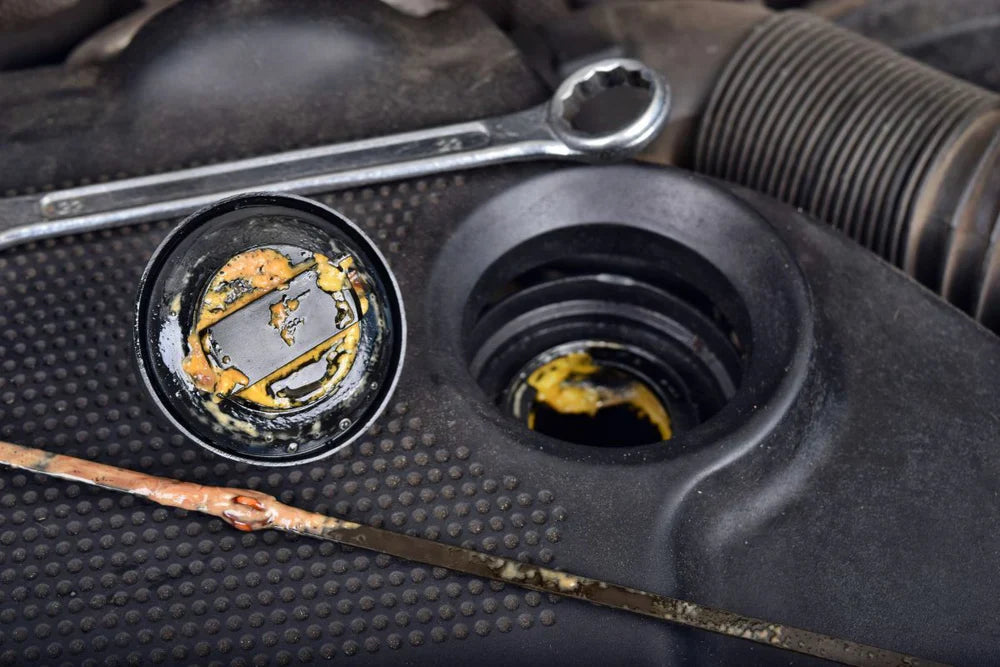
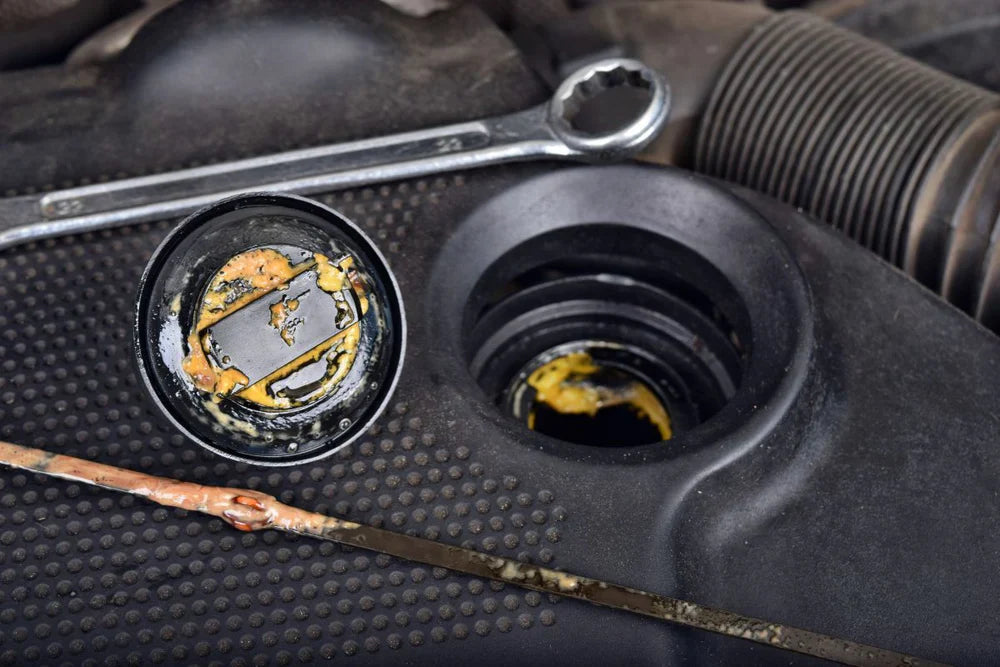
If, after unscrewing the cap, you see a creamy, light sludge resembling mayonnaise, the first thought is usually one: the head gasket. And sometimes that's true. But not always. Mayonnaise on the oil filler cap is very often simply the result of driving short distances, especially in winter. The problem begins when the same sludge also appears on the dipstick, the oil turns cloudy, and the coolant starts disappearing for no obvious reason.
In practice it all comes down to one question: is it just water vapour condensing, or is the oil already mixing with the coolant? In this post we'll break the subject down into its parts: when you can observe “mayonnaise under the oil cap” calmly, and when you have to stop pretending nothing is happening and go for diagnostics.
Mayonnaise on the oil filler cap – what exactly is it and where does this emulsion come from?
Mayonnaise on the oil filler cap is an emulsion of engine oil with water or coolant. It looks like mayonnaise, but chemically it's a mixture that has no business being in the lubrication system.
In the mild version the water comes from condensation. In the more serious version – from the cooling system. And it is precisely this distinction that is crucial.
When we're talking about ordinary condensation:
- water gets into the oil as vapour,
- it collects mainly in the upper parts of the engine,
- it forms a white deposit under the oil cap,
- it disappears after a longer drive and an oil change.
When coolant gets into the oil, however, the situation looks different. What appears is:
- mayonnaise in the engine, visible on the dipstick as well,
- a change in the consistency of the whole of the oil,
- characteristic cloudiness,
- possible overheating of the unit.
The problem with an emulsion is that the oil loses its ability to form a stable lubricating film. And without that film, metal works against metal. In the longer term this leads to:
- accelerated wear of the bearing shells,
- problems with the crankshaft,
- damage to the piston rings.
That's exactly why mayonnaise under the oil cap isn't a subject worth dismissing just because “the car still drives”. What matters is establishing which variant you're dealing with – the operational one or the failure one. And only then does the right decision begin.
Mayonnaise under the oil cap – when is it only the effect of short trips, and when is it an alarm signal?
The shortest answer? If the mayonnaise under the oil cap is only on the cap, and the dipstick shows clean oil – most often it's a matter of how the car is used. If, however, the same emulsion also appears on the dipstick and is accompanied by a drop in coolant – things get serious.
An engine produces moisture while it's running. When you drive mainly around town, 3–5 kilometres to the shop or to work, the unit often doesn't reach full operating temperature. The water vapour has no chance to evaporate and settles at the highest point of the lubrication system – right under the cap. That's when you see a white deposit on the oil cap, which in reality is an emulsion of oil and water.
This is usually the “mild” scenario. It's characterised by the fact that:
- mayonnaise on the oil cap occurs mainly in winter,
- the oil on the dipstick is clear,
- there's no loss of coolant,
- the engine runs normally.
The situation looks different when mayonnaise under the oil cap is only the beginning. If you notice:
- cloudy, milky oil on the dipstick,
- a drop in the coolant level,
- the engine overheating,
- white smoke from the exhaust,
then it's no longer a “because it's cold” subject. It may mean that coolant is getting into the lubrication system, and that very often points towards the head gasket. And here, putting things off stops being sensible.
Mayonnaise under the oil cap in a petrol car – why do you see it more often in petrol engines?
In workshop practice, mayonnaise under the oil cap appears more often in petrol engines than in diesels. The reason is fairly simple and not at all spectacular – the way the car is used.
Petrol engines very often work over short distances. A city car, quick trips, frequently starting a cold engine. And that means:
- more heating and cooling cycles,
- greater condensation of water vapour,
- more moisture in the lubrication system.
On top of that comes the fact that a petrol engine usually works in slightly different temperature conditions than a diesel, especially with gentle city driving. So if you see mayonnaise on the oil cap in a petrol engine and the car is driven mainly around town – the operational scenario is very likely.
That doesn't mean, of course, that you can ignore the subject indefinitely. Even if it is only condensation, the constant presence of moisture in the oil degrades its lubricating properties. And that means:
- faster ageing of the oil,
- a greater risk of sludge forming,
- accelerated wear of engine components.
That's why, in the case of frequent city driving, it's worth thinking not only about reacting to symptoms, but also about prevention.
A white deposit on the oil cap – does it always mean a head gasket?
No. And that has to be said outright, because many people, on seeing a white deposit on the oil cap, immediately assume the worst. In practice, mechanics very often see such a deposit in cars that simply don't drive enough and don't drive far enough. The engine has no chance to “warm through”, the moisture stays inside, and you see the result under the cap.
The problem begins when the white deposit under the oil cap isn't the only symptom. If, at the same time, there appears:
- a loss of coolant,
- a raised operating temperature,
- milky oil on the dipstick,
- rough running of the unit,
then the suspicion of a head gasket stops being forum theory and becomes a real scenario.
It's worth remembering one rule: the cap alone doesn't diagnose the engine. The cap shows what is happening in its vicinity – i.e. at the highest point of the system. So always check the dipstick. If the oil is clean, clear, with no “mayonnaise”, and the coolant level doesn't change – very often you're dealing with typical condensation.
But if the emulsion is visible throughout the lubrication system as well, then the subject becomes serious and carrying on driving “to see what happens” can only make the situation worse.
Mayonnaise under the oil cap – colloquial names, myths and what really matters
Drivers call it various things: mayonnaise under the oil cap, butter, white sludge, slime, yellow paste. Whatever the name, it's the same thing – an emulsion of oil with water or coolant. And here it's worth separating internet scare stories from facts.
- Myth number one: any mayonnaise means an engine rebuild.
- Myth number two: it's enough to ignore the subject, because “in winter that's normal”.
The truth lies somewhere in between.
If mayonnaise in the engine appears only under the cap, mainly in the cold months, and after a longer drive the deposit disappears or clearly diminishes – it's very possible that the engine simply wasn't reaching operating temperature before. In such cases what often helps is:
- changing the oil for fresh oil,
- a longer drive,
- checking the condition of the breather.
If, on the other hand, the mayonnaise under the oil cap starts getting thicker and wetter, and on top of that appears on the dipstick – that's no longer a matter of “how the oil looks”. Then you have to check that the cooling system is sealed and rule out coolant getting into the oil.
What really matters is the scale of the phenomenon and the accompanying symptoms, and not the name of the deposit itself.
How will you know the problem is no longer a trifle?
A deposit on the oil cap on its own doesn't have to be a drama. But there are signals that should set off a red warning light.
If, apart from the deposit, you notice that:
- the engine starts running louder than usual,
- a characteristic “jerking” appears,
- fuel consumption rises with no change in driving style,
- the oil level starts fluctuating oddly,
then it's worth putting a stop to the delaying.
When water gets into the oil, its lubricating ability deteriorates. This isn't an abstraction – the oil film loses its stability, and metal components start working in worse conditions. In the long run this leads to accelerated wear of the bearing shells, the piston rings and the crankshaft.
From the outside you only see a deposit on the oil cap, but inside, sludge may already be forming and settling in the oil galleries. And that is a straight road to oil pressure problems.
If the symptoms are intensifying, don't count on them disappearing on their own.
How do you check for yourself whether the white deposit is condensation or a serious fault?
Before you drive to a workshop, you can do a few simple things. Without specialist equipment, without taking half the engine apart.
First – pull out the dipstick. That's the simplest test. If there's a deposit on the oil cap, but the oil on the dipstick is clean and has a normal consistency – that's a good sign. If, however, the dipstick shows milky, lightened oil – the subject becomes serious.
Second – check the coolant level. If it drops regularly and there are no external leaks, it may mean it's going where it shouldn't – i.e. into the combustion chamber or into the oil.
Third – watch how the car behaves while driving. White smoke from the exhaust, the engine overheating, harder starting – these are no longer subtle signals.
At a workshop you can additionally carry out a test for the presence of exhaust gases in the cooling system (a CO₂ tester). It's a quick method that lets you confirm or rule out damage to the head gasket.
The most important thing is not to rely on a single symptom alone. Mayonnaise on the oil filler cap is a starting point for observation, not a final verdict. The sooner you check the situation, the greater the chance it will end with an oil change rather than with removing the cylinder head.
Can you carry on driving, and what are the real consequences?
In short: sometimes you can make it home, but sometimes it's better to switch the engine off straight away and call a flatbed. It all depends on what, apart from the deposit, you see and feel while driving.
If the deposit is only under the cap, the oil on the dipstick looks normal, the car isn't smoking, isn't overheating and isn't losing coolant – you can calmly get home or to a workshop. It's most often the effect of driving short distances. In such a situation:
- plan an oil change in the near future,
- take a longer drive so the engine reaches full temperature,
- watch the coolant level for a few days.
But if, apart from the deposit, there appears:
- cloudy oil on the dipstick,
- coolant disappearing with no leak,
- white smoke from the exhaust,
- a rise in engine temperature,
then this isn't the moment for “we'll see tomorrow”. Carrying on driving can then end up very expensive. Water in the oil means that lubrication stops working the way it should. And when an engine loses its protection, wear increases in a flash.
In the worst-case scenario the consequences can be serious:
- damage to the bearing shells and the crankshaft,
- the engine seizing,
- the need to rebuild the whole unit.
That's why the rule is simple: if symptoms other than the deposit appear – don't take the risk. The cost of a flatbed is nothing compared with an engine rebuild.
How do you remove the deposit under the cap and clean the lubrication system?
There are two scenarios here. And it's important that you assess correctly which one you're in.
Scenario one – operational. The engine is driven mainly around town, the deposit is only under the cap, the dipstick is clean. Then the solution is relatively simple:
- an oil and filter change,
- using an engine flush before the change,
- checking the breather,
- a few longer drives, so the unit can “burn itself through”.
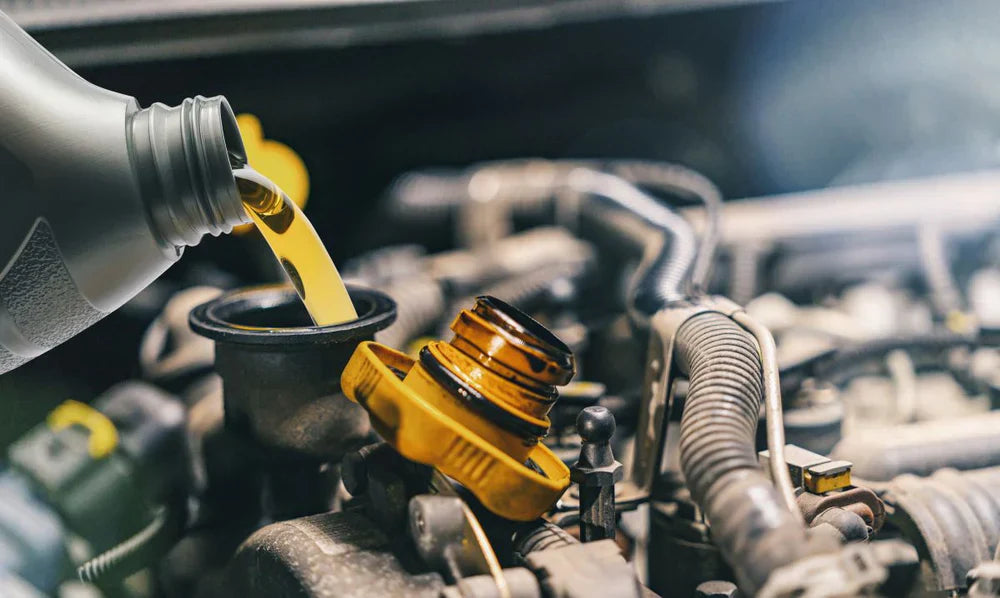
In such a case it's worth reaching for a proven product, e.g. TEC 2000 Engine Flush. You add it to the old oil, the engine runs for a dozen or so minutes at idle, then you drain the oil and change the filter. This helps remove carbon deposits and sludge residue from the oil galleries. A cleaner engine means a lower risk of further deposits forming.
If you want to look after the unit more broadly, you can take a look at the “Engine flushing and protection” category, where you'll find more preventive solutions.
Scenario two – failure. If the deposit is on the dipstick too, the oil looks like milk, and the coolant is disappearing – a flush alone won't solve the problem. Then you have to:
- check whether the head gasket is sealing,
- carry out a CO₂ test,
- if necessary, remove the cylinder head and replace the gasket.
After such a repair it's also worth using an engine flush, in order to remove the remains of the emulsion from the lubrication system. But first the cause has to be removed.
Mayonnaise under the oil cap – costs, from an engine flush to a head gasket replacement
This is where you see the biggest difference between reacting quickly and putting the subject off.
If the matter ends with prevention, the costs are relatively small:
- an engine flush at a workshop – usually from a few euros to a couple of hundred euros,
- TEC 2000 Engine Flush – around €16 per pack,
- an oil and filter change – depending on the car, but still within reasonable limits.
When it comes to damage to the head gasket, however, a different conversation begins. In many cars we're already talking about:
- €350–1,180 for the full job,
- additional costs of skimming the head,
- replacing other gaskets and bolts.
And if someone ignores the symptoms and lets the unit seize? Then the bill can reach several, or even a few thousand euros for a major rebuild or an engine replacement.
That's why in this case the contrast is very clear: a handful of euros today vs. a few thousand later.
How do you avoid the problem in everyday use?
The simplest things work best. You don't need complicated procedures, only consistency.
First – regular oil changes. Don't stretch the intervals “because it still looks fine”. Fresh oil copes better with moisture.
Second – avoid driving exclusively over very short distances. If the car serves mainly for town use, try from time to time to take a longer drive, so the engine reaches full temperature and the moisture evaporates.
Third – keep an eye on the cooling system. A stable coolant level is fundamental. Every unexplained loss should be checked.
Fourth – periodic engine flushing. With every oil change it's worth using a cleaning flush, which removes carbon deposits and sludge. A clean lubrication system means a lower risk of sludge forming on contact with moisture.
These aren't complicated procedures. But it's precisely these simple actions that most often decide whether you'll only see a light deposit in winter, or face the prospect of a serious repair.
FAQ
Mayonnaise under the oil cap – does it always mean a damaged head gasket?
No. The deposit under the cap alone very often results from driving short distances and an under-warmed engine. Only when the emulsion also appears on the dipstick and the coolant level drops do you have to suspect a more serious fault.
Mayonnaise under the oil cap – does it always mean a damaged head gasket?
No. The deposit under the cap alone very often results from driving short distances and an under-warmed engine. Only when the emulsion also appears on the dipstick and the coolant level drops do you have to suspect a more serious fault.
A white deposit on the oil cap only in winter – do you have to go to a mechanic?
If the deposit appears mainly in winter and disappears after a longer drive, it is most often the effect of moisture condensing. When, however, it is accompanied by white smoke, overheating or a loss of coolant, diagnostics are necessary.
Mayonnaise under the oil cap and white smoke from the exhaust – what does that mean?
Such a combination of symptoms may indicate that coolant is getting into the oil. In that situation it's better to limit driving and check whether the head gasket is sealing.
A deposit on the oil cap after short trips – how do you get rid of it?
What most often helps is an oil change, checking the breather and regular longer drives. It's also worth considering using an engine flush before the oil change, in order to clean accumulated deposits out of the lubrication system.
A deposit on the oil cap and an engine flush – when does that make sense?
A flush works well when the problem results from a neglected oil change, and not from mechanical damage. If the oil isn't milky throughout its volume and there are no symptoms of a serious failure, it can be a good element of prevention.
How much does repairing a head gasket cost with such symptoms?
A full repair is an outlay in the region of a few thousand euros. That's why reacting quickly to the first symptoms usually means far lower costs than ignoring the problem.


Leave a comment
This site is protected by hCaptcha and the hCaptcha Privacy Policy and Terms of Service apply.