
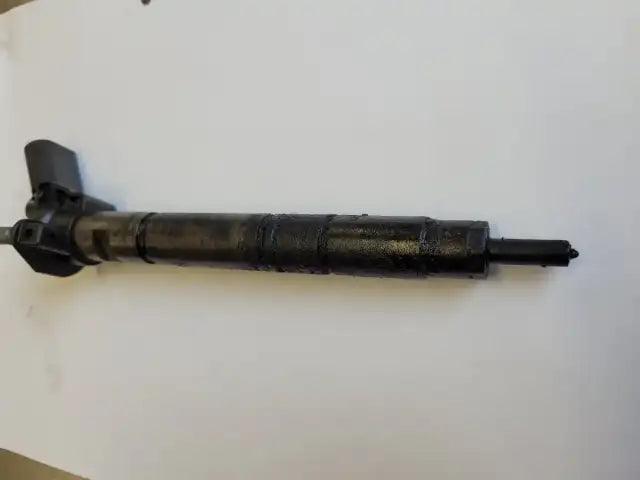
If the car starts jerking, losing power, smoking or struggling to start, very often the injectors are to blame. It's a big problem – but it doesn't always mean replacing the whole set for a couple of thousand euros straight away. In many cases the symptoms of faulty injectors are simply a signal that the fuel system is dirty and needs cleaning, rather than open-engine surgery. The worst thing you can do is pretend that “it'll go a bit longer”, because light contamination quickly turns into a serious failure.
Injectors work under very high pressure and at extreme temperatures. Their job is simple – to deliver a perfectly measured dose of fuel at the perfect moment. If they start leaking, over-delivering or sticking, the engine will show it immediately. That's why the symptoms of faulty injectors – whether diesel or petrol – are visible sooner than many drivers think. And that's exactly where you have to start – by recognising the signals.
Symptoms of faulty injectors – is it always a big problem?
Briefly: yes, if you ignore them. No, if you react early. The symptoms of faulty injectors don't always mean you have to buy new injectors. Often it's a stage of contamination, of fuel deposits, or the start of a problem with atomisation. And at that point it can still be stopped.
If you're dealing with slight jerking, a mild drop in power or slightly higher fuel consumption, very often professional cleaning is enough, before a decision about reconditioning is taken. In practice, mechanics first check the trims and the return-flow test, and only then decide whether the injectors are fit for cleaning or already for the test bench.
The problem begins when:
- the injectors are over-delivering fuel,
- the engine smokes black when accelerating,
- a distinct smell of fuel in the oil appears,
- the car goes into limp mode.
How do you recognise the first symptoms of injector damage in a diesel and in a petrol engine?
Most often it all starts innocently. The car starts less easily, especially on a warm engine. The revs fluctuate slightly. When you press the throttle you feel a momentary hesitation, as if the engine were deciding whether to accelerate. These are typical symptoms of faulty injectors in a diesel, but in a petrol engine it looks very similar.
In a diesel you'll more often see:
- black smoke when accelerating,
- a clear drop in power under load,
- the characteristic “clattering” under the bonnet.
In a petrol engine, the symptoms of faulty injectors are usually:
- misfires,
- the Check Engine light coming on,
- increased fuel consumption despite normal driving.
If you're starting to fill up more often than usual and you haven't changed your driving style, that's a signal that something in the fuel metering isn't working properly. And the injectors are the first suspects.
Symptoms of faulty injectors – what actually goes wrong?
An injector isn't a “magic nozzle”, but a precise mechanical-electrical component. Most often the problem is that:
- the injectors pour fuel instead of atomising it,
- they deliver too large a dose,
- they stick and don't open properly,
- their operating characteristics are disturbed.
In practice this means one thing – the air-fuel mixture stops being correct. And when the mixture is too rich or uneven between cylinders, the engine starts running roughly, smoking and losing efficiency.
In a diesel, over-delivering injectors show their symptoms very quickly – black smoke, a drop in power, higher fuel consumption. In a petrol engine you'll more often see mixture errors and rough running. In both cases, ignoring the problem leads to far more expensive consequences than cleaning or reconditioning alone.
That's why, when you hear terms like: faulty, wrecked, dead, leaking injectors – it's usually no exaggeration. They're simply different names for the same phenomenon: the injectors aren't delivering fuel the way they should. And the engine will always feel it.
Faulty injectors. What are the most common causes of failure?
Most often it isn't “defective parts” that are to blame, but the conditions in which the fuel system works. If you fill up with average-quality fuel, regularly drive on the reserve tank or put off changing the fuel filter, the injectors get exactly what they shouldn't – contamination, water and deposits. And those have no right to appear in a Common Rail system. A small amount of water in the fuel is enough for corrosion of the precision components to begin. A clogged filter is enough for the pressure to start fluctuating. And suddenly the symptoms of faulty diesel injectors appear, even though the injector itself isn't yet “mechanically dead”.
Very often the problem starts in a mundane way:
- constantly driving on the reserve tank,
- filling up at random places,
- no checking of the filters,
- long oil change intervals.
On top of that comes city use – short trips, an under-warmed engine, lots of soot and carbon build-up. In such conditions dirty injectors aren't an exception, but a consequence of the way the car is used. If the car additionally runs on LPG without proper calibration, the petrol injectors can wear out faster. This is the effect of neglect that accumulates over months, and then shows up suddenly – usually at the least convenient moment.
Symptoms of faulty injectors – is it a big problem, and when should you react immediately?
It depends on the stage. Not every symptom means a catastrophe, but every one is a warning signal. If the car has lost a little of its verve, fuel consumption has risen minimally, and the engine sometimes shudders slightly at idle – that's often the stage of light contamination. In such a situation you react calmly, but you don't put the subject off for six months. This is the moment when cleaning can still stop the problem from developing.
The situation looks different when clear jerking, hard starting, black smoke when you press the throttle and a distinct drop in power appear. That's already a signal that the injectors aren't working properly. The engine starts receiving uneven doses of fuel, and that means a greater load on the pistons, the turbo and the exhaust system. There's no room here for “I'll drive on and see”.
The worst case is when the car goes into limp mode, the power drops dramatically, loud knocking appears or smoke obscures the road. That's an acute state. Driving on can lead to damage to a piston, a clogged DPF or an overheated turbocharger. At that point you don't test the car's patience – you react at once. The higher the level of the symptoms, the greater the risk of costs running into the thousands of euros.
Symptoms of faulty injectors – how do you check for yourself whether it's the injectors?
Before you drive to a workshop, you can assess a few things yourself. This isn't about professional diagnostics, but about observing the car consciously. Note when the problem appears – on a cold engine, on a warm one, when accelerating or while driving under load. That already tells you a lot.
Check whether there is any smoking. If a black cloud appears under harder throttle, that's a signal that combustion is disturbed. If the car starts with difficulty when warm, that too may point to over-delivering injectors.
In a diesel you can carry out a simple return-flow test – a popular method using measuring cylinders connected to the fuel returns. If one cylinder gives back clearly more or less fuel than the others, that's a sign the injector isn't holding its parameters. It won't replace a test bench, but it gives a clear signal.
And then there's computer diagnostics. Even a basic reading of the injection quantity trims can show whether one cylinder stands out. If the trims are extreme, that's no longer guesswork, but a concrete fact. The engine is trying to compensate for the uneven operation of an injector.
Symptoms of faulty injectors – workshop diagnostics step by step
At a workshop it starts with specifics, not with guessing. First the injection quantity trims, the ECU fault codes and the rail pressure parameters are checked. That gives a picture of whether the problem is local or affects the whole fuel system.
Then comes the time for a professional return-flow test and – if necessary – removal of the injectors. On the test bench everything is visible: the quality of atomisation, sealing, the delivery characteristics, the response to control signals. There's no room for guesswork here.
If the injectors are dirty rather than mechanically damaged, cleaning without removal is often used – feeding the product directly onto the fuel rail. In such situations professional products are used, such as TEC 2000 Diesel Injector Cleaner, applied with a special piece of equipment. This makes it possible to free up seized tips and remove carbon deposits without taking the engine apart.
If, however, the problem concerns worn mechanical components, cleaning won't be enough. Then reconditioning or replacement comes into play. And that is precisely why diagnostics are crucial – so that you don't replace healthy parts and don't clean ones that are already worn out.
Symptoms of faulty injectors – when is cleaning enough, and when is reconditioning needed?
If the engine starts, runs reasonably steadily and the symptoms are moderate – cleaning is often enough. Light and moderate contamination, no serious fault codes, no mechanical damage – that's the ideal moment to try to restore correct parameters without dismantling the system.
In such cases professional products are used to free up and clean the tips, e.g. TEC 2000 Diesel Injector Cleaner, and in workshop conditions also the stronger version, TEC 2000 Diesel Injector Flush 2500 ml. That solution is particularly useful in larger units and fleets, where contamination can be intensive.
Reconditioning is needed when an injector doesn't hold its seal, has worn tips, a damaged solenoid or doesn't pass the tests on the test bench. Replacement, on the other hand, is a last resort – used in cases of serious mechanical damage. The financial difference is enormous, which is why it pays to react early. A couple of hundred euros for cleaning can save you an outlay of a few thousand on new components.
And that is exactly the heart of the matter. The symptoms of faulty injectors are not a death sentence. They're information. And it depends on your reaction whether it ends with prevention or with an expensive repair.
Symptoms of faulty injectors – how much do cleaning, reconditioning and replacement cost?
In the shortest terms? The difference between reacting fast and dragging your feet is often a couple of thousand euros. The symptoms of faulty injectors may end with a couple of hundred euros for cleaning, but if you ignore them, the bill grows exponentially. So before you decide on a replacement, it's worth knowing the realistic ranges.
|
Type of action |
Scope |
Approximate cost |
|
Computer diagnostics + return-flow test |
Reading fault codes, injection quantity trims, basic assessment of condition |
€35–70 |
|
Chemical cleaning (without removal) |
Cleaning with equipment, using a product |
€70–120 |
|
Reconditioning a CR injector (1 unit) |
Removal, cleaning, tip replacement, calibration |
€35–95 per unit + parts |
|
Reconditioning a full set (4 units) |
Full service for a typical passenger car |
€140–375 |
|
New / reconditioned injector |
Purchase of 1 unit |
€70–95 (cheaper aftermarket) to €350–470 per unit (branded) |
At first glance you can see that chemical cleaning is the cheapest scenario, especially when the problem is at an early stage. Professional injector cleaning – e.g. using a product fed directly onto the rail – often closes the subject before mechanical wear sets in.
Reconditioning is the next level of cost, but still far more sensible than buying new parts. In many cases full reconditioning of four injectors falls within the €235–470 range, whereas buying new components can exceed several times that amount.
The most expensive scenario? Replacing all the injectors with new, branded parts. In more advanced diesel units the cost can reach €1,400–1,900 for a set, and that isn't the end – add labour, adaptation and any coding.
And here the key difference appears. If you catch the symptoms of faulty injectors early and decide on diagnostics and cleaning, you'll often stop the problem at the level of a couple of hundred euros. If you ignore the smoking, the jerking and the rising fuel consumption, you may end up with a bill that hurts considerably more. Remember that the cheapest repair is the one done in time.


Leave a comment
This site is protected by hCaptcha and the hCaptcha Privacy Policy and Terms of Service apply.