
If your oil light has come on or the gauge is showing strange values, first check the oil level on the dipstick – that is the most common and the simplest cause. Correct oil pressure depends on the revs, the temperature and the specific engine, but simplifying: at idle it is usually about 1–2 bar, and at higher revs about 3–6 bar. A diesel usually holds slightly higher than a petrol engine. Below we explain which values are normal, where deviations up and down come from, how to check it yourself and when there is no point putting off a visit to the mechanic.
THE KEY POINT
With low oil pressure you do not drive "just to see". If the light is on with the engine warm, pull over and switch the engine off – driving on risks the engine seizing. The light only comes on at very low pressure (about 0.2–0.5 bar), so treat it as the last warning, not the first signal.
What does engine oil pressure do?
Oil in the engine does not only lubricate – it circulates under pressure, forming a thin film between parts that would otherwise rub metal on metal. That pressure is built up by the oil pump, and its upper limit is watched over by the pressure relief valve, which lets off the excess when the pressure rises too far.
The value is not constant – it rises with the revs and falls as the oil warms up (warm oil is thinner). That is why the pressure read straight after a cold start will be higher than on a warm engine at idle. That is normal and nothing to worry about.
What should engine oil pressure be?
The most honest answer is: as stated by the manufacturer in the service book. The specific engine, the oil viscosity and its temperature can change the reading considerably. There is, however, a simple rule of thumb that mechanics use:
RULE OF THUMB
The rule of thumb: a minimum of about 10 psi (≈0.7 bar) of pressure for every 1,000 rpm, on a warm engine. That is the lower safety limit, not a target value.
In practice, to work out whether you are within the norm, the ranges below help. Remember that this is a guide – not rigid values for every car.
Correct oil pressure – petrol engine (table)
|
Operating state |
Approximate range |
Notes |
|
Idle (warm) |
approx. 1–2 bar |
Some engines drop to ~0.7 bar and that can still be normal |
|
Mid revs (approx. 2,000–3,000) |
approx. 2.5–4 bar |
The most commonly seen working range |
|
High revs |
approx. 3.5–6 bar |
The upper limit is cut off by the relief valve anyway |
|
Cold start |
higher than when warm |
Thick oil = temporarily higher pressure |
Correct oil pressure – diesel engine (table)
|
Operating state |
Approximate range |
Notes |
|
Idle (warm) |
approx. 2–4.5 bar |
A diesel usually holds higher than a petrol engine |
|
Mid revs |
approx. 4–5 bar |
Depending on the design and the oil viscosity |
|
High revs |
approx. 5–7 bar |
Limited by the relief valve |
|
Cold start |
higher than when warm |
A brief rise is a normal phenomenon |
If your values are close to these ranges and the light is not on, it is most likely fine. Only clear deviations or an illuminated oil light should give cause for concern.
How do you check engine oil pressure?
A home check is within reach of most drivers, although an accurate measurement requires a pressure gauge. In order:
step by step
- start with the dipstick – check the oil level on a cold, evenly parked car and, if it is low, top up with oil of the correct viscosity,
- watch the oil light: if it goes out after the ignition comes on and does not return, that is a good sign,
- for an accurate measurement, connect a gauge in place of the oil pressure sensor – read the value at idle and at about 2,000–3,000 rpm,
- compare the result with the service book or with the rule of 10 psi per 1,000 rpm.
What not to do yourself: do not ignore an illuminated light in the hope that "it will sort itself out". If you have neither a gauge nor the experience, it is better to have the measurement and the diagnosis done by a mechanic – it is a cheap job compared with repairing a seized engine.
Oil pressure too high – symptoms and causes
Excessively high pressure occurs more rarely and more often in older cars. The most typical symptoms are a permanently illuminated light, oil leaks from the seals and, in extreme cases, the system losing its seal.
The most common causes:
causes
- too much oil in the system – the most common and the simplest, for example overfilling at an oil change or topping up old oil,
- in diesels: dilution of the oil with fuel during frequent DPF regeneration, which raises the level and the pressure,
- a blocked oil filter – dirt restricts the flow and pushes the pressure up,
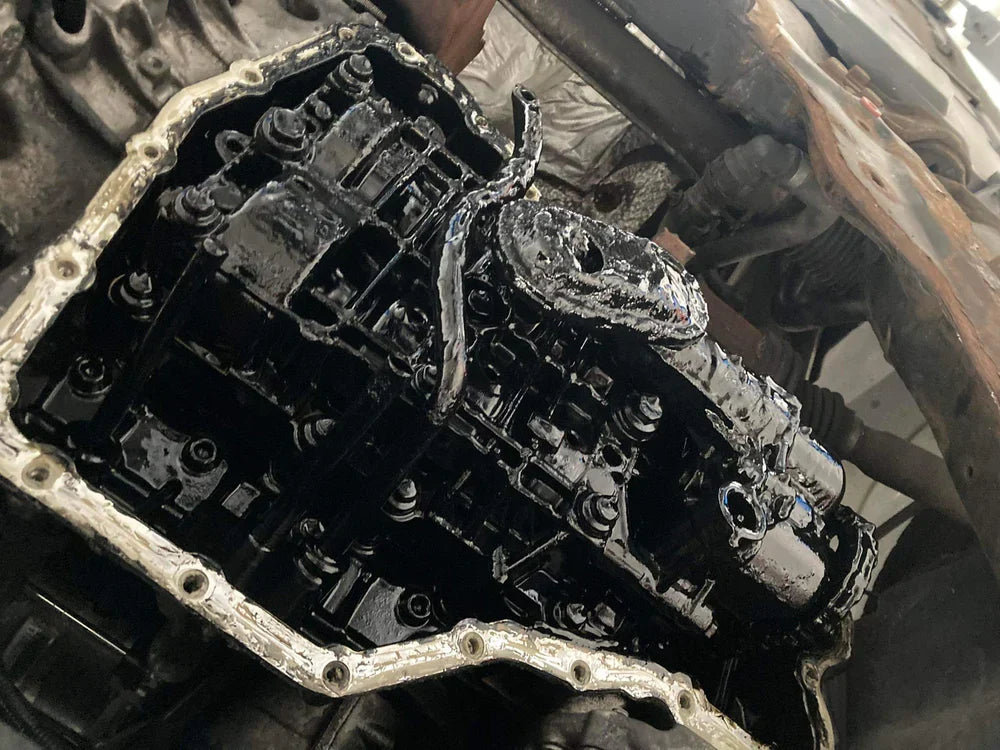
- blocked oil galleries – deposits and carbon build-up narrow the flow path,
- a seized relief valve – it does not let off the excess pressure.
Is it a big problem? Usually smaller than pressure that is too low, but it must not be taken lightly – sustained high pressure pushes oil out through the gaskets and the oil seals. How do you reduce it? First check and correct the oil level, fit the correct filter, and if that does not help – have the relief valve and the patency of the oil galleries diagnosed by a mechanic.
Oil pressure too low – symptoms and causes
This is the more dangerous scenario. The symptoms: an illuminated oil light, louder, "metallic" engine running, knocking, sometimes a rise in temperature. There is no room for delay here.
The most common causes:
- too low an oil level – loss through burning or a leak; check this first,
- a worn oil pump – it does not produce the right pressure,
- worn bearing shells (crankshaft) – the clearances increase oil leakage; this is the most serious of the faults,
- a faulty oil pressure sensor – the problem is then "apparent", it shows an incorrect value,
- a blocked pick-up strainer / suction gallery in the sump, restricting the oil supply to the pump,
- oil that is too thin or diluted with fuel.
Can you drive like that? No. Low pressure means the oil film is breaking down and the metal parts are starting to rub against each other. That is a straight road to the engine seizing. How do you raise it? If the cause is a low level – top up the oil. If it is the pump, the bearing shells or the galleries – a mechanical repair is necessary, because no additive will replace the replacement of a worn part.
How do you prevent oil pressure problems?
Most of the trouble can be avoided with ordinary prevention: regular oil and filter changes, keeping an eye on the correct viscosity and level, and reacting to the first symptoms. It is also worth keeping the oil system clean – because it is precisely deposits and carbon build-up in the galleries that can disturb the oil flow over time.
Here we come back to one of the causes of high pressure – partially blocked oil galleries. TEC 2000 Engine Flush can help; it is used before an oil change to dissolve and flush deposits out of the inside of the engine, including the oil ways. It is a preventive treatment: it will not repair a worn pump or bearing shells, but it helps keep the system clean and reduce the risk of deposits starting to choke the oil flow.
After the oil change, the oil’s work can be supported with the TEC 2000 Oil Booster additive – used with fresh oil, it helps limit oil consumption and supports the stable performance of the lubricant, especially with urban driving and higher mileage. If you are battling with oil loss, take a look as well at the posts on how to reduce engine oil consumption and why an engine burns oil.
FAQ
What should oil pressure be at idle?
As a guide, about 1–2 bar on a warm petrol engine and about 2–4.5 bar in a diesel. Some engines drop lower and that is still within the norm. What is binding is the value from the service book and whether the light is off.
What does low oil pressure mean?
Most often a low oil level, but also a worn pump, worn bearing shells or a faulty sensor. Because the light only comes on at very low pressure, take it seriously and stop the car.
What causes oil pressure that is too high?
Usually an excess of oil in the system, a blocked filter, blocked oil galleries or a seized relief valve. In diesels it can be dilution of the oil with fuel during DPF regeneration.
Can you drive with low oil pressure?
No. It is a straight road to the engine seizing. With the light on and the engine warm, you should pull over and switch the engine off.
How do you check oil pressure?
Start with the oil level on the dipstick. For an accurate measurement, a gauge is connected in place of the pressure sensor – the reading is taken at idle and at about 2,000–3,000 rpm, and the result is compared with the manufacturer’s specification.
Does the oil filter affect oil pressure?
Yes. A blocked filter restricts the flow and can push the pressure up; some filters have a bypass valve which, when the filter clogs, lets the oil through bypassing the element. That is why the filter is replaced at every oil change.
Will an oil additive raise the pressure?
An additive will not replace the repair of a worn pump, bearing shells or seals. It works preventively – it helps keep the system clean and supports the work of the oil. If the pressure is dropping because of worn parts, a mechanical repair is needed.
Is too much oil harmful?
Yes. Overfilling raises the pressure and puts a strain on the seals, and it can also lead to the oil foaming. After overfilling, the excess should be drained down to the correct level.


Leave a comment
This site is protected by hCaptcha and the hCaptcha Privacy Policy and Terms of Service apply.