
On the face of it everything works normally, but the car starts losing power, is harder to start or jerks strangely – and that's usually exactly when a problem begins that can't be seen with the naked eye.
In practice it very often comes down to something mundane, but at the same time dangerous – water in the fuel, which slowly upsets the operation of the whole system. And what's worse, most drivers only catch on once the first more serious symptoms appear, or… the workshop bill. If you have the impression that “something isn't right”, but you don't quite know what – this subject concerns exactly your car.
Where does water in the fuel come from and why does it go straight into the fuel system?
Water in the fuel appears mainly through the condensation of moisture in the tank and through contaminated fuel, and very quickly finds its way into the whole fuel system.
The most common sources of the problem are:
- the condensation of water vapour with temperature changes – especially in winter and in the transitional seasons,
- filling up with fuel of poor quality or stored in poor conditions,
- leaks in the fuel filler or in the venting system,
- the presence of biocomponents and fuels of the E10 type, which absorb moisture more easily,
- frequent driving over short distances and long periods with the car standing.
In practice it looks like this: water settles on the walls of the tank, runs down to the bottom and starts accumulating, because it is heavier than fuel. The problem builds up slowly, without spectacular symptoms – until the moment the pump starts drawing water in together with the fuel.
That's when the real consequences begin: disturbances in combustion, drops in power and the first overloading of the injectors. And what's important – this isn't a one-off situation. If you don't react, the process will only deepen.
Water in the fuel tank – the invisible enemy that gathers for years and strikes suddenly
Water in the fuel tank can accumulate for months, or even years, before it clearly makes itself known.
The most important facts, which are often forgotten:
- the tank is never 100% sealed – air always gets into it,
- the less fuel there is in the tank, the more room there is for moisture and condensation,
- water sinks to the bottom, so for a long time it gives no symptoms,
- when the fuel level is low it goes directly into the pump and on into the system,
- modern injection systems are exceptionally sensitive to even small amounts of water.
That's why many drivers say: “the car suddenly started going haywire after filling up” – even though in reality the problem had been building up much earlier.
At a certain point a situation arises in which instead of clean fuel, a mixture of fuel and water reaches the system. The result? Rough running, no response to the throttle, and sometimes even the engine stalling.
And that is precisely why ignoring a low fuel level, or occasionally filling up “for €10", is one of the simplest ways to create a problem for yourself.
Symptoms of water in the fuel filter and in the fuel system – these signals appear sooner than you think
The symptoms of the presence of water in the fuel system are fairly characteristic, but they are easy to confuse with other faults.
Most often you'll notice:
- starting problems, especially in the morning or after the car has been standing,
- rough engine running at idle,
- jerking when accelerating,
- a drop in power and the car feeling “bogged down”,
- increased fuel consumption,
- the engine stalling occasionally.
In a diesel there are additional signals on top of that:
- the fuel filter clogging faster,
- louder, harsher running of the power unit,
- going into limp mode,
- messages about a problem with the fuel system.
In practice it looks like this: the engine starts running unstably, because water doesn't take part in combustion, it merely disturbs the proportions of the mixture.
And here an important thing appears – many people replace the spark plugs and coils or look for the problem in the electronics, while the real cause sits in the fuel. The effect: you lose time and money, and the problem comes back.
Water in the fuel filter and the warning light – what does the signal mean and why can't you ignore it?
The water-in-fuel-filter warning light means that the sensor has detected its presence and the fuel system requires an immediate reaction.
The most important information:
- it concerns mainly diesel engines with a filter with a water separator,
- it means that the water has reached a level that may damage the system,
- ignoring the light increases the risk of failure of the pump and the injectors,
- it is often accompanied by a drop in power or rough engine running,
- in extreme cases the car goes into limp mode.
If you react quickly – it most often ends with draining the water and replacing the filter. If you don't – the costs begin. Common rail injectors and high-pressure pumps are repairs counted in thousands of euros.
That's why such a warning light isn't a “for later” warning, but a signal: act now, before you damage the system.
Water in diesel fuel – why does a diesel react faster and more noticeably?
Diesel engines react to the presence of water considerably faster, because their fuel system works under high pressure and requires perfect precision.
The most important reasons:
- common rail systems work under a pressure of as much as 2,000 bar and more,
- injectors have microscopic tolerances,
- the fuel performs a lubricating function – and water doesn't perform that function,
- the presence of water causes a loss of the lubricating film and accelerated wear of the components,
- even a small amount of moisture can disturb the atomisation of the fuel.
A diesel “shows straight away” that something isn't right – it starts running more loudly, loses its refinement and responds more quickly with a drop in power.
If the problem persists, seizing of the pump's components and damage to the injectors occur, and those are no longer minor faults.
That is precisely why additives are used in diesels which bind water and remove it from the whole fuel system, improving combustion and stabilising the engine's operation.
Symptoms of water in petrol – the engine starts misfiring and losing its rhythm before it refuses to cooperate altogether
The symptoms of water in petrol most often begin with rough engine running and a clear deterioration in combustion.
Pay particular attention to:
- jerking when accelerating, which appears suddenly and for no clear reason,
- noticeable “holes” in the power – you press the throttle and the car responds with a delay,
- problems starting, especially after the car has been standing,
- misfires and the characteristic engine “hiccups”,
- greater fuel consumption, even though your driving style hasn't changed.
This is no accident. Water reaching the combustion chamber doesn't take part in the combustion process, so it disturbs the engine's whole working cycle. The result? The air-fuel mixture stops being stable, and the power unit starts running unevenly.
And here comes a moment that is easy to miss. At the beginning the symptoms are occasional – it jerks once, then it doesn't. Later they start recurring. Until finally you reach the point at which the car can't be used normally.
So if you notice such behaviour, don't put the subject off. It isn't “the engine having a bad day”, but a signal that something has appeared in the system that shouldn't be there.
How do you check whether you have water in the fuel system – a few simple signals you can catch yourself
The presence of water in the fuel system can be provisionally recognised from the symptoms and from a few simple diagnostic steps.
The most commonly used methods are:
- observing how the car behaves after filling up – if the problems appeared suddenly, that's an important lead,
- checking the fuel filter – in many cars you can check whether water has collected in it,
- draining a fuel sample – the water separates and forms a distinct layer at the bottom,
- the response of the fuel system warning light in a diesel,
- assessing the engine's operation – rough running, drops in power, difficult starting.
You don't need advanced diagnostics straight away. In many cases the first signals are very clear, you just have to put them together.
And this is exactly where many people make a mistake – they ignore the symptoms or look for the problem elsewhere. Replacing spark plugs, coils, electronic diagnostics… and the problem still comes back.
Meanwhile a quick check of the fuel can point straight to the source of the problem. A few minutes can save a couple of thousand euros.
How do you drain water from the fuel filter, and when does such an operation stop being enough?
Draining water from the fuel filter only helps when the problem is still at an early stage and hasn't affected the whole system.
The basic steps look like this:
- locating the fuel filter – in a diesel it often has a special drain plug,
- unscrewing the valve and draining the contaminated liquid,
- checking whether a separated layer of water appears,
- replacing the filter with a new one if necessary,
- checking the engine's operation after the procedure.
It sounds simple – and in many cases it really is. The problem begins when the water has already made its way further – into the lines, the pump and the injectors.
Then draining the filter alone doesn't solve the matter. The car may still jerk, lose power or have trouble starting.
And this is where the second part of the action comes in – if you don't want to take the whole system apart, you need a solution that reaches all the components and removes moisture from the entire installation, and not just from one place.
Removing water from petrol and diesel – when do additives work, and when is mechanical work needed?
Removing water from fuel with additives works effectively when there is a small or moderate amount of moisture in the system.
In such situations the products:
- bind the water molecules and allow them to be burned safely,
- dry out the fuel lines, the filter and the tank,
- improve the quality of combustion and stabilise the engine's operation,
- limit the risk of corrosion and damage to the system's components,
- support correct fuel atomisation.
This solution makes sense particularly when the symptoms are only just appearing and aren't yet severe.
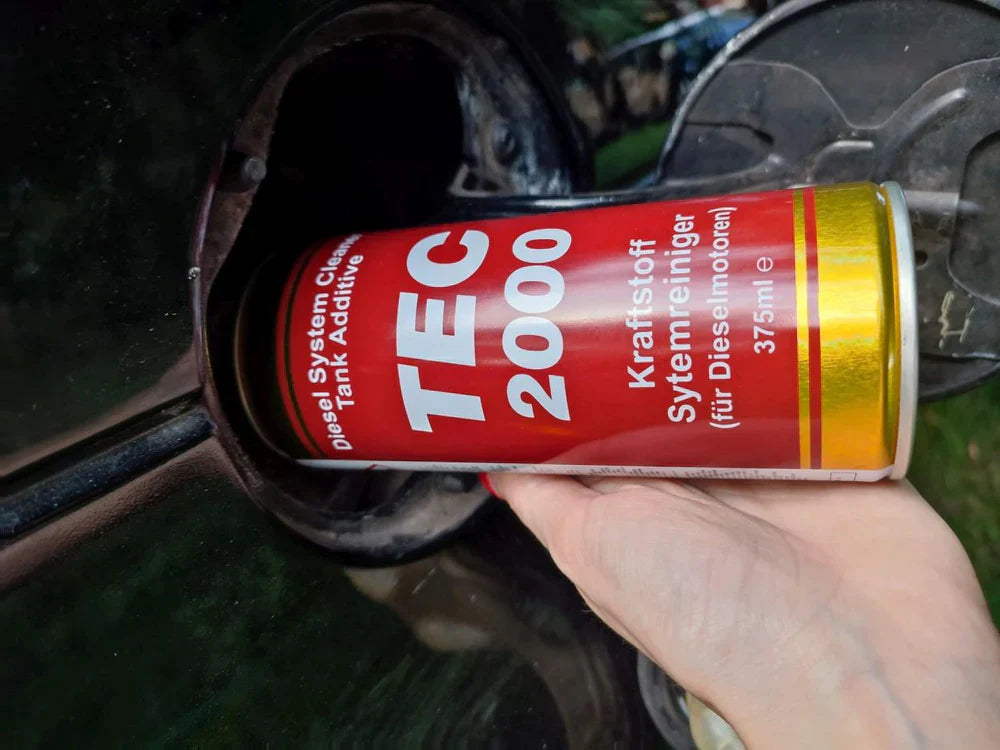
An example is TEC 2000 Fuel System Cleaner, which in petrol engines removes moisture from the whole fuel system and at the same time cleans the injectors, improving combustion and the engine's operation.
In a diesel it works similarly, but is even more important – because the system is more sensitive. TEC 2000 Diesel System Cleaner binds water and removes it from the whole fuel system, while at the same time improving the operation of the injectors and reducing smoking.
If, however, there is a lot of water – then mechanical intervention can't be avoided. And there are no shortcuts here.
A product for removing water from diesel – when is it worth reaching for a solution that works throughout the system?
A product for removing water from diesel makes sense when you want to get rid of moisture not only from the tank, but from the whole fuel system.
A good solution should:
- reach the injectors, the pump and the lines,
- bind water and remove it while the engine is running,
- improve combustion and limit rough running,
- protect the system's components against wear,
- work without having to take the installation apart.
And that is precisely why drivers reach for additives that work “while you drive”. You don't stop the car, you don't take the system apart – you simply pour the product in and let it work.
TEC 2000 Diesel System Cleaner starts working from the very first kilometres – it removes water, improves fuel atomisation and restores stable engine running, which has a direct impact on power and on the refinement of the drive.
FAQ
Can you drive with water in the fuel?
You can cover a short distance, but driving on increases the risk of damage to the injectors and the fuel pump. If the engine starts stalling or clearly losing power, it's better to stop the car and deal with the problem at once.
How do you remove water from fuel quickly?
The fastest solution with a small amount of moisture is to use a fuel additive that binds the water and allows it to be burned safely in the engine. With greater contamination, cleaning the system at a workshop will be necessary.
Does water in the fuel always mean a serious failure?
Not always, but ignoring the problem almost always leads to one. At the beginning it ends with rough engine running; later, damage to expensive components of the fuel system can occur.
How do you know it's water in the fuel and not another fault?
It is most often indicated by a sudden deterioration in the engine's operation after filling up, starting problems and jerking when accelerating. In a diesel an additional signal is sometimes the water-in-fuel-filter warning light.
Does adding more fuel remove water from the tank?
No. Adding fuel merely dilutes the problem, but doesn't remove the water, which sinks to the bottom of the tank anyway and finds its way into the fuel system.
How often does water appear in fuel?
The phenomenon is fairly common, especially in winter and with large temperature swings. Even a fully serviceable car can gather moisture in the tank through the condensation of water vapour.
Do fuel additives really work?
Yes, provided they are used as intended. The products bind water, remove moisture from the system and improve combustion, which has a real effect on the engine's operation.
Can water in the fuel damage the injectors?
Yes, because water doesn't lubricate the components of the fuel system. As a result, increased friction and accelerated wear occur, and in extreme cases the injectors or the pump seize.


Leave a comment
This site is protected by hCaptcha and the hCaptcha Privacy Policy and Terms of Service apply.