
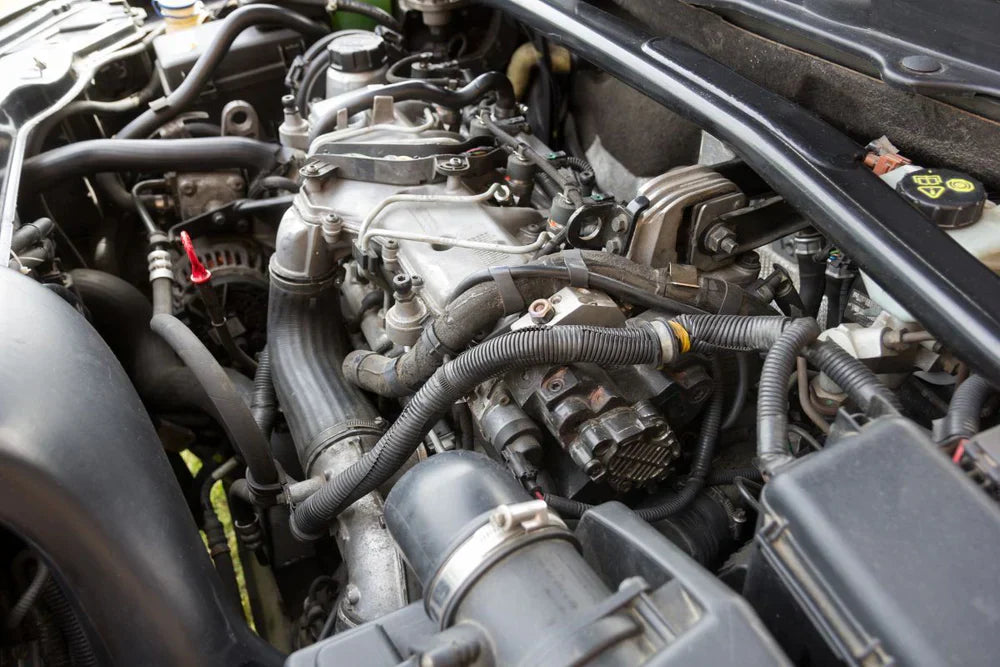
A diesel that suddenly starts accelerating poorly does not always mean a damaged turbocharger or an expensive rebuild straight away. In many cases the problem begins much more "down to earth" – with dirty injectors, a blocked fuel filter, a leaking intake or a DPF that has not been able to regenerate properly for some time. The symptoms tend to be similar: the car becomes sluggish, responds worse to the throttle, loses its urge when overtaking or going uphill, and sometimes starts smoking and using more fuel on top of that.
One thing matters most – do not start the diagnosis by replacing the most expensive parts. Very often drivers are told straight away "the turbo needs reconditioning", even though the problem turns out to be a fuel filter worth a couple of dozen euros, a cracked vacuum hose or a dirty fuel system. On the other hand, ignoring the symptoms can also end up being expensive, because driving with a blocked DPF or badly working injectors can overload the turbocharger, raise exhaust temperatures and lead to further faults.
Symptoms – how do you know your diesel is losing power?
It usually starts with the fact that the car stops responding to the throttle the way it used to. The diesel still drives, still starts and "everything supposedly works", but when overtaking you have to press the accelerator harder, the car picks up worse from low revs or clearly weakens under load. You feel it particularly well when driving uphill, with a full load of passengers or at higher speeds.
The most typical symptoms look like this:
- weaker acceleration,
- delayed response to the throttle,
- no urge when overtaking,
- problems driving uphill,
- uneven engine running and vibrations,
- higher fuel consumption,
- limp mode and restricted revs,
- smoke from the exhaust,
- louder engine running or a turbo whistle.
The colour of the exhaust gases also tells you a lot.
- Black smoke usually suggests a problem with burning the mixture – the engine is getting too much fuel relative to air, or the exhaust system cannot cope with getting the gases away. Such a symptom often appears with problems in the intake, the EGR, the turbocharger or with dirty injectors.
- White or grey smoke, on the other hand, more often points the diagnosis towards the fuel, combustion temperatures or mechanical problems.
In modern diesels some of the symptoms can be heavily masked by the DPF. The car may lose power and go into limp mode, even though practically no smoke is visible from the exhaust. VERT technical guidance emphasises that with cars fitted with a DPF, simply observing the exhaust gases is often not enough, and back-pressure measurements along with diagnostics of the engine running parameters are needed.
Causes – why does a diesel have no power?
A diesel loses power when the engine is not getting the right amount of fuel or air, or cannot get the exhaust gases away freely. It sounds simple, but there really can be a lot of sources of the problem – from a dirty air filter through to poor compression and a damaged turbocharger.
The most common causes of a loss of power are:
- dirty injectors,
- a blocked fuel filter,
- water or deposits in the fuel,
- a leaking intake,
- a damaged turbocharger,
- a problem with the mass air flow sensor or the MAP sensor,
- a blocked DPF,
- a stuck EGR,
- poor engine compression,
- ECU faults or limp mode.
In a diesel engine even small amounts of dirt can badly disturb combustion. Pearson Higher Education, in a paper on diesel diagnostics, points out that the efficiency of the engine depends on very precise fuel metering and the right amount of air. If the injectors start delivering fuel unevenly or the intake loses its seal, performance can drop faster than many drivers expect.
Very often the problems also start with the quality of the fuel. Bosch, in its materials on common rail systems, indicates that water and contaminants in diesel fuel are among the most common causes of corrosion and of problems with injector operation. The symptoms then tend to be fairly characteristic:
- uneven engine running,
- harder starting,
- harsh diesel running,
- smoking under load,
- clearly weaker acceleration.
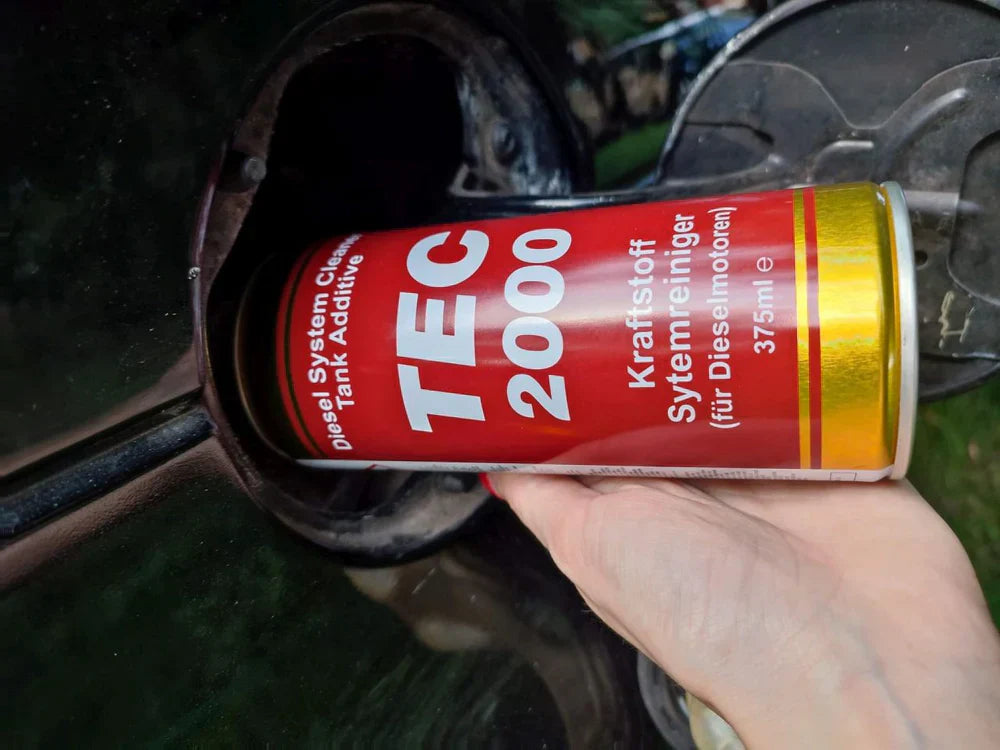
In such situations some drivers start with cleaning the fuel system. Products such as TEC 2000 Diesel Injector Cleaner or TEC 2000 Diesel System Cleaner are used as support with dirty injectors, deposits and problems with fuel quality. You do, however, have to separate dirt from mechanical failure – a cleaning agent will not repair a damaged injector, a cracked turbocharger or a worn high-pressure pump.
Injectors and fuel – can a dirty fuel system really slow a diesel down that much?
Yes – and it often happens gradually. A diesel can drive "more or less normally" for a long time, even though the injectors are no longer atomising the fuel properly. The driver first notices a slight loss of urge, later higher fuel consumption, and only after a while do vibrations, smoking or starting problems join in.
The symptoms of dirty injectors and fuel problems often include:
- jerking under acceleration,
- uneven running at idle,
- black smoke under load,
- a sluggish response to the throttle,
- harder cold starting,
- louder engine running.
Quite a few problems are also caused by deposits building up throughout the fuel system. If the car is driven mainly around town, is filled up at random places or runs on the same fuel filter for a long time, the common rail system starts coping worse and worse with precise fuel metering. And a diesel very strongly "feels" even small deviations in combustion parameters.
When dirt is suspected, some drivers use TEC 2000 injector cleaning products as part of preventive maintenance or as support for the diagnosis. TEC 2000 Diesel Injector Cleaner is intended for directly cleaning the injectors and removing deposits that affect fuel atomisation, whereas TEC 2000 Diesel System Cleaner is used more broadly – with contamination of the entire fuel system, water and deposits in the fuel.
If, however, the following appear:
- very large injection quantity trims,
- metal filings in the fuel system,
- problems with fuel pressure,
- heavy smoking and limp mode,
an additive alone will not be enough. Full diagnostics of back-leakage, rail pressure and the condition of the injectors are then needed.
Air, intake and turbo – why does a diesel without boost immediately lose its character?
A diesel needs a large amount of air to burn fuel efficiently. When the airflow is restricted or the turbocharger stops building pressure properly, the car instantly becomes sluggish. Very often the driver then describes it as "a slug", "turbo lag" or the impression that the car has suddenly become much heavier.
The most common problems in this area are:
- a blocked air filter,
- a leaking intake,
- a cracked intercooler pipe,
- vacuum leaks,
- sticking variable turbo geometry,
- a faulty MAF sensor,
- incorrect boost pressure.
The symptoms tend to be very characteristic. The car accelerates poorly from lower revs, a delayed response to the throttle appears, sometimes there is a whistle or a shriek from the turbo, and under heavier load the car may go into limp mode. In many cases the problem becomes worse precisely when overtaking or driving uphill.
Cummins, in its diagnostic materials on turbochargers, points out that similar symptoms can also be caused by other components in the system – which is why simply saying "the turbo is not working" is not enough. Very often the culprit turns out to be:
- a leaking intake pipe,
- a problem with the vacuum system,
- a dirty intake,
- restricted exhaust flow through the DPF.
It is worth starting with the simple things. An air filter for €7–35 can make an enormous difference if it has been badly neglected. The same goes for the intake pipes and clips – sometimes a small leak causes a clear drop in performance, and the driver immediately starts suspecting turbo reconditioning costing more than €260–350.
DPF, EGR and the exhaust – can a blocked filter take away a diesel's power?
Yes – and very effectively. A blocked DPF increases exhaust back-pressure, which means the engine starts to "choke" under load. The symptoms often appear gradually: first a slight weakening, later more frequent DPF regeneration, higher fuel consumption, and finally limp mode and a clear restriction of power.
The most common signs of problems with the DPF or the EGR:
- no power at higher revs,
- frequent attempts at filter regeneration,
- a rise in fuel consumption,
- limp mode,
- a DPF message,
- fans running after the car has been switched off,
- jerking or uneven diesel running.
Many drivers ignore the first symptoms, because the car still "somehow drives". The problem is that an overloaded DPF also affects the turbocharger. Melett, in its materials on turbo failures, emphasises that excessive back-pressure and problems with exhaust flow can cause turbo lag, overboost or damage to the variable geometry.
The way the car is used matters a great deal. A diesel used exclusively on short journeys often does not have the conditions for the DPF to regenerate properly. Soot starts to build up faster and faster, and the filter gradually loses its flow capacity. The Motor Ombudsman points out that a particulate filter usually regenerates itself, but with town driving and interrupted regenerations it may need cleaning or further diagnostics.
The costs can vary a great deal:
- cleaning the DPF – usually around €95–425,
- a new DPF – often €470–1,880 and more.
That is why quick diagnostics really do matter.
Diagnostics – what to check first, before you replace the turbo or the injectors?
The biggest mistake? Starting with the most expensive parts without checking the basics. A lack of power in a diesel can be caused both by a dirty fuel filter worth a couple of dozen euros and by a serious compression problem. Without good diagnostics it is very easy to spend a couple of thousand euros and still not solve the problem.
A good order of checks looks like this:
- reading OBD fault codes,
- checking the fuel and air filters,
- checking that the intake is sealed,
- checking the vacuum hoses,
- analysing the live data parameters,
- measuring the boost pressure,
- DPF and EGR diagnostics,
- an injector back-leakage test,
- a compression test.
Simply observing when the symptoms occur already gives you a great deal of information. If the car only loses power under load, suspicion often falls on the turbo, the DPF or the intake. If the problem appeared after filling up, it is worth starting with the fuel quality and the fuel system. When a diesel runs unevenly when cold and starts with difficulty, the injectors or the compression have to be taken into account.
Modern diesels also require you to look at parameters, not only "by ear". The DPF can effectively mask smoking, so an absence of black smoke does not mean at all that the system is working properly. VERT technical guidance clearly emphasises the importance of back-pressure measurements and diagnostic data rather than a purely visual assessment of the exhaust gases.
In many cases the cheapest part of the whole repair turns out to be good diagnostics. A computer check of the live data for around €25–70 can save you an unnecessary turbo rebuild, a DPF replacement or expensive experiments with parts.
FAQ
Why does a diesel have no power when accelerating?
Most often because of a problem with the fuel, the boost, the intake or the exhaust flow. It is worth checking the turbo, the DPF, the filters and the injectors.
Can a blocked DPF restrict engine power?
Yes. Increased exhaust back-pressure very often causes limp mode and a clear drop in performance.
Do dirty injectors cause a lack of power?
Yes. Incorrect fuel atomisation makes combustion worse, which means the diesel accelerates more weakly and may smoke.
The diesel is smoking black and has no power – what does that mean?
Most often a problem with burning the air-fuel mixture. Suspicion usually falls on the turbo, the intake, the EGR, the DPF or the injectors.
Can you drive a diesel that has no power?
Only carefully and for a short time. If limp mode, smoking or a loud turbo appear, it is better to limit driving to getting to a workshop.
How much does it cost to repair a lack of power in a diesel?
From a couple of dozen euros for filters up to a couple of thousand euros with the DPF, the turbocharger, the injectors or mechanical problems.
Does limp mode always mean a damaged turbocharger?
No. The reason can also be the DPF, the EGR, sensors, the intake, fuel pressure or ECU faults.
Can a diesel additive help restore power?
Yes, if the problem stems from contamination of the fuel system or from deposits. It will not, however, replace a mechanical repair of damaged components.


Leave a comment
This site is protected by hCaptcha and the hCaptcha Privacy Policy and Terms of Service apply.