

B0 fuel is pure diesel with no added biocomponents (FAME) – the kind we used to fill up with before 2009, when the EU imposed mandatory blending. It is valued for its stability, its resistance to moisture and its better behaviour in winter and during long periods of standing. The problem is that it is poorly available – the biocomponent regulations mean that most stations dispense B7, while B0 turns up only occasionally and usually costs about €0.05–0.12 per litre more. Below we explain what exactly it is, who it pays off for and where you can realistically find it.
The key point in one sentence: B0 is not "better for everyone" – it mainly makes sense with older diesels, cars used seasonally and long-term fuel storage. For everyday use, with regular driving, standard B7 is perfectly sufficient.
B0 diesel – what exactly is it?
B0 fuel is diesel that is 100% of fossil origin – with no fatty acid methyl esters (FAME), in other words with no bio-additives. The letter "B" in the designation refers to biocomponents, and the number says how much of them there is. Hence B0 means zero per cent biodiesel, and B7 – up to 7%. It is precisely this difference that decides everything: how the fuel behaves in the frost, how long it can be stored and how it acts on the injection system.
Before EU regulations requiring biocomponent blending came into force in 2009, B0 was simply "diesel" – the standard at every station. Today it is the other way round: B7 is the standard, and pure diesel has become a niche product. Interestingly, B0 even differs in appearance – it tends to be lighter, more transparent, slightly bluish, while B7 and B10 are usually cloudier and more yellowish. If you want to go through all the diesel variants, we have gathered them in a separate post on the types of diesel fuel: B7, B10 and XTL.
Why is B0 fuel so hard to get?
The main reason for the poor availability of B0 is the biofuels legislation. Fuel producers and importers are obliged to meet the so-called National Indicative Target (NCW) – they have to place a set share of biocomponents on the market. The easiest way for them to meet that target is by selling B7 across the board. Pure B0 does not help with that, so it reaches the offer more rarely, in smaller volumes and usually at a higher price.
It works out so that you cannot just pull into the nearest station and ask for "zero-grade". There have been periods when wholesalers said outright that B0 had not been on sale for several weeks and that they could not obtain it. Availability is therefore variable and seasonal – sometimes it is there, sometimes it disappears. On top of that there is lower demand: a fair share of drivers have no idea that such a fuel exists, so many sellers see no point in stocking it.
There is also a formal catch. Even when a station dispenses fuel that is practically free of biocomponents, it sometimes labels it as B7 – to protect itself against the consequences of any trace blending. That is why "pure B0" is most effectively hunted down today not by the name of the chain, but through apps and station maps (Google Maps, Waze), forums and a simple phone call to a specific station asking about current availability.
How does B0 fuel affect the engine?
In short: B0 burns "cleaner" and puts less strain on the fuel system, because it contains no biocomponents, which absorb water and age faster. Drivers who switch to pure diesel most often notice that the engine runs more smoothly and is less prone to injection problems – especially in older designs.
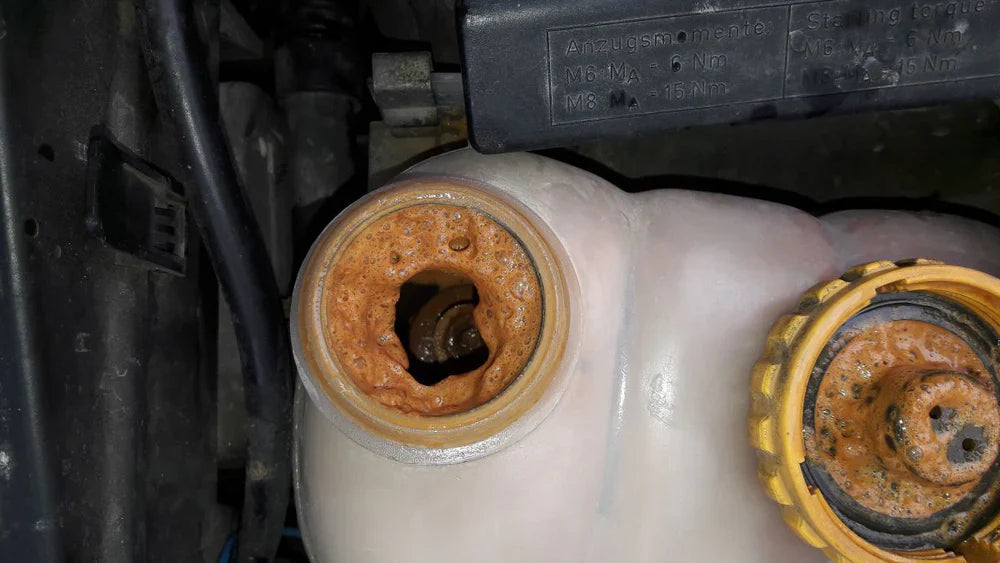
The weak point of biocomponents is their hygroscopic nature – FAME binds water more readily, and water in the fuel is a straight road to corrosion, microorganism growth and deposits in the tank. In modern common rail systems, where pressures reach as much as 2,000 bar and working clearances are measured in micrometres, every impurity matters. We write more about where the deposits come from and why a modern diesel "breaks down by itself" in a separate post.
The difference between B0 and a good quality B7 is not spectacular and you will rarely feel it "straight away". It is a long-distance effect – less water in the system, more stable fuel while the car stands, a lower risk of corrosion. If you drive every day and use up fuel quickly, a well-chosen additive for B7 can offset most of these differences – without hunting for B0.
Why choose B0? The advantages of pure diesel
Pure diesel has several concrete advantages, which show up most clearly in specific operating conditions.
- Better resistance to frost and clouding – without FAME, the fuel drops out wax less readily and behaves more reliably at sub-zero temperatures.
- Stability in long-term storage – B0 can be kept for as long as about 2 years, which is why it is also held as a strategic reserve; B7 ages considerably faster.
- Less tendency to bind water – the absence of hygroscopic biocomponents means a lower risk of corrosion and microorganism growth in the tank.
- Cleaner combustion and fewer deposits – fuel closer to its "original" form puts less strain on the injectors and the fuel filter.
- More reliable starting in winter and efficiency on long routes – hence the popularity of B0 in transport and agriculture.
These properties mean that B0 is readily chosen wherever the fuel has to "wait" in a tank or a container: in agricultural machinery, seasonal equipment and occasionally used cars. If you are wondering more broadly which fuel to put in – B0 or B7 – we break it down into its component parts in a dedicated comparison.
Does B0 have drawbacks and contraindications?
Yes – and it is worth knowing them before you start hunting for pure diesel at all costs. The biggest "drawback" of B0 is simply its availability: you have to look for it, ask around and accept that sometimes it will be there and sometimes not. On top of that comes the price – usually higher than standard B7.
- Poor and variable availability – you will not buy it "on the way", you often have to phone around and check.
- A higher price per litre – the absence of biocomponent subsidies and the extra refining stages push the cost up.
- A less favourable environmental balance – without biocomponents, B0 comes off worse than B7 in terms of CO2 emissions and biodegradability.
- No real advantage in everyday driving – if you turn over the fuel in your tank quickly, the "purity" of B0 changes little.
- Poorer lubricity – FAME biocomponents, for all their faults, improve the lubrication of the fuel system. Pure diesel with no blending lubricates the injection pump and the injectors slightly less well, which at the high pressures of common rail matters for the durability of those components. Importantly, this is one drawback that is easy to address. If you deliberately fill up with B0, it is worth using an additive that improves lubricity and protects the fuel system – TEC 2000 Diesel System Cleaner works well here, protecting the pump and the injectors regardless of whether you have B0 or B7 in the tank.
Important: B0 is not a fuel that is "incompatible" with modern cars – most engines will take it without trouble. The catch is that newer units are designed with B7 in mind and will not experience any miracle with B0. It is always worth checking the manufacturer’s recommendations at the fuel filler or in the manual.
Which engines is B0 diesel recommended for?
B0 pays off most where fuel stability and resistance to conditions matter, rather than everyday availability. In practice that means:
- older diesels with more sensitive pumps and injectors, still designed "for" pure diesel,
- cars used seasonally and standing for longer periods – where the fuel has to survive in the tank for weeks or months,
- agricultural machinery and stationary equipment – tractors, combine harvesters, generator sets, often designed for FAME-free fuels,
- heavy transport on long routes – where efficiency and reliable winter starting are valued.
If your car stands through the winter or you are bringing it back into use after a longer break, the choice of fuel alone is not everything – it is also worth dealing with the moisture that has had time to collect in the tank. We have written about this in more detail in the guide on water in the fuel and on what to do when the fuel freezes in the car.
How much does B0 diesel cost? Current prices
B0 diesel is usually more expensive than B7 by around €0.04–0.12 per litre, although the difference depends heavily on the station, the region and the market situation. At some stations the premium is just a few cents, at others – as much as around €0.12. Sometimes it is less than the premium for premium fuels such as Verva or Ultimate, but it can also shoot up when availability falls.
Where does the higher price come from? Two things add up to it: the extra refining stages needed to obtain the pure fuel and the absence of the subsidies that cover cheaper biocomponents. On top of that comes the cost of meeting the NCW – to avoid penalties, producers sometimes limit the distribution of B0, which further destabilises the price. At extreme moments on the wholesale market, B0 has been more expensive than B7 by as much as around €0.12 per litre.
A practical tip: before you drive a dozen or so kilometres for B0 and pay more per litre, work out whether it adds up in your case. With everyday driving you will more often "make up" the difference in quality with a good additive for standard B7 than with the type of fuel itself.
Where can you buy B0 fuel? Stations and wholesalers
You will buy pure B0 diesel above all at smaller, private stations and at fuel wholesalers, and occasionally also at selected stations of the big chains. Smaller sellers have more freedom in choosing their range and are not as tightly bound by biocomponent targets as the big corporations.
It is worth knowing that B0 is produced by, among others, Orlen – the fuel is made on a separate line at the refineries in Płock and Gdańsk, and is topped up with imports when needed. It goes more often into wholesale sales with delivery (popular among farmers and fleets) than to a typical neighbourhood station. In larger cities, such as Warsaw, the chances of finding B0 are higher than in the provinces, but even there the number of outlets is limited.
How to search effectively?
- Use maps and fuel apps (Google Maps, Waze, refuelling services) and filter by fuel type.
- Phone the station or the wholesaler directly and confirm current availability – it changes from week to week.
- Check local wholesalers and fuel outlets – they often have B0 available "on request".
- Ask outright for "B0 diesel" or "diesel without biocomponents" – not every seller will recognise the colloquial "zero-grade".
B0 or B7 fuel – a quick comparison in a table
A summary of the most important differences below.
|
Feature |
B0 fuel |
B7 fuel |
|
Biocomponents (FAME) |
0% (pure diesel) |
up to 7% |
|
Availability |
Poor, variable – private stations and wholesalers |
Very good – practically every station |
|
Price |
Higher by approx. €0.04–0.12 per litre |
Lower, more stable |
|
Frost resistance |
Better – drops out wax less readily |
Good in the winter version, but FAME worsens behaviour in the cold |
|
Storage |
Very stable, up to around 2 years |
Ages faster, absorbs water |
|
Environment |
Worse CO2 balance (no renewable components) |
Better – a smaller carbon footprint |
|
Who it is for |
Older diesels, seasonal cars, agriculture, transport |
Most modern cars, everyday driving |
What is the future of B0 fuel?
The direction of the regulations is unambiguous: the EU is betting on an ever higher share of biocomponents and renewable fuels, not on a return to pure diesel. B7 remains the standard at the stations, B10 increasingly appears alongside it, and in the background the role of synthetic fuels of the XTL type is growing. In that light, B0 looks more like a niche product, one that will survive where it has a real technical justification – in agriculture, in transport and in fuel storage.
To put it plainly: B0 is unlikely to disappear completely, but it will not come back on a mass scale either. For the average driver that means one thing – in practice you will be filling up with B7 anyway. And if so, what matters is not so much "hunting for pure fuel" as taking care of the quality of what you actually put in the tank.
Since we mostly fill up with B7 anyway – how do you look after it?
The biggest weakness of B7 is that the biocomponents absorb water and age faster. That is something you can deal with without looking for B0. Regular use of a fuel treatment that binds water, cleans the fuel system and stabilises the fuel largely offsets the advantages of pure diesel. From our range, TEC 2000 Diesel System Cleaner works well here – for years a popular choice among owners of diesel-engined cars, especially with little-used cars and before a longer period of standing.
If you are interested in how preparations of this kind perform in practice, we have compared them in the piece on how TEC 2000 products stack up against typical fuel stabilisers. You will find the whole diesel range in the diesel engine additives category.
A final rule: a fuel additive will not replace the repair of a mechanically damaged system and it is not a "magic" equivalent of B0. It is prevention – it helps keep things clean, bind water and limit the effects of poorer quality fuel. If the engine is already clearly losing power, jerking or smoking, diagnostics first, chemistry second.
FAQ
Can you mix B0 and B7?
Yes, B0 and B7 can be mixed in one tank without any concerns – it is still the same diesel, differing only in the share of biocomponents. When you top one up with the other, the FAME content simply averages out. There is no need to empty the tank or to prepare the car in any special way.
Does B0 fuel freeze?
Any diesel can "freeze" in the sense that in frost the wax drops out of it and blocks the fuel filter – this is not freezing in the way water freezes. B0 copes with this better than B7, though, because without biocomponents wax precipitation and clouding are less likely. What matters most anyway is the fuel season: winter diesel usually works down to about −20°C, and arctic versions even lower. There is more in the guide on frozen fuel in the car.
Is B0 better than B7?
There is no single answer. B0 wins on stability, frost resistance and behaviour in long-term storage. B7 wins on availability, price and environmental balance. For most drivers who drive every day, B7 is simply more practical.
Can you fill up any diesel with B0?
In the vast majority of cases yes – B0 is pure diesel, which diesel engines take without any problem. It is always worth checking the manufacturer’s recommendations at the fuel filler or in the manual, though, especially in newer cars designed for fuels containing biocomponents.
Why is B0 so hard to get?
Because the biofuels legislation (the National Indicative Target) forces producers to include a set share of biocomponents in the fuel they sell. The easiest way for them to meet that target is by selling B7, so pure B0 reaches the offer more rarely and in smaller volumes – mainly at private stations and at wholesalers.
Does B0 use less fuel than B7?
Drivers sometimes report slightly lower consumption and better efficiency on long routes, which is linked to the calorific value of pure diesel. In practice, though, the differences are small and depend heavily on driving style and the condition of the engine – we would not treat this as the main argument for B0.
Can a fuel additive replace B0?
It will not replace it 100%, but it can offset most of its advantages in everyday driving. A good fuel treatment binds water, cleans the system and stabilises the fuel – in other words it addresses exactly those weaknesses of B7 for which some drivers go looking for pure diesel. TEC 2000 Diesel System Cleaner works well here, for example.
Note: fuel prices and availability change dynamically – the ranges given are indicative and it is worth verifying them locally before you buy.


Leave a comment
This site is protected by hCaptcha and the hCaptcha Privacy Policy and Terms of Service apply.