
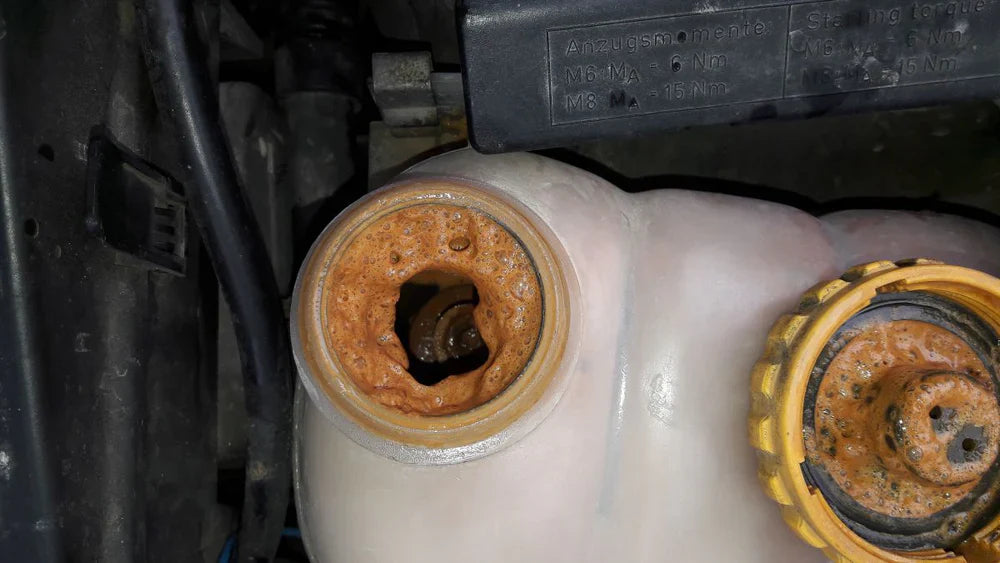
Sometimes one look into the expansion tank is enough to know that something bad is starting to happen in the engine. A greasy layer appears on the surface of the coolant, the colour turns suspiciously dark, and the fluid stops looking like ordinary coolant.
That's precisely the moment when many drivers notice oil in the coolant. And unfortunately – it's very rarely a trifle.
The problem usually means that two systems in the engine have started mixing with each other: the lubrication system and the cooling system. And that can lead to the engine overheating, a drop in power, and in extreme cases even to serious damage.
The good news is that the first symptoms can often be noticed very early – before the repair becomes really costly.
What does oil in the coolant look like? The first signal that a problem is starting in the engine
Most often oil in the coolant looks like a greasy, shiny layer floating on the surface of the fluid in the expansion tank.
You can usually notice:
- a greasy layer resembling oil on water,
- a brown or black deposit in the tank,
- cloudiness of the coolant,
- characteristic “eyes” of oil floating on the surface,
- a thick sludge around the tank cap.
This is the result of a simple physical phenomenon. Oil has a lower density than coolant, which is why it always floats up to its surface.
And here an important thing appears, which many drivers don't think about. What you can see in the tank is often only a small part of the problem. The rest of the oil may already be circulating through the whole cooling system – in the hoses, the radiator and the galleries in the engine block.
Oil in the expansion tank – why does it appear precisely there?
The problem is easiest to notice in exactly this place, because the expansion tank is the highest point of the cooling system.
That is where all the contaminants circulating in the coolant end up. When oil gets into the system, it very quickly starts collecting on the surface of the fluid.
In practice it looks like this:
- oil gets into the cooling system,
- it circulates together with the coolant,
- it floats up to the surface at the highest point of the system,
- it forms a characteristic greasy layer.
That's why oil in the expansion tank is one of the easiest symptoms of the problem to notice. Many drivers discover it by accident – while topping up the coolant or during a routine check under the bonnet.
Black oil in the coolant – does the colour say anything about the scale of the problem?
If black oil in the coolant appears in the tank, it usually means that used engine oil has got into the system.
The longer the problem lasts, the more the appearance of the coolant changes. At the beginning single greasy patches appear. Over time the fluid starts becoming more and more cloudy.
You can then notice:
- a brownish colour of the coolant,
- a thick emulsion resembling coffee with milk,
- deposits on the walls of the tank,
- a sticky film in the hoses of the cooling system.
Such a mixture conducts heat considerably worse than clean coolant. As a result the cooling system stops working the way it should.
And that's a straight road to the engine overheating.
Oil mixing with the coolant – the most common causes of this fault
Most often the situation in which oil mixes with the coolant results from damage to the components separating these two systems in the engine.
The most common causes include:
- a damaged head gasket,
- a cracked cylinder head,
- a cracked engine block,
- a leaking oil cooler,
- damage to the oil or coolant galleries.
In many cases the problem starts innocently – with a small leak. Over time, however, the pressure in the system causes oil to start gradually getting into the cooling system.
And then exactly what you can see in the tank appears: a greasy layer, cloudy fluid and the characteristic traces of oil.
What symptoms beyond the tank can reveal a more serious failure?
Oil in the expansion tank on its own is only the beginning of the symptoms. In many cases the problem also makes itself known in other places, only drivers don't always put the facts together straight away.
It's worth paying attention especially to signals such as:
- a rapid drop in the coolant level,
- the engine overheating while driving,
- white or greyish smoke from the exhaust,
- a drop in engine power,
- rough running of the power unit.
Why does this happen? When oil gets into the cooling system, it changes the properties of the coolant. Instead of a light fluid that conducts heat well, a mixture appears that takes heat away from the engine less effectively.
In practice it looks like this: the engine starts heating up faster than usual, and the cooling system isn't able to dissipate the heat effectively. Over time this can lead to the engine overheating and to further damage.
Can you drive with such a problem?
The short answer is: it's better not to.
If oil in the coolant has appeared in the system, it means that somewhere in the engine a leak has developed between two important systems – lubrication and cooling.
Driving with such a problem can lead to:
- the engine overheating,
- worse cooling of the power unit,
- deposits building up in the coolant galleries,
- increased wear of the engine's components,
- serious failures requiring a costly rebuild.
The biggest problem is that oil in the cooling system starts forming a sticky layer on the system's components – in the hoses, the radiator and the galleries in the engine block.
The longer such driving continues, the more deposits form in the system. And later, even after the cause of the fault has been repaired, the cooling system may still work worse than it should.
Why does simply topping up with new coolant solve nothing?
Some drivers try to solve the problem in the simplest way – they drain the old coolant and pour in new. Unfortunately, in most cases that's only a temporary improvement.
The reason is simple. When oil gets into the cooling system, it starts settling practically everywhere:
- in the radiator hoses,
- in the heater matrix,
- in the engine's coolant galleries,
- in the radiator itself.
These deposits are greasy and very difficult to remove with ordinary coolant. Even after the old fluid has been drained, the remains of the oil still stay in the system and after a short time mix with the new coolant again.
That's why in such situations mechanics always recommend thoroughly flushing the whole cooling system before fresh coolant is poured in.
Oil in the cooling system after a repair – why is flushing the system absolutely essential?
Removing the cause of the problem – for example replacing the head gasket – is only half the job. The other half is thoroughly cleaning the whole cooling system of the remains of the oil.
If this isn't done, the system may still contain:
- greasy oil deposits,
- carbon build-up and contaminants,
- contaminated radiator hoses,
- dirty coolant galleries in the engine.
That's why after a repair mechanics often carry out a chemical flush of the cooling system. Products such as TEC 2000 Radiator Flush help dissolve the remains of oil, deposits and contaminants that would normally be very difficult to remove.
Thanks to this the cooling system returns to working properly, and fresh coolant can once again effectively take heat away from the engine and protect it from overheating.
FAQ
Does oil in the coolant always mean a damaged head gasket?
Not always, but that is the most common cause of the problem. Oil can also get into the cooling system through a damaged oil cooler, a cracked cylinder head or leaks in the engine block.
How do you check whether oil is mixing with the coolant?
The easiest thing is to look into the expansion tank. If you can see a greasy layer, a brownish film or characteristic “eyes” of oil on the surface of the fluid, that's a clear signal that oil has appeared in the cooling system.
Can you drive when oil appears in the coolant?
It's better to avoid it. Such a mixture worsens the cooling of the engine and can lead to overheating of the power unit and to serious damage.
Why does oil float on the surface of the coolant?
Because oil has a lower density than coolant. That's why, after getting into the cooling system, it always floats up to the surface and is visible in the tank.
Is changing the coolant enough to get rid of the problem?
No. Draining the fluid alone usually doesn't remove the oil from the system. A thorough flush of the cooling system is needed, which removes greasy deposits and the remains of oil from the hoses and the radiator.
Do you have to clean the cooling system after a repair?
Yes. After the cause of the fault has been removed, it's worth carrying out a chemical flush of the system, e.g. with TEC 2000 Radiator Flush, which helps dissolve the oil and contaminants remaining in the system.



Leave a comment
This site is protected by hCaptcha and the hCaptcha Privacy Policy and Terms of Service apply.