
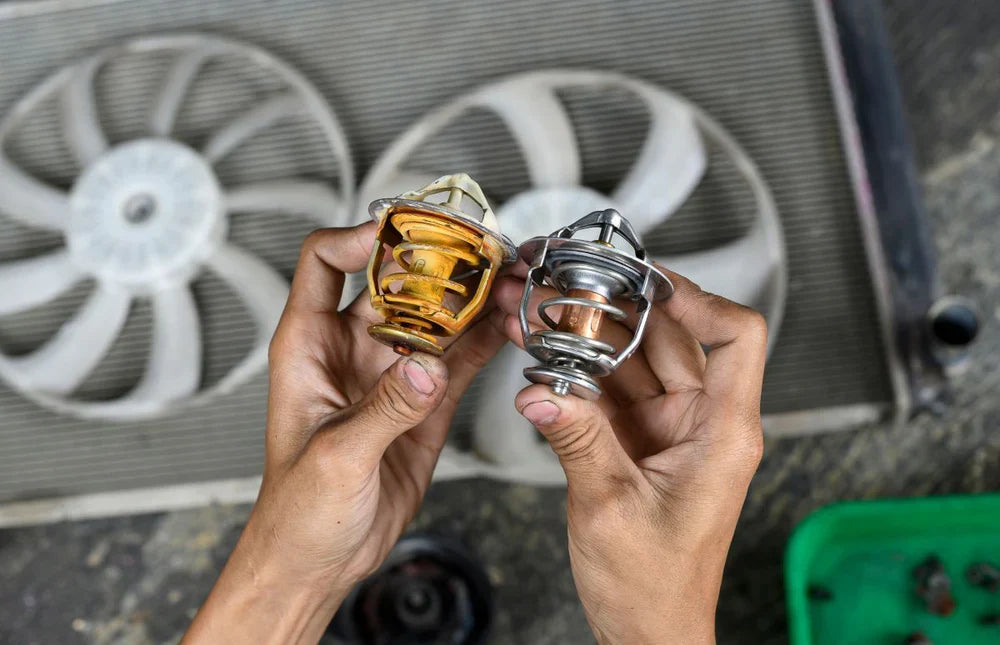
The engine doesn't warm up, or suddenly starts running hot? Very often one small component is to blame – the thermostat, which has stopped working the way it should. The problem is that you can ignore it for a long time, because the car “drives somehow”. Except that the costs are rising in the background – higher fuel consumption, faster engine wear, and sometimes the risk of a serious failure.
The most important thing is to recognise the symptoms quickly and to understand what exactly is happening under the bonnet. A thermostat can stick in one position, and then a whole series of problems begins – from a cold blast of air in winter all the way to overheating on a long drive.
Can a thermostat stick – and what does that mean for the engine?
Yes, a thermostat very often fails by sticking in one position, and then it stops controlling the engine's temperature.
Most often it looks like this:
- sticking in the open position – the engine doesn't reach the right temperature,
- sticking in the closed position – the temperature rises too quickly,
- no response to a change of temperature – the cooling system works “blind”,
- irregular operation of the thermostat – it works one time, and not the next.
The thermostat doesn't disappear from the system, it doesn't suddenly fall apart – it simply stops responding. And that's the most treacherous part. The car may drive normally, but the engine's temperature stops being stable, and that is one of the key parameters of its operation.
A combustion engine works best within a specific temperature range – usually around 90°C. If the temperature is too low or too high, the whole logic of the engine management starts to fall apart. As a result you get higher fuel consumption, worse performance and a greater load on the components.
This is one of those faults that don't always stop the car straight away. But left without a reaction they can lead to considerably more serious problems.
Symptoms of a faulty thermostat – this is how you'll recognise the problem before it's too late
The most common signal is the absence of a stable engine temperature – the needle doesn't hold the middle or behaves unnaturally.
What to pay attention to while driving:
- the engine doesn't reach operating temperature – the needle is clearly below halfway,
- very long warm-up – even after several or a dozen or so kilometres the temperature is too low,
- cold or lukewarm air from the vents despite driving,
- temperature fluctuations – too low one moment, suddenly rising the next,
- a sudden rise in temperature to high values,
- clearly higher fuel consumption, especially in town,
- a worse response to the throttle and a drop in power.
Some of these symptoms are easy to ignore, especially in winter. Cold air from the vents? You might think “that's how it's meant to be”. A longer warm-up? That doesn't always arouse suspicion either.
The problem is that the engine is then working outside its optimal temperature range most of the time, and that translates into real wear.
If you see that the temperature needle doesn't reach the middle or fluctuates frequently, that's one of the most characteristic signals. And that is precisely when it's worth reacting – before the opposite scenario appears, i.e. overheating.
Where does a faulty thermostat come from?
Most often it is the thermostat's own mechanism that fails, or the conditions in which it works – mainly because of a contaminated cooling system.
The most common reasons for failure:
- natural wear of the material – the wax element and the spring lose their properties,
- deposits in the cooling system – scale, rust and sludge block the thermostat's movement,
- old or unsuitable coolant,
- frequent overheating of the engine,
- mistakes after an earlier repair – e.g. a badly chosen thermostat.
A cooling system is rarely perfectly clean, especially in cars with a higher mileage. Over time deposits gather which restrict the flow and hinder the operation of the moving components, and the thermostat is one of the first to feel it.
On top of that comes the coolant. If it isn't changed regularly, it loses its anti-corrosion properties and starts encouraging the formation of contaminants. This isn't a process visible straight away, but over time it makes a difference.
That's why, when replacing a thermostat, more and more people recommend not only the part itself, but also cleaning the cooling system. Products such as TEC 2000 Radiator Flush remove deposits and scale, thanks to which a new thermostat has a chance to work in a clean environment, rather than in lingering sludge.
What happens when the thermostat stays open – an engine that is permanently under-warmed
A thermostat stuck open means the engine works all the time at too low a temperature, which directly translates into fuel consumption and wear.
The most common effects of such a situation:
- constant running on a rich mixture,
- higher fuel consumption, by as much as several litres in town,
- slower warm-up of the engine oil,
- greater build-up of carbon deposits,
- worse operation of the catalytic converter,
- a noticeable drop in power and performance.
An engine that is under-warmed works a bit like it does just after starting – even if you've already been driving for a dozen or so minutes. The ECU sees a low temperature and keeps “holding the choke on”, i.e. it delivers more fuel in order to speed up the warm-up.
The effect is simple: more fuel reaches the combustion chamber, but it isn't burned in optimal conditions. That means greater wear, more deposits and worse refinement.
On short routes this becomes an everyday problem. The car burns more, responds sluggishly and doesn't give the driving comfort you're used to. And what's important – this isn't a one-off situation, but something that repeats itself every time the engine is started.
What happens when the thermostat closes – overheating and a real risk of failure
A thermostat stuck closed causes a rapid rise in temperature, which can lead to serious engine damage in a short time.
The most common symptoms and effects:
- a rapid rise in temperature – the needle heads towards the red zone,
- steam or smoke from under the bonnet,
- the fan cutting in at high speed,
- a drop in power and limp mode,
- a risk of damaging the head gasket,
- the possibility of the oil mixing with the coolant,
- in extreme cases – the engine seizing.
Here the situation becomes serious very quickly. Coolant stops circulating in the cooling system, so the heat has nowhere to disperse and starts accumulating in the engine. The temperature rises, and with it the pressure in the system.
If you ignore the first signals, the consequences appear in a flash. The head gasket doesn't hold, the fluids start mixing, and the repair stops being a “minor fault”.
That's why with overheating there's no room for guessing. Every further minute of driving increases the risk of a costly failure, and often the only sensible decision is to stop the car and wait for the engine to cool down.
A faulty thermostat and fuel consumption – why does a car suddenly start burning more?
A faulty thermostat very quickly affects fuel consumption, especially when the engine is running under-warmed.
What exactly influences fuel consumption:
- the engine control unit sees too low a temperature,
- it extends the warm-up (“choke”) phase,
- it delivers a richer air-fuel mixture,
- fuel consumption rises by as much as 2–4 litres in town,
- more fuel means more carbon build-up in the system.
An engine has a specific temperature range programmed in, within which it works most efficiently. When that range isn't reached, the whole combustion process stops being optimal.
The effect is visible not only at the pump. The car starts responding more slowly, works harder and more often holds higher revs in the same driving conditions.
In the longer term one more problem appears – an excess of fuel encourages deposits to build up in the engine and the exhaust system. That in turn worsens the refinement and can lead to further faults.
And here an important relationship appears: one small part affects the engine's whole working system, from combustion all the way to the durability of the components.
Can you drive with a faulty thermostat – when can you still set off, and when is it better not to risk it?
With a faulty thermostat you can drive only to a limited extent – everything depends on the position in which it stuck.
Two scenarios that change everything:
- a thermostat stuck open – the car will drive, but:
- fuel consumption will be clearly higher,
- the engine wears out faster,
- driving comfort drops (no heating, a weaker response),
- a thermostat stuck closed – the situation looks different:
- the engine overheats,
- the risk of a serious failure rises very quickly,
- driving may end with a costly repair.
In the first case you can still get to a workshop. It's a temporary solution, but a realistic one. In the second – the risk is so great that every kilometre may make the situation worse.
Many drivers try to “nurse” the car to their destination despite the rising temperature. The problem is that an engine doesn't give you much time to react. Overheating can occur very quickly, especially in a traffic jam or at higher revs.
That's why the decision is simple: an under-warmed engine means costs, an overheated one – the threat of a serious failure.
How much does replacing a thermostat cost?
The cost of replacing a thermostat depends mainly on the engine's design and on the type of part used.
The approximate ranges look like this:
- a simple mechanical thermostat – around €12–60,
- more elaborate designs – €70–190,
- integrated or electronic thermostats – as much as €95–350,
- labour – usually €35–95, but with difficult access considerably more.
In many older models access to the thermostat is easy, so the final cost doesn't make much of an impression. In newer cars the situation can be different. The thermostat is integrated with its housing, hidden deep in the system and requires more work to remove.
That's why the spread of prices is so wide. The part alone can cost more than the whole job in an older car.
One thing doesn't change – putting off the replacement usually ends with higher costs, because further problems are added resulting from the engine's incorrect operating temperature.
What should you do when the thermostat is faulty – a quick reaction instead of putting the repair off
The most sensible action is to confirm the fault and replace the thermostat before further problems appear.
What is worth doing:
- booking diagnostics at a workshop,
- checking the condition of the coolant,
- assessing the operation of the whole cooling system,
- replacing the thermostat with a new one,
- bleeding the system after the repair.
The replacement itself is one thing, but the condition of the system in which the new part works is equally important. If there are deposits, scale or sludge in the system, the new thermostat may quickly share the fate of the old one.
That's why more and more often a flush of the cooling system is carried out with such a repair. Products such as TEC 2000 Radiator Flush help remove contaminants and restore the correct flow of coolant, which directly translates into the thermostat's working conditions.
It's a small extra step, which can extend the service life of the whole system and limit the risk of the problem coming back.
How do you prevent thermostat failure?
The greatest influence on a thermostat's service life comes from the condition of the cooling system and the quality of the coolant.
The most important preventive measures:
- regular coolant changes,
- keeping the system clean,
- reacting to the first symptoms of temperature problems,
- avoiding overheating the engine,
- periodically flushing the cooling system, which removes deposits.
A cooling system works in difficult conditions – high temperatures, variable pressure, contact with metals and contaminants. Over time even small deposits start affecting its operation, and the thermostat is one of the first components to feel it.
Looking after the coolant and the cleanliness of the system isn't complicated, but it is often put off until later. And it is precisely these simple actions that mean the system works stably and the engine's temperature stays under control for long years.
FAQ
Does a faulty thermostat increase fuel consumption?
Yes, especially when the engine is under-warmed – the ECU then delivers more fuel.
Can you drive with a faulty thermostat?
With one stuck open you can get to a workshop; with one stuck closed it's better not to risk driving.
How quickly should an engine warm up?
In most cars operating temperature appears after a few kilometres of driving.
How much does replacing a thermostat cost?
Most often from around €70 to €165, but in more complicated engines it can exceed €235.
Does a thermostat fail suddenly?
It often gives symptoms beforehand, but it does happen that it sticks suddenly and the problem appears at once.


Leave a comment
This site is protected by hCaptcha and the hCaptcha Privacy Policy and Terms of Service apply.