
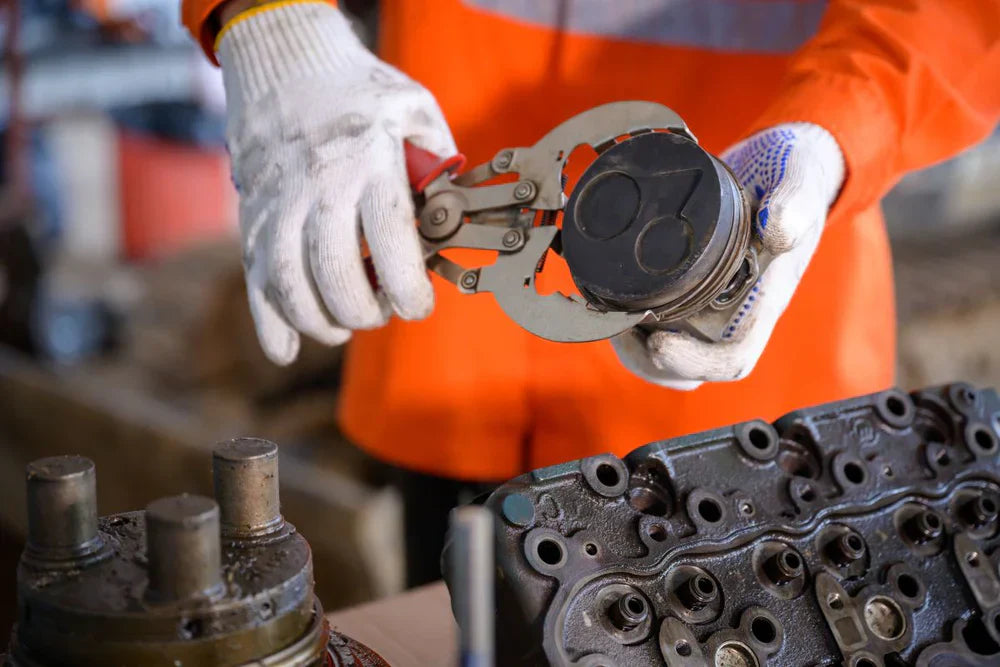
The engine starts using oil, bluish smoke appears from the exhaust, the car accelerates worse and the top-ups get more and more frequent? In many cases the problem is not yet cracked engine components, but seized piston rings, which through carbon build-up and deposits lose their freedom of movement. That is precisely when problems with compression, oil burning and how smoothly the engine runs appear. The good news is that with light or moderate seizing you can sometimes still limit the problem without stripping the engine down. The key, however, is recognising the symptoms quickly and telling carbon build-up apart from typical mechanical wear.
Is the engine using oil and smoking – and could seized piston rings be to blame?
Very often this is exactly where the whole problem begins. The symptoms of seized piston rings are fairly characteristic, although at first they are easy to dismiss. First a slightly higher oil consumption appears. Later the engine starts smoking more heavily, responding more slowly to the throttle, and the car gradually loses its urge. Many drivers then limit themselves for a long time solely to topping up the oil, assuming that "this type is just like that". The problem is that the deposits and carbon build-up keep working away inside the engine.
The most common set of symptoms looks like this:
- oil disappearing between changes,
- bluish or darker smoke from the exhaust,
- a loss of engine power,
- slower acceleration,
- higher fuel consumption,
- uneven engine running,
- oil appearing in the breather.
And it is precisely the combination of several symptoms at once that is the most important warning signal. Smoking alone does not settle anything, and nor does a single oil top-up. If, however, the engine simultaneously starts burning oil, losing compression, accelerating worse and running louder, it is very possible that the rings are starting to lose their freedom of movement because of carbon build-up settling in the piston grooves.
Importantly, seizing does not always mean immediate mechanical damage. And this is precisely where the biggest difference appears between:
- seized rings,
- worn rings,
- cracked piston rings.
In the first case the problem is mainly deposits, soot and contaminants restricting the movement of the rings. Only later can permanent wear or mechanical damage occur.
How do you recognise seized piston rings before it ends in an engine rebuild?
The most important thing is to observe the changes that appear gradually. Seized rings rarely give one sudden symptom overnight. Far more often the engine starts running worse and worse over weeks or months.
The first signals tend to be fairly subtle:
- the car becomes more sluggish,
- higher fuel consumption appears,
- the engine starts running unevenly after starting,
- the exhaust gases change colour,
- the oil level drops faster than before.
It is also very characteristic that the problem often gets worse with:
- town driving,
- short journeys,
- an engine that never fully warms up,
- stretched oil changes.
And that is no coincidence. Manufacturers' service bulletins, among others Honda/NHTSA, indicate that regularly driving with an engine that has not warmed up encourages deposits to settle on the oil control rings. The carbon build-up then restricts the movement of the rings and makes it harder for them to scrape the oil properly off the cylinder walls.
It is also worth paying attention to the nature of the smoking itself. With oil burning, what most often appears is:
- smoke with a bluish tint,
- a more intense smell of exhaust gases,
- an oily deposit around the exhaust tip.
On top of that come the symptoms related to compression:
- harder starting,
- weaker acceleration,
- uneven running at idle,
- clearly worse performance under load.
The sooner you manage to catch this stage, the greater the chance that the problem still mainly concerns deposits, rather than permanent damage to the pistons or the cylinders.
Does an engine flush really help with seized rings – or is it only a temporary effect?
That depends on the scale of the problem. And this is precisely where it is worth separating marketing promises from real diagnostics. Will an engine flush help with seized rings? In many cases – yes, but on one condition: the rings must be blocked mainly by deposits, and not mechanically damaged.
If the problem stems from:
- carbon build-up,
- soot,
- deposits from old oil,
- restricted movement of the rings,
an engine flush can help clean the inside of the engine and improve the operation of the piston rings. And that is exactly why questions like these come up so often:
- what to use on seized rings,
- which engine flush for seized rings,
- will an engine flush help with seized rings.
Products such as TEC 2000 Engine Flush are used at an oil change precisely in order to dissolve the deposits found in the oil gallery, the piston ring grooves and other components of the lubrication system. The standard procedure usually takes around 10–15 minutes at idle, but with stronger symptoms the working time of the product is sometimes extended to as much as 25–30 minutes.
One thing has to be said plainly, though: an engine flush for seized piston rings will not repair a cracked ring, a worn cylinder or a damaged piston.
And that is exactly why the best results usually appear when:
- the symptoms are still moderate,
- the engine does not have very low compression,
- the car is not smoking extremely,
- oil burning is not extremely high.
If, on the other hand, the engine:
- smokes heavily,
- uses enormous amounts of oil,
- clearly loses compression,
- knocks or starts with difficulty,
a product for seized rings alone may no longer be enough, and more thorough workshop diagnostics will be needed.
Why do piston rings seize even though the car drives and starts normally?
That is precisely why the problem is so often ignored. For a long time the engine may start normally, have no warning light and still "somehow drive", even though inside, carbon build-up is gradually settling and restricting the operation of the rings.
The biggest influence here comes from:
- old or worn-out oil,
- oil changed too rarely,
- frequent driving over short distances,
- an engine that never warms up properly,
- carbon build-up and soot from the exhaust gases,
- poor-quality fuel,
- intensive town driving.
In practice it very often looks like this: the car does a few kilometres to work every day, the engine does not reach full operating temperature, the oil picks up moisture and contaminants faster, and deposits start settling in the piston ring grooves. Over time the rings lose their freedom of movement and stop scraping the oil properly off the cylinder walls.
That is exactly when the first symptoms appear:
- higher oil consumption,
- smoking,
- a drop in compression,
- uneven engine running,
- higher fuel consumption.
The oil itself is also hugely important. If the changes are stretched by:
- a few thousand kilometres,
- a few months,
- or the car constantly runs on heavily contaminated oil,
the risk of deposits settling clearly rises. And that is exactly why engine manufacturers emphasise the importance of regular oil servicing so strongly.
It is worth remembering that seized piston rings are very often the result of many small pieces of neglect building up over the years, rather than of one sudden failure.
How do you free up seized piston rings without stripping the engine?
If the problem is not yet very advanced, it often starts with an attempt to clean the inside of the engine and improve the movement of the rings. And this is exactly where the question most often comes up: how do you free up seized piston rings without a rebuild?
The most popular way of dealing with seized rings is using an engine flush.
The whole process is meant to help dissolve:
- carbon build-up,
- soot,
- oil deposits,
- contaminants blocking the rings.
In the case of TEC 2000 Engine Flush the standard procedure usually takes around 10–15 minutes, but with symptoms such as:
- smoking,
- oil burning,
- uneven engine running,
the working time can be extended to as much as around 25–30 minutes before the oil change.
It is worth keeping a sense of proportion, however. Freeing up piston rings makes sense mainly when the problem stems from deposits and not from mechanical damage. If the rings are:
- cracked,
- very worn,
- the cylinders are scored,
- the compression is very low,
no engine flush for piston rings will undo physical wear of metal.
That is why the best results usually appear when you react early – before the seizing turns into a more serious engine failure.
When does an engine flush for seized rings make sense – and when is the problem already mechanical?
This is the most important question in the whole subject. Because the mere presence of symptoms does not yet tell you whether the problem can be limited chemically, or whether the engine already needs stripping down.
An engine flush for seized rings makes the most sense when:
- oil burning is only just starting to rise,
- the engine smokes slightly,
- the compression is not yet very low,
- the car has not lost much power,
- the problem looks more like deposits than mechanical wear.
In such situations an engine flush for seized rings can help improve:
- the movement of the rings,
- the operation of the oil system,
- the sealing,
- how smoothly the engine runs.
There are symptoms, however, with which you have to be very careful. If the car:
- smokes heavily blue,
- uses enormous amounts of oil,
- has very poor compression,
- starts with difficulty when cold,
- clearly knocks or rattles,
the problem may already be considerably more serious.
And this is exactly where it has to be said clearly: an engine flush will help with deposits and carbon build-up, but it will not repair a cracked ring, a damaged piston or a worn cylinder.
In such cases what often turns out to be necessary is:
- thorough diagnostics,
- a compression test,
- a wet compression test,
- an endoscope inspection of the cylinders,
- and sometimes even stripping the engine down.
That is why the best approach usually looks like this:
- first an assessment of the symptoms,
- then diagnostics,
- and only after that a decision on whether it is worth trying chemical cleaning, or whether the problem has already reached a typically mechanical stage.
Can you drive with seized piston rings, or is it better to react straight away?
In short – you can, but the longer the problem is ignored, the greater the risk that ordinary seizing will turn into a fully fledged mechanical failure. And that is exactly why many mechanics keep repeating that with rings, the moment you react is the most important thing.
If the engine:
- only uses a little oil,
- does not smoke much,
- still holds reasonably even compression,
- does not knock and does not lose much power,
you can usually calmly plan:
- diagnostics,
- an oil change,
- a compression check.
The problem starts when the car:
- smokes heavily,
- clearly weakens,
- uses large amounts of oil,
- starts with difficulty,
- runs unevenly or loudly.
In such a situation, driving on can deepen the damage to:
- the pistons,
- the cylinders,
- the cylinder bore surfaces,
- and even the whole crank and piston assembly.
Constantly putting the problem off "until later" is also very dangerous. Many drivers limit themselves for months solely to topping up the oil, while the engine runs the whole time under ever worse lubrication and compression conditions.
And that is exactly why, with symptoms such as:
- rapid oil burning,
- heavy smoking,
- a drop in compression,
- a clear loss of power,
it is better to take the subject seriously, before the repair costs rise several times over.
What to use on seized piston rings – an engine flush, diagnostics or straight to the workshop?
The most sensible approach is to combine diagnostics with an assessment of the scale of the problem. Not every engine with symptoms of oil burning needs an immediate rebuild, but nor can every case be solved with chemistry alone.
If the symptoms are moderate, it often starts with:
- checking the oil change history,
- checking the oil level,
- observing the smoking,
- assessing the compression,
- flushing the engine at the oil change.
And this is exactly where the questions most often come up:
- what to use on seized rings,
- which engine flush for seized rings,
- will an engine flush help with seized rings.
Products such as TEC 2000 Engine Flush are meant to help remove:
- carbon build-up,
- soot,
- oil deposits,
- contaminants restricting the movement of the piston rings.
With light or moderate seizing of the rings, such a procedure can genuinely improve how smoothly the engine runs, its response to the throttle and its compression, and also help limit oil consumption and the amount of deposits in the oil system.
If, however, the symptoms are strong or persist despite the flush, the next step should include:
- a compression test,
- a wet compression test,
- a cylinder inspection,
- workshop diagnostics.
And that is exactly why the best answer to the question "what to use on seized piston rings" is usually not one magic solution, but:
- reacting quickly,
- proper diagnostics,
- an assessment of the engine's condition,
- and matching the action to the real cause of the problem.
A short summary
Seized piston rings often start with carbon build-up, deposits and stretched oil changes, but when ignored they can lead to serious problems with compression and oil burning. The sooner diagnostics and a reaction to the first symptoms appear, the greater the chance that the problem can be limited without an expensive engine rebuild.
FAQ
What are the symptoms of seized piston rings?
Most often these are oil burning, bluish smoke from the exhaust, a loss of power, higher fuel consumption and uneven engine running.
Will an engine flush help with seized rings?
Yes, if the problem stems mainly from carbon build-up and deposits blocking the movement of the rings. It will not help, however, with mechanical damage.
How do you free up seized piston rings?
It most often starts with an engine flush at the oil change. With more serious problems, diagnostics or a mechanical repair may be needed.
Can you drive with seized rings?
For a short time yes, but driving on for longer may deepen engine wear and increase the cost of the repair.
What to use on seized piston rings?
With light seizing, engine flushes, an oil change and diagnostics are used. With strong symptoms a mechanical repair may be necessary.
Which engine flush for seized rings?
Most often products for flushing the oil system are used, for example TEC 2000 Engine Flush, applied at the oil change.
Do seized rings always mean an engine rebuild?
No. If the problem mainly concerns deposits and carbon build-up, you can sometimes still improve the operation of the rings without stripping the engine down.
What causes piston rings to seize?
Most often old oil, carbon build-up, driving on short journeys, an engine that never warms up and stretched oil changes.
How much does it cost to repair piston rings?
An engine flush costs a couple of dozen euros, but mechanically replacing the rings usually already costs a couple of thousand euros.
Do seized rings cause oil burning?
Yes. When the rings lose their freedom of movement and their seal, oil can get into the combustion chamber and be burnt along with the fuel.


Leave a comment
This site is protected by hCaptcha and the hCaptcha Privacy Policy and Terms of Service apply.