
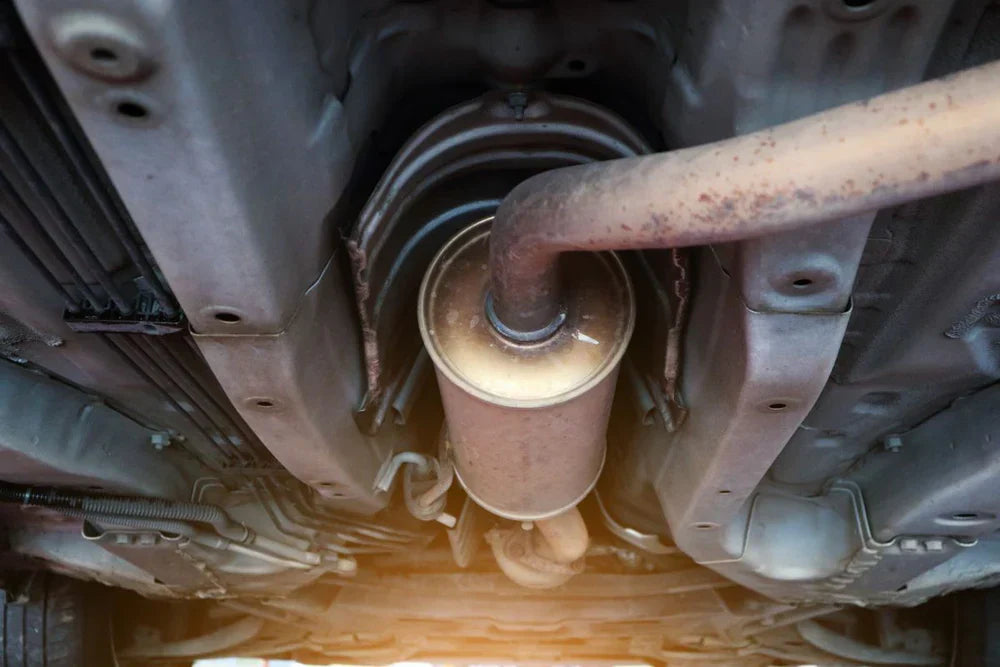
A drop in power, higher fuel consumption, strange engine behaviour – many drivers put it down to “the car's age” or poorer fuel. Meanwhile, the culprit is very often a clogged catalytic converter, which gradually blocks the flow of exhaust gases and forces the engine to work under an ever greater load.
The problem is that the symptoms of a clogged catalytic converter aren't always obvious. The car may still drive, but the consequences of putting off the repair can be costly – from worse performance all the way to a real risk of engine damage.
In this article we look at how to recognise a clogged catalytic converter, whether you can still drive with such a fault, and what solutions are available – from flushing to replacement.
A catalytic converter clogging up is… a result of the component doing its job
It's worth saying it outright: a catalytic converter doesn't clog because it's defective. It is simply doing its job. Throughout the car's service life it filters the exhaust gases, “collects” whatever the engine didn't burn perfectly, and over time this starts to become noticeable. This is a natural wear process, not a sudden failure that appears without warning.
The rate at which a catalytic converter clogs up is influenced by a few very down-to-earth things that most drivers never even think about.
First – how the car is used.
Cars driven mainly around town have it much harder. Short trips, traffic jams, frequently switching the engine off. The catalytic converter simply never gets a chance to heat up properly. And without the right temperature it doesn't work the way it should. It's a completely different story in cars that regularly cover longer routes, where the exhaust system works steadily and under the right conditions.
Second – operating temperature. A catalytic converter needs heat. And a specific amount of it. If:
- the car is driven mainly over short distances,
- the engine rarely reaches full operating temperature,
- the drive ends sooner than the converter manages to “come to life”,
then contaminants start to build up faster than they should. There's no magic in this – it's pure physics and chemistry.
Third – driving style. This is where many drivers unknowingly do themselves harm. What definitely doesn't suit a catalytic converter is:
- constantly driving at very low revs,
- labouring the engine,
- ignoring ignition or mixture problems,
- putting off repairs “until later”, because the car still drives.
The effect is simple – more unburnt fuel residue and soot end up in the exhaust system, and they stay in the catalytic converter for longer.
What are the symptoms of a clogged catalytic converter? Below is a list of potential causes
The symptoms of a clogged catalytic converter are very often dismissed, because at first they look like minor faults or “the car just having a bad day”. The car still drives, so it's easy to assume the problem will go away on its own. Unfortunately, in practice the symptoms intensify over time, and driving with a clogged catalytic converter can lead to ever more serious and expensive faults – including engine damage.
Symptoms of a clogged catalytic converter in a petrol engine
In petrol engines, catalytic converter problems usually build up gradually. Most often you can notice the following.
- A drop in engine power – the catalytic converter restricts the flow of exhaust gases, so the engine “has nothing to breathe with” and loses efficiency.
- Worse acceleration, especially at higher revs – the more exhaust gas has to leave the engine, the more a clogged converter starts to obstruct it.
- Increased fuel consumption – the engine tries to compensate for the problem by delivering more fuel, which you quickly notice at the pump.
- Rough engine running or jerking – disrupted exhaust flow affects the composition of the mixture and the stability of the engine's operation.
- The “check engine” light coming on – the sensors, including the lambda sensor, begin to detect irregularities in the composition of the exhaust gases.
- An unpleasant exhaust smell – the catalytic converter stops effectively neutralising harmful compounds, which is quickly noticeable.
Symptoms of a clogged catalytic converter in a diesel engine
In diesel engines the symptoms can be more abrupt and are often confused with DPF or turbocharger problems.
- A clear drop in power, especially under load – a clogged catalytic converter causes pressure to build up in the exhaust system, which limits engine operation.
- The car goes into limp mode – the engine control unit protects the engine from damage by limiting power.
- Trouble picking up revs – the engine responds sluggishly, especially when overtaking or driving uphill.
- Increased smoke from the exhaust – the exhaust gases are not being properly cleaned and start coming out in a visible form.
- More frequent regeneration attempts by other exhaust system components – the disrupted flow has a negative impact on the entire exhaust after-treatment system.
- Emission-related warning lights coming on – the diagnostic system quickly detects a problem with exhaust evacuation.
How do you check whether the catalytic converter has clogged up?
Before you start thinking about cleaning or replacement, it's worth making sure it really is the source of the problem. The symptoms of a clogged catalytic converter can be misleading and very often resemble other faults. That's why it's best to approach the subject step by step – from what you can spot yourself, all the way to things that already require workshop equipment and knowledge.
1. Symptoms you feel while driving – the first warning signs
Driving itself provides the most information. A car very rarely “breaks down overnight”. Usually it gives subtle signals beforehand that are easy to ignore. If the catalytic converter is starting to clog, you may notice, among other things:
- a drop in power, especially when accelerating or under load,
- the impression that the car “doesn't pull” the way it used to,
- a delayed response to the throttle, particularly at higher speeds,
- increased fuel consumption, even though your driving style hasn't changed,
- trouble when driving uphill or overtaking.
Why does this happen? Because a clogged catalytic converter restricts the flow of exhaust gases. The engine starts working against greater resistance, and you get the feeling that something is holding it back. This is often the first moment when it's worth dropping the illusion that “it will sort itself out”.
2. Computer diagnostics – what will the fault codes and the lambda sensor show?
The next step is hooking the car up to a diagnostic computer. In many cases, faults appear related to:
- catalytic converter efficiency,
- exhaust gas composition,
- the operation of the lambda sensor.
One thing has to be said clearly, though: the computer won't always say outright “the catalytic converter is clogged”. It often shows only the effects of the problem, not its cause. The lambda sensor may report incorrect values because the exhaust gases aren't flowing as they should. That's an important clue, but not a verdict. At this stage we're still talking about a suspicion, not a one-hundred-per-cent diagnosis.
3. Workshop methods – when a concrete diagnosis is needed
If the symptoms are clear and the fault codes keep coming back, it's time for workshop diagnostics. This is where the problem can be confirmed unambiguously. The most commonly used methods are:
- exhaust back-pressure measurement – it allows you to check whether the catalytic converter really is blocking the flow,
- an endoscopic inspection – the mechanic looks inside the catalytic converter and assesses its condition.
These methods show not only whether the catalytic converter is clogged, but also how badly. And that is crucial when choosing what to do next – flushing, reconditioning or replacement.
4. What you can't check on your own – and it's worth knowing this
Finally, something many people forget. Not everything can be checked yourself, even if you have basic knowledge and an OBD interface. You are not able to:
- assess how free-flowing the catalytic converter is “by eye”,
- inspect its interior without specialist equipment,
- determine whether the problem is reversible without measurements.
If the symptoms are intensifying and the car responds worse and worse to the throttle, carrying on driving “to see what happens” usually only makes things worse. At this point it's better to check the catalytic converter sooner than to face a far more expensive repair later.
How do you deal with the problem of a clogged catalytic converter?
To start with, one thing has to be said outright: you shouldn't drive for long with a clogged catalytic converter, even if the car still starts and can be driven normally. The car may still function, but the engine is then working in worse conditions. The exhaust gases have nowhere to escape, the temperature rises and the load goes up. And that is exactly when the real problems begin.
What can you do about it? It all depends on what stage you're at.
Engine flush – the best option to start with
If the symptoms are fresh and the car has only just started losing power or burning more fuel than usual, a flush is the most sensible first step. Not because it's cheap, but because it works where the problem often begins – in the engine.
When the engine is dirty with carbon deposits, more unburnt residue reaches the catalytic converter. It doesn't disappear. It settles there. A flush helps put a stop to that.
When does it make sense?
- When the problem has only just appeared.
- When the car is driven mainly around town.
- When you want to react quickly rather than wait for a worse scenario.
Why does it work?
- The engine burns fuel more cleanly.
- Fewer contaminants reach the exhaust.
- The catalytic converter has an easier life.
A good example is TEC 2000 Engine Flush. It's a flush that cleans the inside of the engine of deposits and carbon build-up. The effect isn't magic, but it is very logical – a cleaner engine = fewer problems with the catalytic converter. And, importantly: when used correctly, there are no downsides here.
Reconditioning – when the problem is already clear
If the catalytic converter is heavily clogged but not yet damaged, it can sometimes be reconditioned. It's a middle-ground solution. Not the cheapest, not the most expensive. Simply one of the options.
It makes sense when diagnostics show that the converter's substrate can still be saved. You do have to know one thing, though: results vary. A lot depends on the method and the quality of the service.
It's an option for those who:
- don't want a replacement yet,
- but know that a flush is no longer enough.
Replacing it with a new one – when there's no way around it
There are situations where there's no point trying to be clever. If the catalytic converter is damaged, melted or completely clogged, fitting a new one is the only sensible solution.
Yes, it costs money. But in return:
- the engine gets its normal operating conditions back,
- the problem goes away instead of coming back,
- there's no stress about emissions or the roadworthiness test.
It's the solution for those who want peace of mind for longer.
Finally, the most important point: the sooner you react, the more options you have to choose from. At the beginning it's often enough to look after the engine and keep it clean. Later on, only the more expensive decisions remain. That's why it isn't worth waiting until a clogged catalytic converter starts dragging further problems along with it.
The consequences of ignoring a clogged catalytic converter. Why isn't it worth dismissing the problem?
At first, a clogged catalytic converter seems like a problem you can “drive through”. The car goes, it starts, you can use it every day. And that is exactly why many people put the subject off. The problem is that a catalytic converter won't unclog itself, and every extra kilometre usually makes the situation worse.
The most common consequences of ignoring the problem are:
- an ever greater drop in engine power – over time the car responds worse and worse to the throttle, and driving becomes tiring and unpredictable.
- a rise in temperature in the exhaust system – the exhaust gases have no outlet, so heat builds up where it shouldn't. That's very bad news for the engine,
- a risk of serious engine damage – driving for a long time with a clogged catalytic converter can lead to overheating, valve problems and, in extreme cases, costly engine failures,
- damage to other exhaust system components – catalytic converter problems often drag others along with them – lambda sensors, the silencer and other components start working in unnatural conditions,
- problems with the roadworthiness test – excessive emissions mean failing the test; and that means extra stress and cost,
- environmental and legal consequences – a clogged catalytic converter doesn't fulfil its role; the car emits more harmful substances, which can mean fines or being taken off the road.
In short: the longer the problem is ignored, the more expensive it becomes to fix. This is one of those cases where reacting quickly really does pay off.
FAQ
Can you drive with a clogged catalytic converter?
You can, but you shouldn't. In the short term the car may still work, but driving for longer increases the risk of serious damage to the engine and the exhaust system.
Does a clogged catalytic converter always mean replacement?
No. At an early stage a flush or other remedial measures are often enough. Replacement only becomes necessary when the catalytic converter is heavily clogged or damaged.
Can a flush really help?
Yes, especially when the problem is only just beginning. Flushes such as TEC 2000 Engine Flush help clean carbon deposits out of the engine, so that fewer contaminants reach the catalytic converter. That genuinely takes the strain off the whole system.
Can a clogged catalytic converter increase fuel consumption?
Yes. The engine tries to compensate for the obstructed exhaust flow, which often ends in noticeably higher fuel consumption.
Does the “check engine” light always mean a problem with the catalytic converter?
Not always, but it is very often linked to it. Faults related to emissions or the lambda sensor may indicate that the catalytic converter is clogged.
Does driving style affect how quickly a catalytic converter clogs up?
It has a huge effect. Short trips, city driving, frequently switching the engine off and driving at low revs considerably speed up the clogging process.
Is catalytic converter reconditioning permanent?
It can be effective, but it doesn't always give a lasting result. It all depends on the degree of clogging and the condition of the converter's substrate.



Leave a comment
This site is protected by hCaptcha and the hCaptcha Privacy Policy and Terms of Service apply.